
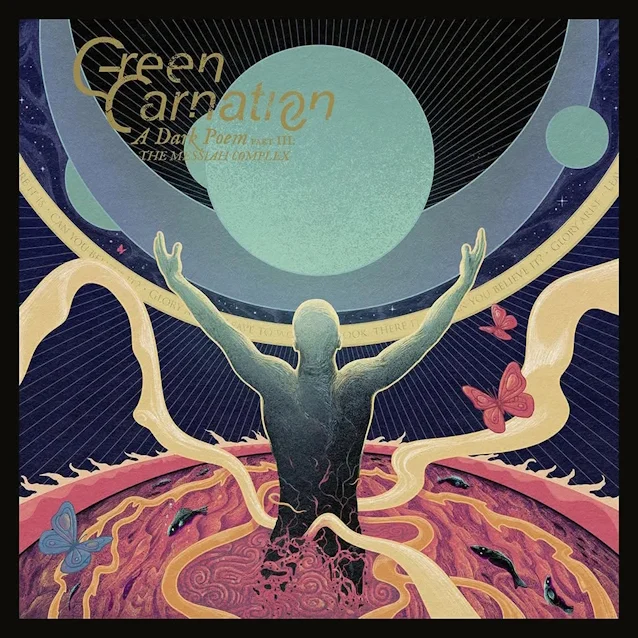
Sixteen minutes and forty seven seconds. That is the length of the final track on a record that runs thirty eight minutes and twenty nine seconds, and for the whole of it there is no distortion, no rumbling bass and no lead vocal, only the Kristiansand Symphony Orchestra and an opera choir. Subtract the suite and twenty one minutes and forty two seconds of songs remain, three of them, before the closing piece tears the song form out of the album altogether, verse, chorus and riff with it. Nobody disputes the arithmetic. The dispute is about what it adds up to.
The composers of a one-song album, Green Carnation, have never treated proportion as a rule, and A Dark Poem, Part III: The Messiah Complex, their ninth studio record, is the most consequential test of that habit since Light of Day, Day of Darkness in 2001. Released through Season of Mist on 4 September 2026, one day short of a year after The Shores of Melancholia opened the trilogy and five months after Sanguis held it open in April, the third part closes the cycle with the core line-up that began it. The personnel has not moved. Kjetil Nordhus sings, the founder Tchort and Bjørn Harstad play guitars, Stein Roger Sordal plays bass and writes the words, Endre Kirkesola plays keyboards and Jonathan Pérez plays drums. In the label's announcement of 3 September, Nordhus called the record the band's "biggest achievement since Light of Day, Day of Darkness", which is a large claim and also the right comparison.
Twenty one minutes of songs
"Unconditional Artificial Chemistry" opens the door, and its title announces what this closing part adds to the cycle: artificial intelligence and the collapse of the systems built around it, laid over the alienation and trauma the first two records carried. It is the gentlest entrance the album could have chosen, melodic before it is heavy and dark without once raising its voice. On all three songs Kirkesola does the orchestrating long before any orchestra is hired, with mellotron atmospheres and touches of harpsichord and organ that owe as much to Debussy as to Sibelius, which is to say that they treat harmony as colour in one phrase and as architecture in the next. The orchestra, when it finally arrives, changes the scale of that habit and not its nature.
"The Messiah Complex" is the best song on the album, and it earns that standing on one decision as much as on its writing: Stein Roger Sordal steps forward from the bass to take a lead vocal. Handing the melody to a second voice this late in a three-part cycle is the oratorio's oldest device, the one that keeps a new character offstage until the drama has a use for him, and it matters here that the new voice belongs to the man who wrote the words. The song that names both the album and the final part of the cycle gets the one timbre the trilogy had been holding in reserve. That is not an accident of casting.
"Broken Souls, Common Enemies" does the heavy lifting. At eight minutes and forty five seconds it is the longest of the three songs and carries the heaviest riffing on the record, and its guitar solo is the high point not merely of this record but of the three taken together, the one passage here that needs no defending. It is also the last distorted guitar the album allows, and what follows arrives like a pedal point cut away from under a choir, the floor pulled out so the upper voices can finish the sentence alone.
Sixteen minutes without the band
"A Dark Poem - Orchestral Suite" is the piece that breaks the record's own mould, and it is where the album divides its audience. Hear it as the resolution the trilogy was owed, and it is the most ambitious thing this band has attempted. Hear it as sixteen minutes of underscoring appended to an album with only twenty one minutes of metal in it, and the whole second half belongs to a different record. The second hearing is not eccentric. Anyone who came to this album for a conventional Green Carnation record will find that its last third has sent the band off the stage.
Both hearings describe the same object, and only one of them catches its function. On any honest reading the objection has the arithmetic right: as the fourth track of a thirty eight minute album, a suite of that length is out of all proportion. But it was not written as the fourth track of an album. It is the final cadence of a form that opened in September 2025, and the trilogy has spent a year holding a suspension, the note struck on The Shores of Melancholia and tied over into Sanguis while the harmony shifted beneath it and turned it dissonant, so that the suite arrives as the moment the organist pulls the last stop, lets the full weight of the instrument fall onto the tonic, and allows a note that has ached for twelve months to drop a single step and rest. That is what the suite is for, and it is why the three records end as one work rather than as a series. A resolution does not need the instruments that built the tension. It needs the tension.
What the resolution costs
That is also precisely where the record stops short of essential. A cadence resolves nothing for a listener who never heard the dissonance, and The Messiah Complex heard on its own offers exactly that listener three strong songs, one of them the best of the cycle, followed by sixteen minutes answering a question nobody put to them. The metal on the album comes to twenty one minutes and forty two seconds, and for the newcomer the suite that crowns the trilogy plays like the coda of a piece performed in another room. Nordhus has vocal mannerisms that wear on a listener who plays the record often, and that is the smaller complaint. The structural question is the one that does not go away.
A cadence resolves nothing for a listener who never heard the dissonance.
For the faithful who have followed the cycle since September 2025, this is the record that makes the other two make sense, and doing without it leaves two albums suspended on a chord that never lands. For anyone arriving now, the instruction is simple: start with The Shores of Melancholia, take the three parts in order, and earn the last sixteen minutes. They are worth the wait.