
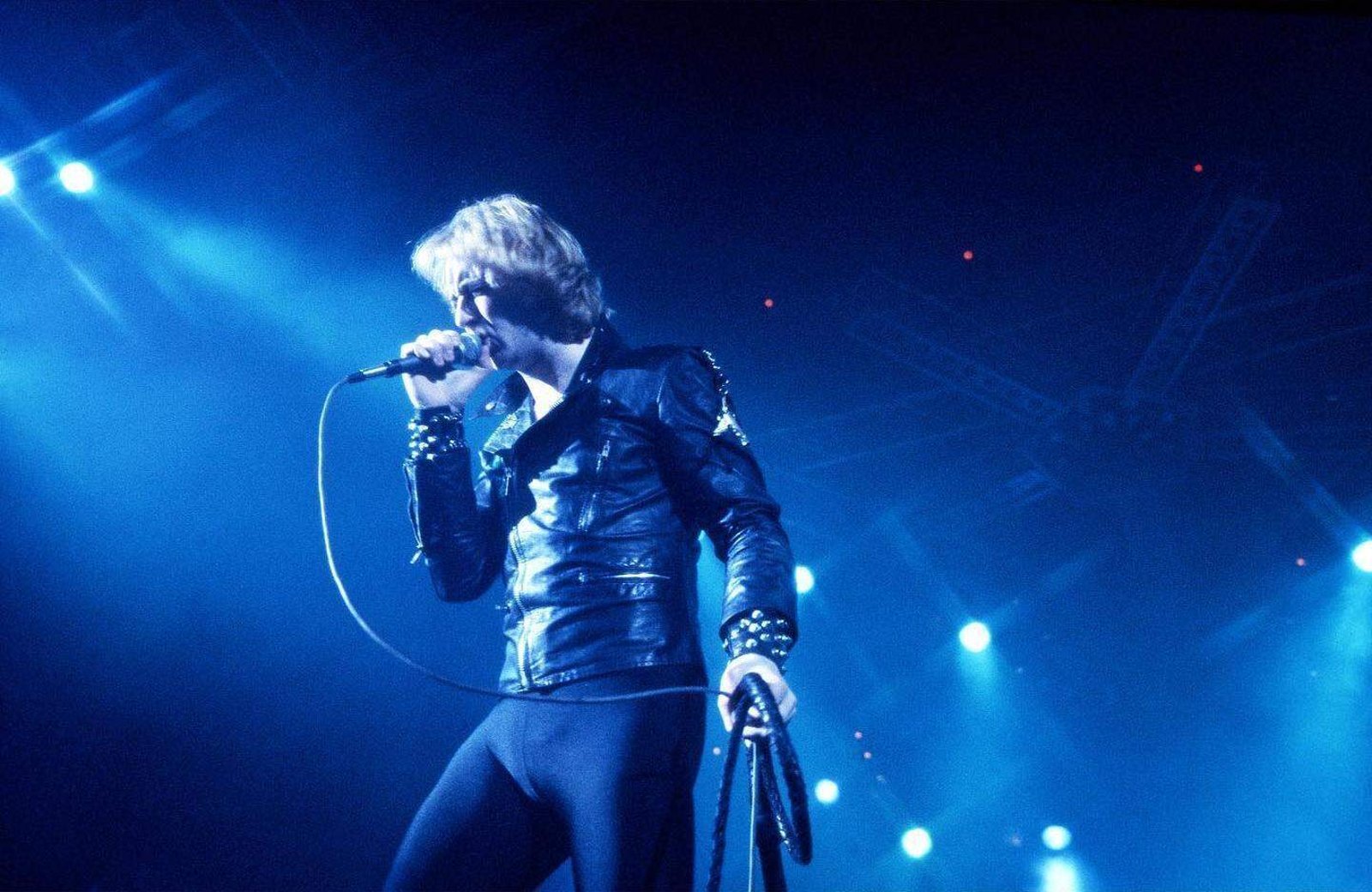
"Heavy metal. What's that?" The Birmingham guitarist who threw that question back at a Melody Maker journalist in his own home, just back from America, and who insisted that his band played heavy rock, was Tony Iommi, telling the story decades later to Gibson TV. The man who had built the sound did not recognise its name. It took him years to accept it.
Heavy metal music quotes begin there, with the builders arguing over the sign above their own door, and the best of them work like the smooth stone David took from the brook in the valley of Elah and slung once at a champion armoured in bronze, sinking it in his forehead so that the giant went down on his face in front of two armies. A good line from a musician does that to a committee, a courtroom or a critic. It needs no second throw.
The lines that last share a shape. They are short, they were spoken under pressure, and they were aimed at somebody in the room. The music's pictures have their own witnesses, the painters and designers behind heavy metal cover art, but the words were fought over in places with microphones, stenographers and lawyers, and most of them were said by men who had been summoned to explain themselves.
Heavy metal music quotes from the witness table
On 19 September 1985 the Senate commerce committee sat to hear the Parents Music Resource Center make its case for warning labels on records, and among its list of fifteen offending songs was a Twisted Sister single. The singer who walked in to answer for it, and who opened by demolishing the caricature the committee had been handed before a single member could use it, was Dee Snider.
"I was born and raised a Christian and I still adhere to those principles," he told the senators, and then, with the whole hall listening, "Believe it or not, I do not smoke, I do not drink, and I do not do drugs." He went on to take apart Tipper Gore's newspaper reading of "Under the Blade", a song he said was about surgery and the fear it instils, and told the committee that "the only sadomasochism, bondage, and rape in this song is in the mind of Ms. Gore."
A good line from a musician does that to a committee, a courtroom or a critic. It needs no second throw.
The singer who answered a courtroom's theory of hidden messages with a sales pitch was Rob Halford. In the summer of 1990 a civil court in Reno heard a claim that subliminal words buried in a Judas Priest record had driven two young men to shoot themselves in 1985, and the judge ruled for the band on 24 August. Halford's answer, as he gave it to Record Collector in 2024, was a question: "We'd be better off hiding messages like, 'Buy more Priest records' or 'Buy more T-shirts', wouldn't we?"
The drummer who crossed to the other side of that argument fifteen years later, asking the Senate to protect musicians rather than to leave them alone, was Lars Ulrich. Before the Senate Judiciary Committee on 11 July 2000 he described how five or six versions of "I Disappear", a work in progress for the Mission: Impossible 2 soundtrack, had leaked onto American radio by way of Napster, and he said the new paradigm the internet gurus were preaching sounded to him like "good, old-fashioned trafficking in stolen goods." The witness table had changed sides.
On what to call it
Iommi's question never went away. It came back from every direction for half a century, and the loudest voice to keep asking it belonged to a man whose records were filed under heavy metal in every shop on earth while he spent his whole life objecting to the heresy.

The bassist who spent forty years correcting the label on his own records was Lemmy, and in 2010 he snapped it at The Independent: "We were not heavy metal. We were a rock'n'roll band. Still are." His trio had already made the point in 1987 with an album called Rock 'n' Roll, released by GWR, the name nailed to the front of the sleeve above Joe Petagno's grinning war pig.
The singer who turned the devil into a question of where the viewer stands was Ronnie James Dio. In 2000, the year of his concept record Magica, he told the Las Vegas Sun that fans had always asked why the Holy Diver sleeve showed a monster killing a priest, and that he answered "how do you know it wasn't the other way around?" and "I know a few priests who are monsters." It is the creed of the whole style in a sentence. The dark is not the enemy. The dark is the material.
The Swedish guitarist who met the oldest advice in music with arithmetic is Yngwie Malmsteen, and his answer to "less is more", repeated in interview footage and posted on his own official page, blew the proverb apart in three short sentences: "How can less be more? It's impossible! More is more." Nobody who has heard Rising Force needed telling.
| Who | The line | Where | Year |
|---|---|---|---|
| Dee Snider | "I do not smoke, I do not drink, and I do not do drugs." | Senate commerce committee hearing | 1985 |
| Lars Ulrich | "Good, old-fashioned trafficking in stolen goods" | Senate Judiciary Committee hearing | 2000 |
| Ronnie James Dio | "I know a few priests who are monsters" | Las Vegas Sun interview | 2000 |
| Lemmy | "We were not heavy metal" | The Independent interview | 2010 |
| Rob Halford | "The metal community has always been inclusive" | NME interview | 2019 |
| Rob Halford | "Buy more Priest records" | Record Collector interview | 2024 |
Said about the crowd
The singer who treats a festival field of thirty thousand as a room with one listener in it is Bruce Dickinson, and in Sam Dunn's film Metal: A Headbanger's Journey, released in 2005, he described the method: to find "the guy who's right at the back of the 30 000 capacity festival" and single him out until the man realises he is the one being sung to. It is a job description, not a boast.
In the same film he said what the music gives the people at the back of that field: "an alternative universe," a life of imagination through which to hear everything else, and very often the push to pick up a guitar and start playing. Critics had spent thirty years calling that escapism. Dickinson called it the reason.
Lines with no address
For every line with a hearing record behind it, ten circulate with nothing behind them at all. "If you think you are too old to rock 'n' roll, then you are" is printed under Lemmy's name on posters, mugs and shirts across the world, and the quotation sites that carry it give it no interview, no book, no broadcast and no year.
A quotation with no source is a police photofit. The witness remembers a jaw from one face and a pair of eyes from another, the operator slides the strips together under a glass, and the result looks like everybody's idea of the suspect and like the suspect himself not at all. Lemmy's name draws those strips toward it because it fits them, gruff and funny and defiant, and the fit is the whole danger. A real line has a date. A photofit has only a likeness.
"The metal community has always been inclusive and yet we've been kicked around like a football over the years."
Rob Halford, NME, 21 October 2019
The singer who has answered to the title Metal God since "Metal Gods" in 1980 is Rob Halford, and he said it to NME in 2019, nearly thirty years after Reno, in the plainest summary the style has of what the witness tables were for. By common consent the music won most of those arguments on the record while losing some of them on the shop shelf. The words are what the faithful kept.
Words were not the only thing the style got wrong in public, and the sleeves had their own disasters, some of them loved precisely because they were so bad, the ones collected under the worst heavy metal album covers. The quotations at least had a speaker who could be held to them. The pictures often had nobody willing to sign.
