
One hundred and seven songs were cleared for a single video game put out in October 2009, which is more heavy metal than most American radio stations played in a decade. The game sold poorly. That track list is still the best argument anybody has made for what the heavy metal music games could do and a record company could not.
In 1929 the son of a piano and organ builder in Binghamton put a wooden aeroplane on a pedestal, worked it with the bellows and valves out of his father's trade, and dropped a hood over the pupil so that he flew on instruments alone while the box pitched, rolled and yawed underneath him. The Link Trainer never once left the hangar floor. The hours logged inside it counted towards a licence all the same, and by the end of the war more than half a million airmen had been taught to fly blind in a box bolted down in a shed.
The Texan composer who was handed a stack of Pantera, Slayer and Alice in Chains CDs by John Romero and told to take them apart was Bobby Prince, and the twenty-three tracks he wrote for Doom, which id Software released as shareware in December 1993, are heavy metal riffs with the serial numbers filed off and the vocals never recorded. A generation heard those riffs through a sound card first. Some of them went looking for the originals.
What the heavy metal music games were actually for
Two jobs, and they have almost nothing to do with each other. The first is delivery: a game carries a song into a house that a record shop, a radio station and a magazine had all failed to reach, and it does it without asking the listener to buy anything with a sleeve on it. The second is the Link Trainer job. A plastic controller logs hours of concentrated attention on one recording, and attention is the thing the whole industry had been failing to buy since 1991.
Neither job is about the game being good. Both are about volume of exposure, and the trade was never even. A game with a hundred songs in it makes one of them famous and leaves ninety-nine as furniture, exactly as a compilation does, and which one gets pulled out depends on where the designers put it rather than on what it is.
There is a third strand, older than either, in which metal is not licensed into the game but written for it from scratch, and that strand runs from a shareware soundtrack in 1993 to guest vocalists on a rhythm shooter in 2022. Where the games sit beside the sleeves, the logos and the shirts is the related chapter. What the games did to the bands is a separate ledger.
Doom, and a soundtrack built out of other people's riffs
The 1993 soundtrack works because it never pretends to be a song. It has no chorus to wait for and no voice to follow, and the riff simply repeats under whatever the player is doing until the player stops hearing it as music and starts hearing it as the room, which is the one thing a heavy metal riff has always been able to do and a heavy metal single never can.
Twenty-three years later the series went back and did it properly. The Australian composer who rebuilt that idea out of nine-string guitars, a wall of synthesisers and a rhythm section that lands on the beat like a press was Mick Gordon, and the score he wrote for the 2016 Doom pushed the guitars so far into distortion that the tone is nearer to industrial machinery than to any band on a label. It won awards. It also ended in a public quarrel that opened with the studio's own open letter in May 2020 and closed only when Gordon published his own account two and a half years later, a fight over credit that neither side has ever fully settled.
The riff repeats until the player stops hearing it as music and starts hearing it as the room.
What a licence actually did for a band
The plainest case of a band writing straight into the machine is Megadeth, whose "Sudden Death" was written for Guitar Hero: Warriors of Rock in 2010 and put in front of players before it ever appeared on an album, and it was nominated for the Grammy for Best Metal Performance in 2011, then remixed the same year for the opening slot on Thirteen. Dave Mustaine wrote a song for a controller. The controller put it in more houses than the album did.
The heavier deals were struck two years earlier. Metallica issued Death Magnetic as playable content for Guitar Hero III on 12 September 2008, the same day the record reached the shops, so that a listener could play the album before owning it, and the following spring an entire game, Guitar Hero: Metallica, was built around the band. That is not a licence. That is a distribution channel, and for two or three years it was the only one the genre had that reached teenagers who did not already know the genre existed.
By common consent the salvo from the plastic guitars was the loudest of these, and the record that went furthest on it belonged to DragonForce, whose case is argued where it belongs, with the genre it came from. The heavy metal end of the shelf profited more quietly. A Slayer track behind a boss fight sold no albums that anyone could count, and it put the band's name in front of a million people who would never have typed it into anything.
Ed Hunter, and the games the bands built themselves
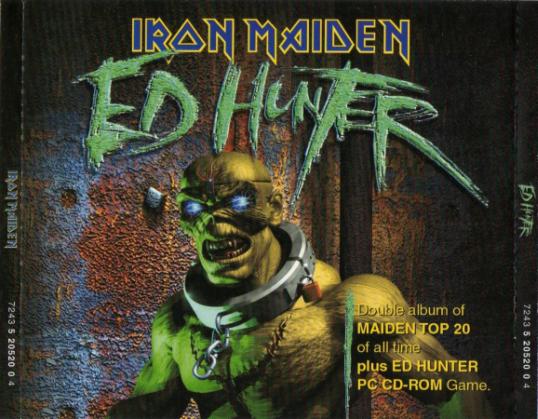
The band that stopped waiting to be licensed and shipped its own game with its own mascot chasing through its own album sleeves was Iron Maiden, and Ed Hunter, built by the British studio Synthetic Dimensions and released in 1999, came boxed with a compilation whose twenty-song running order fans had voted into place on the band's own website. The game itself is a shooting gallery and nothing more. The idea underneath it has outlasted every plastic guitar ever sold.
That idea came back in 2016 as Legacy of the Beast, a mobile role player Roadhouse Interactive built around the same figure, and the long-term point is not the software. A mascot with fifty years of sleeves behind him is a character in the sense a game needs, with a face, a history and a wardrobe, which is why the bands with a drawn figure on the front of their records were always going to be the ones a studio could build around.
The spectacle that Brütal Legend made of all this in October 2009 is the closest the two trades have come. Built at Double Fine under Tim Schafer and published by Electronic Arts, it put Jack Black inside a world assembled out of album covers, with Ozzy Osbourne voicing the Guardian of Metal, Lemmy Kilmister voicing the Kill Master and Rob Halford cast as both General Lionwhyte and the Baron, and then buried the whole thing under a real-time strategy game its own audience had not asked for. The world is the best thing any studio has built out of this music. The game around it is the reason nobody has tried since.
Between them these games moved more heavy metal into more houses than any television channel after 1995, and they did it without a single presenter, playlist or chart. The other machine that ever managed it needed all three, and what it produced is the argument in the best heavy metal music videos. One of the two is still running.
