
Deathcore came into Japan through the front door.
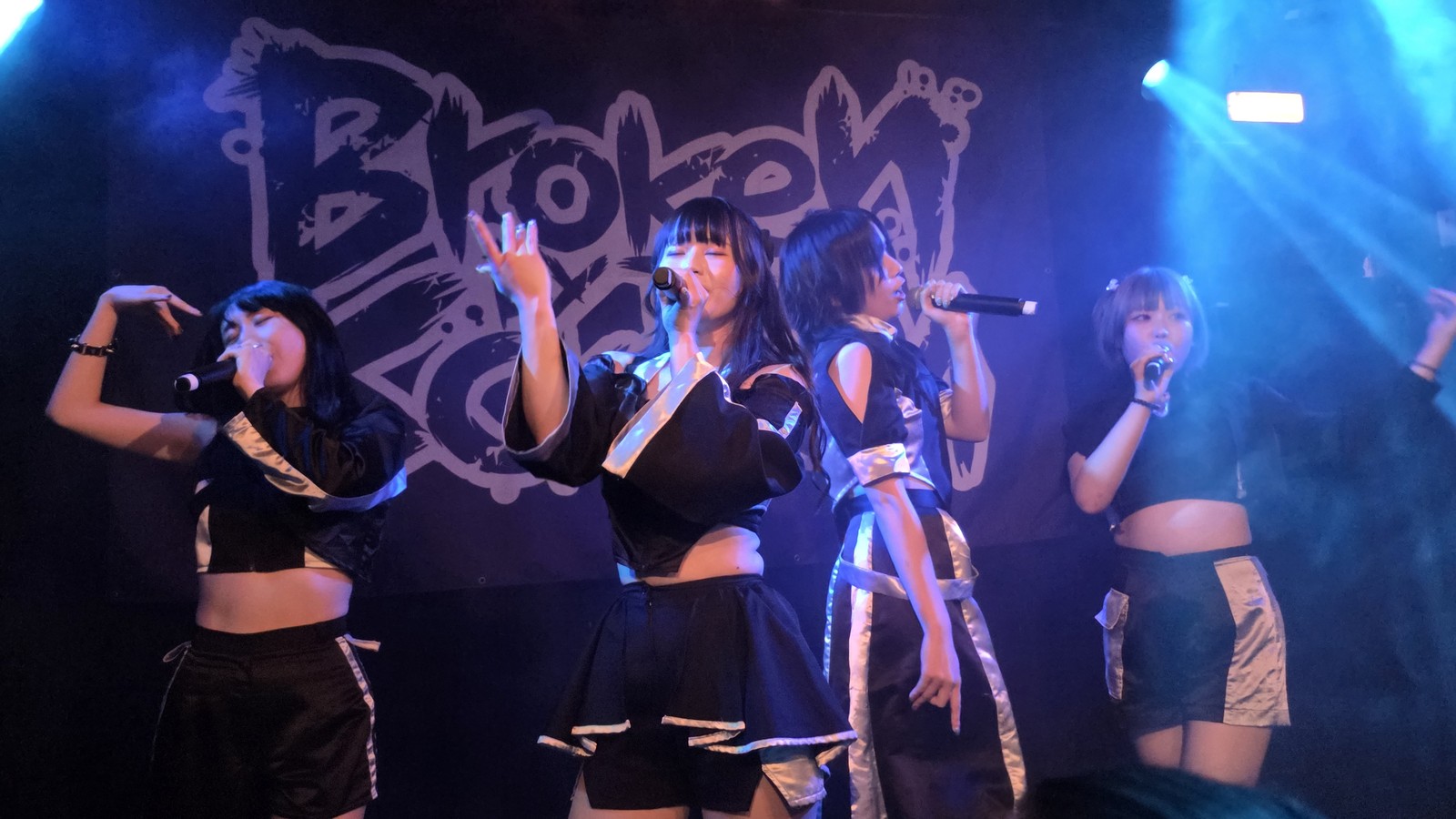
Announced by its management in October 2016, sent onto its first stage in January 2017, booked onto the main stage of Resurrection Fest in Spain in 2025, signed by Metal Blade on 5 February 2026 and built around four singers who throw sweet melodic lines against deep growls and harsh screams while the riffs underneath tear the ribbons off the idol stage, the Tokyo idol group that the death metal label Brian Slagel founded in 1982 took onto its roster is Broken By The Scream. It reads like a novelty. It is the pattern.
Look closely at the Japanese deathcore bands that count and the same thing turns up almost every time. The breakdown did not come in through a basement door. It came through the pop business, through visual kei management companies, idol agencies, the Oricon sales chart and the major labels, and it walked out of that building with its weight intact. Japanese deathcore is the scene where the guttural signed the same kind of contract as the boy band.
That is what separates Japan from the other deathcore scenes, which grew out of all-ages halls and small labels and fought their way up toward the industry from below. In Japan the industry was already standing in the doorway with the paperwork.
Picture a karaoke box rented by the hour, the padded room built for two cordless microphones on a glass table and a screen scrolling the words of a pop ballad, and a singer pushing a full guttural through the house echo until the speakers clip, the cones split along their seams and the screen jumps off its wall bracket while it keeps scrolling the ballad over a sound the room was never wired to carry. The room is pop. What comes out of it is not.
Japanese deathcore bands in visual kei make-up
Visual kei, the Japanese rock movement of costume, stage make-up and dyed hair that grew out of X Japan in the 1980s, gave the genre its first and loudest bastion. Put out by 9th Records, an imprint under the Danger Crue company, on the release schedules of the visual kei business, and sent to number one on the iTunes Japan metal chart with Dystopia in December 2021, a record that hammers blast beats and gutturals through songs built for a crowd in eyeliner, the Osaka band that bills itself as the most violent and extreme act in visual kei is Deviloof. The boast is about the playing. Fast riffs, double kick, blast beats and gutturals: deathcore with the eyeliner on.
The crowd is the harder problem. A visual kei audience comes with furitsuke, choreographed hand and head movements that fans learn song by song and perform together, and in September 2019 Deviloof's drummer Kanta told JRock News that the practice barely exists outside visual kei, while the guitarist Ray said plainly that the band did not need it. So a band in costume asks a costumed crowd to drop the choreography it rehearsed and to move like a pit. That is a sortie into a home crowd, and the breakdown is the weapon: a half-time hit on the open string gives the learned gesture nothing to count.
The international audience arrived through a screen. The 2019 video for "GouZinZanGoku", the opening track of Oni, drew fans outside Japan, and the band's headlong speed works like a kid at the bank of capsule toy machines by a live house staircase cranking every handle at once, plastic capsules pouring out by the hundred, until the whole rack tips off its stand and smashes down the stairs on the first beat of the breakdown. In January 2025 Deviloof put out "Inshu" with a video starring the actor Tadanobu Asano. A film star in a deathcore video is a fact about the Japanese market, not a gimmick.
More restless with its own sound than any band beside it, swapping a nu metal bounce on one single for a ballad on the next while its heavy songs keep driving the drop into the open low string, the Tokyo band that treats its music the way visual kei treats its wardrobe is Nocturnal Bloodlust. Visual kei bands change their clothes for every release. Nocturnal Bloodlust changes its music the same way, and on the heavy side of the rack the breakdown hangs exactly where it always did.
Painted for the stage and tuned for the pit, a singer in visual kei make-up out front and a band behind him that slams every song down onto the same half-time drop, the Nagoya band that puts both on one stage is DEXCORE. "DRAGOUT.", the band's video, is the proof that the make-up and the breakdown can share a stage. Its first album, Metempsychosis, followed in September 2020.
Idols, major labels and the Oricon chart
Oricon, the company that has compiled Japan's record sales charts since 1968, is where this music measures itself, and it measures itself against pop. Started with Decadence in 2010, taken onto Warner Music Japan and sent to number 51 on the Oricon albums chart with Bakemono in September 2016, a record whose breakdowns sat in the same weekly table as the pop singles around it, the Tokyo metalcore band that sits on the border of the genre was Her Name in Blood. A major label put a breakdown into the same sales column as the idol singles. The column did not care.
Tokuma Japan Communications handled the major-label step for Deviloof in 2023 and released Broken By The Scream's third album, Rise Into Chaos, in Japan before JPU Records took it abroad in November 2022. That is the idol business carrying the growl abroad on its own logistics.
The industry was already standing in the doorway with the paperwork.
Picture an idol crowd meeting the breakdown. Idol fans wave penlights in the colour of their favourite member, and at an idol metal show a whole front row of them is held steady through the melodic line, then the drop lands and the plastic tubes are snapped in half by fists coming down on the barrier, chemical glow spattered across the floor in four colours. Metal Blade's announcement of 5 February 2026 carried that idol crowd's music onto the big German festival fields, listing Wacken Open Air on 29 July and Summer Breeze on 13 August among the band's dates that summer.
Live houses, Triple Vision and the Tokyo circuit
The live house, the small standing club with its own sound system and its own staff that hosts almost every rock band in Japan below arena level, is where these bands learned the trade, and the circuit through it was built in part by foreign tours. In 2013 the Sumerian Tour crossed Japan with Born of Osiris and Upon a Burning Body from America and Her Name in Blood and Crystal Lake from Tokyo on the same bill, and Crystal Lake spent the rest of that year opening for Her Name in Blood and others across the country. Triple Vision Entertainment, then the label behind Her Name in Blood, took its self-titled album to number 73 on Oricon in April 2014.

Released in Japan in November 2018, months before the rest of the world could buy it, and carried abroad on a foreign label the following year, Helix is the record to hear first, and the metalcore band that sits on the border of the genre and keeps hammering deathcore's low end into its songs is Crystal Lake. In the autumn of 2019 it headlined the Impericon Never Say Die tour of Europe, nineteen shows in ten countries from 7 November in Germany. A Tokyo band at the top of that bill is the circuit running in reverse.
| Band | Base | Formed | Start with | Released by |
|---|---|---|---|---|
| Deviloof | Osaka | 2015 | Dystopia (2021) | 9th Records |
| Nocturnal Bloodlust | Tokyo | 2009 | The Omnigod (2014) | IRIS & CRISIS |
| DEXCORE | Nagoya | 2016 | Metempsychosis (2020) | Jelly Records |
| Her Name in Blood | Tokyo | 2007 | Decadence (2010) | Keep and Walk |
| Victim of Deception | Tokyo | 2013 | Victim of Deception EP (2017) | Triple Vision |
| Broken By The Scream | Tokyo | 2016 | Rise Into Chaos (2022) | Tokuma, JPU |
| Crystal Lake | Tokyo | 2002 | Helix (2018) | SharpTone |
Without the make-up: the independent label
Not every Japanese band in the genre went through a costume department, and Japan touched deathcore before Deviloof, DEXCORE or Broken By The Scream had formed: the Japanese label Amputated Vein put the debut of the Bay Area band All Shall Perish on disc in 2003, two years before most American kids had a name for the music.
Recorded for an independent label, Triple Vision Entertainment, rather than for an idol agency or a visual kei company, and pressed as a six-song, twenty-two-minute self-titled EP on 18 January 2017, the band that plays the genre straight, without stage costume and without a pop company behind it, is Victim of Deception. Riffs tempered on live house stages grind the low string into the floorboards and the blasts strip the paint off the edges of each song. No ribbons, no penlights, no choreography.
The Godless EP of 2018 stayed on the same independent label. Without a costume department or a film star in the video, what holds a room is the riff and the drop, and that is all this band brings to it. The independent version of Japanese deathcore is the same music with the costume department taken away.
What the Japanese bands carried abroad
Deviloof's road out of the country shows what it took. A visual kei band made its European live debut at Resurrection Fest in Viveiro in June 2025, came back that November for eight headline dates from Helsinki to Munich, and in the summer of 2026 supported the American band Enterprise Earth in China and Japan.
Every one of those trips ran on the same engine. A Japanese band could sign with an idol agency, wear the costume, chart on Oricon and sit on a pop label's release schedule, and the half-time drop still hit a Spanish festival field as hard as it had hit the floor of a Tokyo live house. Built the opposite way, out of small clubs and hardcore matinees, the UK deathcore bands had to break in from outside.
