

Misheard metal lyrics are the phantom islands of the music. Charted in the Coral Sea between the Chesterfield Islands and New Caledonia since 1876, copied from one survey into the next and still sitting in the scientific coastline databases long after French hydrographers dropped it in 1974, Sandy Island lasted until November 2012, when the Australian research vessel Southern Surveyor sailed over its coordinates and sounded some fourteen hundred metres of open water where the beaches should have been. Nobody had invented it on purpose. Somebody wrote it down once, and everybody after that trusted the chart.
A wrong line in a song works exactly the same way. The American writer who gave the thing its name, in an essay for Harper's Magazine in November 1954 about a Scottish ballad she had got wrong as a child, was Sylvia Wright, and the word she coined, mondegreen, has had to cover everything since. Heavy metal has produced more of them than any other music. It had every reason to.
Built for a volume that shakes the dust out of the ceiling tiles, sung in registers ordinary speech never visits, recorded with the voice sunk inside two distorted guitars and passed round for years on cassettes copied from copies until the hiss had scoured the treble off the tape, the music handed its listeners half a word and left them to supply the rest. They supplied it with total confidence.
How misheard metal lyrics are made
Start with the register. Once a singer's pitch climbs above the first resonance of the vowel he is shaping, the acoustic fingerprints that tell one vowel from another begin to converge, which is why a heavy metal falsetto, however thrilling, so often carries the melody and very little of the dictionary. Phoneticians measured the loss on opera sopranos. Metal supplied men who sang at the same altitude every night.
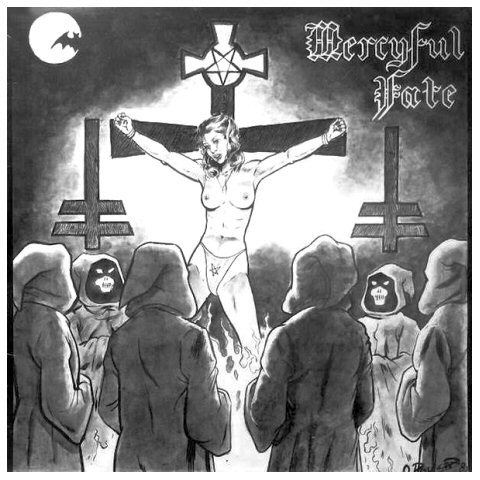
Recorded in two days at Stone Sound in Roosendaal, in the Netherlands, in September 1982 and released by Rave-On on 8 November that year, the four-song Mercyful Fate EP swung its singer from a mid-range snarl to a falsetto and back inside a single bar. The Danish voice that turned a whole generation of bedroom transcriptions into guesswork belonged to King Diamond, singing in his second language, and the guitars of Hank Shermann and Michael Denner wound round every line like barbed wire round a fence post. Mercyful Fate never made it easy.
On "Evil", the opening track of Melissa, released by Roadrunner in 1983, the falsetto tells a horror story in the first person, stacked with occult proper names no dictionary could help with, and a listener without the words on paper gets the shape of the tale, the menace and the relish in it, and almost none of the nouns. Fans filled in the nouns anyway. That is where every mondegreen begins.
Mud on the registration plate
The second culprit is the guitar. Most of what makes a word intelligible lives in its consonants, the short noisy bursts that start and stop the syllables, and those bursts sit close to the same crowded band, roughly 2 to 4 kHz, where a distorted guitar piles up its own harmonics, so the riff does not drown the voice so much as rub the edges off every word.
A vocal sunk inside that barrage is a rally car on a forest stage in the rain: by the third kilometre the rear wheels have flung mud over the flanks, the windscreen and the registration plate, and the spectators behind the tape name the car by its colour and the note of its engine, which is to say by the vowels and the melody, and now and then they name the wrong one. The timing sheet never agrees with them.
Engineers made it worse. Where a pop record of the seventies and eighties set the singer on top of the band, a heavy metal mix tended to set him inside it, level with the guitars, because the weight of the thing was the point and the voice was meant to be felt as one more instrument in the wall.
A voice treated as an instrument is not a voice anybody can take dictation from.
Accent finished the job. The Hanover band that sold English choruses into American arenas in the early eighties, its songs written and sung by men working in their second language, was Scorpions, and Klaus Meine's vowels, shaped in German and delivered at full power, sent native speakers off in directions the band never intended. The traffic ran both ways. Crowds in countries where English was barely taught learned the anthems by sound off worn cassettes and sang them back phonetically, word-shaped noises in the right places, with more conviction than many crowds who understood every syllable.
No words on the sleeve
The third culprit was the packaging. Plenty of the records that built the style came with no lyric sheet at all, and the band that printed the words of one song, and one song only, on the inner sleeve of its untitled fourth album in November 1971 was Led Zeppelin, the song being "Stairway to Heaven". Everything else the listener took down by ear. The words, where they can be recovered, are about something, war, myth, the road, madness, and each of those subjects is mapped in the chapter it belongs to.
Taking it down by ear meant a cassette deck, a pause button and a pencil, and the tape trading circuit multiplied the damage, since every generation of copy lost a little more of the treble where the hiss sits and the sibilants sit beside it, until a fifth-generation dub of a demo carried a singer with no sibilants left at all. Fanzines printed transcriptions typed from those tapes. The next reader copied them in good faith.
I understand a fury in your words, But not the words.
William Shakespeare, Othello, Act 4, Scene 2
The parents' group that carried the question of what the words actually said to a Senate committee on 19 September 1985 was the Parents Music Resource Center, and among its demands was that lyrics be printed on the record jacket, which turned the lyric sheet from a courtesy into a warning. The compromise the record companies offered that November let a sticker stand in for the printed words, a black and white label reading "Explicit Lyrics, Parental Advisory" as the alternative to setting the lyrics themselves on the sleeve. Death metal later settled the matter from the other side: once the voice went down into a growl, the printed sheet was the only place the words existed.
From the playground to the subtitle
The most famous mishearing in rock is older than the style it now haunts. Released as a single by Track Records in March 1967, "Purple Haze" by The Jimi Hendrix Experience carries a line whose final noun a vast audience swapped for a man standing beside the singer, and the guitarist who took the joke onto the stage, singing the misheard version and pointing at Noel Redding or Mitch Mitchell as he did it, was Jimi Hendrix. He could have corrected them. He preferred to join in.
Before the internet the mondegreen travelled the way a catechism does, by mouth and slightly wrong: the school playground, the bus to the gig, the letters page of a fanzine where one reader wrote in to correct another and got it wrong himself. The music journalist who first gathered the collection between two covers, in a paperback of 1995 titled after the Hendrix line, was Gavin Edwards, and an online archive opened in September 1995 under the same borrowed name.
The web did not correct the errors. It gave them a server. Fan transcriptions typed from worn cassettes went up on the first lyric pages of the nineties and were copied from site to site with the mistakes intact. Video sites then made a genre of it: the song plays, the subtitles print what the uploader heard, and the faithful in the comments argue about it for years.
The labels answered with the official lyric video, a clip in which the words themselves scroll across the screen in the band's own typeface, and through the 2010s a lyric video became a common way for a new metal single to reach an audience before any conventional clip was ready.
Some bands never wanted to be understood in the first place. The opening line of "Iron Man", on Black Sabbath's Paranoid in 1970, went through processing disputed even among the band, a ring modulator by the usual account, an oscillating desk fan held to the microphone by another, until Ozzy Osbourne sounded like the machine the song describes, a voice pulled out of plain English on purpose, and the machines it stands among are the business of sci-fi and dystopia in heavy metal.
The mondegreen did not die of the lyric video. It retreated to the concert hall, where nobody reads a screen during the chorus and a full room still sings the version it learned at fourteen, and on any honest reading the bands have long since stopped minding. Some of them sing it back.
