
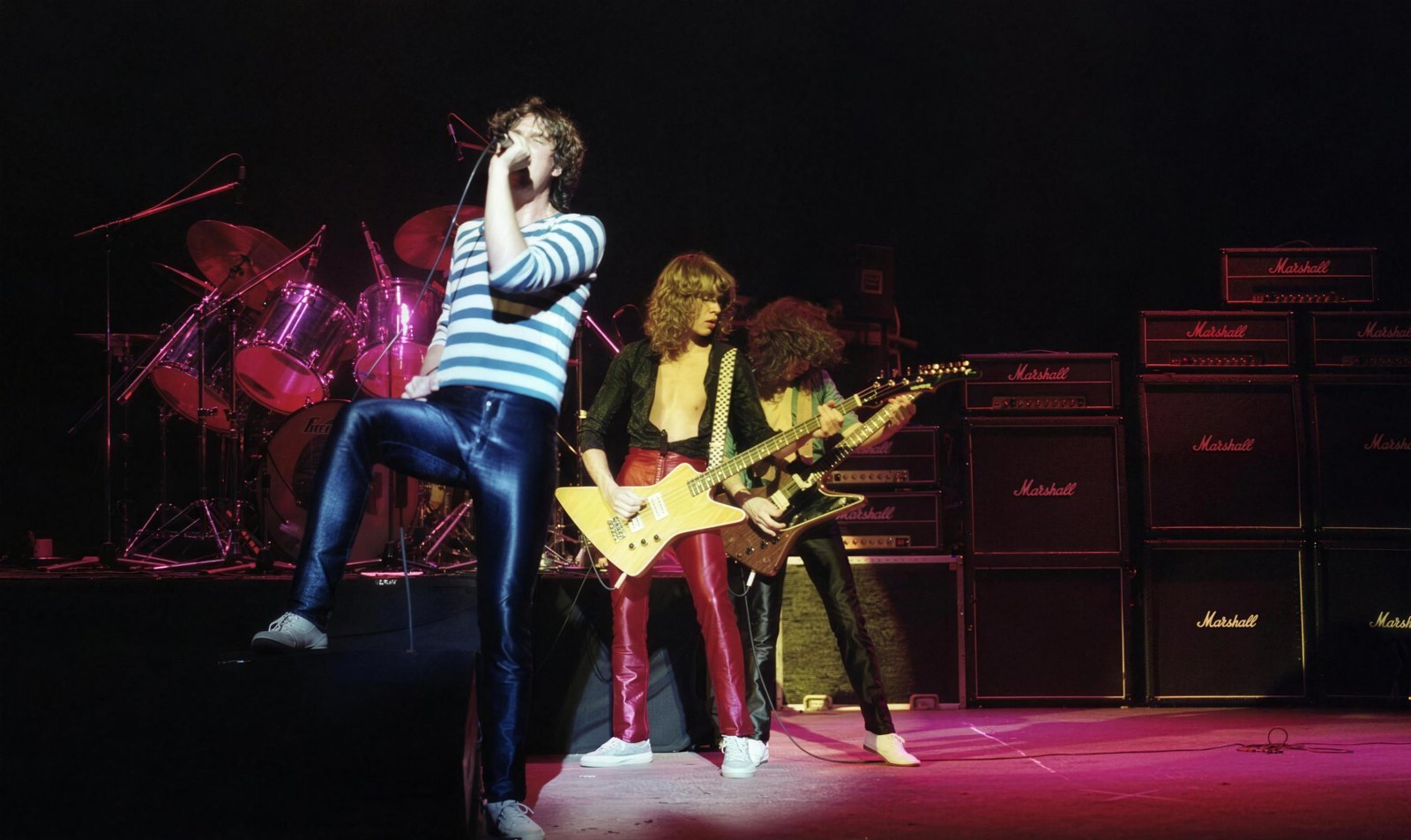
One hundred and forty eight pounds and fifty pence. Borrowed from the singer's father in the autumn of 1978, spent on three songs taped at Fairview Studios in Hull that November and turned into a pressing of a thousand copies on a label the band named Bludgeon Riffola, the sum bought a Sheffield quintet its first record. The young band that had that record in the shops in January 1979, four months before Sounds printed the phrase new wave of British heavy metal, was Def Leppard.
Is Def Leppard NWOBHM? By birth, beyond dispute. On that first record "Getcha Rocks Off" strips the plaster off the walls of a practice room with two guitars and a singer pitched at the top of his range, and nothing about it was built anywhere but the North of England. By the weight the band put on afterwards, no. The whole quarrel lives in the distance between those two answers.
A salmon is hatched in river gravel and weighed at sea. It fights its way down through rapids and past the estuary nets to the open Atlantic, tears into the herring shoals for years, and comes back three times the size to a riverbank where every ghillie still calls it a river fish, though not an ounce of that bulk was grown in the river. The birth certificate says Sheffield. The bulk says America.
The movement the band was born into, with its pub discos, its weekly paper and its cash-on-delivery pressings, is laid out in the wave that saved the genre. Membership of it cannot be settled with a single date. It has to be read record by record, and the reading changes with the year.
Is Def Leppard NWOBHM? What the first record says

Every credential the young British bands would later be judged by is on The Def Leppard E.P.: the money borrowed at home, the regional studio, the short pressing, a label that existed only to put out that one record. It carried "Ride into the Sun", "Getcha Rocks Off" and "The Overture", nearly eight minutes long, and it sold the way the wave's records sold, at gigs and through the post, before a single London company had shown any interest.
The disc jockey who gave it a national audience, after the singer Joe Elliott handed him a copy at a Sheffield University night where he was playing records, was John Peel, and the play on his BBC Radio 1 show put a pressing of a thousand copies in front of listeners in every county at once. That is exactly the channel the movement ran on. Vertigo reissued the EP that September with the first two songs swapped round.
The pair of guitarists who drive "Getcha Rocks Off" at a pace closer to a punk single than to anything the band would record after 1981 were Pete Willis and Steve Clark, and the song is the pedigree of the band in three and a half minutes: a blunt riff doubled across two guitars, a chorus shouted rather than sung, and a production that sounds as if it cost what it cost. Nothing on it was aimed at radio. It was aimed at the room.
Vertigo, a Priest producer and AC/DC's manager
The speed of what came next is the first argument against. By 5 August 1979 the band had signed to Vertigo. That September the New York management company that took it on, and that also managed AC/DC, was Leber-Krebs, through Peter Mensch. Mensch booked the band onto AC/DC's Highway to Hell tour of Britain that autumn, the run of dates that closed at Hammersmith Odeon in early November. Eight months after the EP, the Sheffield five had American management and an arena support slot.
The producer who saw them open for AC/DC and agreed to make their first album was Tom Allom, the man behind the desk for Judas Priest, and On Through the Night was recorded with him in December 1979 at Startling Studios, the studio at Tittenhurst Park in Berkshire, and released on 14 March 1980. Martin Popoff later called it one of the most polished and savvy records of the NWOBHM, in his Collector's Guide to Heavy Metal: Volume 2, The Eighties. Polished was the word the wave's audience would hold against it.
The songs themselves sit comfortably inside the wave. "Rock Brigade" opens the album as a salute to the faithful in the hall, a mid tempo stomp with the twin guitars laid flat across the chorus. "Wasted", the single Vertigo released on 2 November 1979, reached number 61 in Britain. The sound says NWOBHM. The itinerary says something else.
| Album | Released | UK peak | US peak (Billboard 200) |
|---|---|---|---|
| On Through the Night | March 1980 | 15 | 51 |
| High 'n' Dry | July 1981 | 26 | 38 |
| Pyromania | January 1983 | 18 | 2 |
In May 1980, two months after the debut, the band landed in the United States to open for Pat Travers at the Santa Monica Civic Auditorium on 20 May, the first of nine shows, then for Judas Priest in Texas and for Ted Nugent and Scorpions across the Midwest and the South. No other band of the wave had an American bridgehead that early. Read down the table and the two columns cross within three years, the British number falling as the American one climbs.
High 'n' Dry, and the current stepped up
The producer who had made AC/DC's Highway to Hell and Back in Black, and who took the band into Battery Studios in London from March to June 1981, was Robert John "Mutt" Lange. He worked on them like a step-up transformer in a grid substation, taking the low, dirty current of a Sheffield rehearsal room and forcing it out at the voltage of the American transmission lines, enough to light a stadium and enough to burn out every small practice amp still plugged into the old supply.

Released on 6 July 1981, High 'n' Dry is the border post. "Let It Go", the first single that August, is still a riff song the wave would have recognised, built on a chugging figure and two guitars trading lines, but every edge on it has been filed and every drum placed exactly where Lange wanted it. The raw noise of 1979 is gone. The riff survived.
"Bringin' On the Heartbreak", issued as a single in America that November, is the other half of the record, a slow song swelling to a full band and a guitar solo in its last minute, the shape the American radio of the decade would pay for over and over. On an album made in London by a British band, it is the first song aimed squarely across the Atlantic. The album stayed on the Billboard chart for 123 weeks.
The sound says NWOBHM. The itinerary says something else.
Channels, sound, audience, and a band that refused the label
Weighed on three separate scales, the band comes out differently on each. By the channels it came through, the self-pressed EP, Peel's show and a Vertigo contract, the band passes. By sound, On Through the Night passes and High 'n' Dry passes on its louder side only. By audience, the band had already begun to fail in 1980, when the wave's own paper accused it of selling out to America before the debut had been in the shops six months.
Even after all these years, the British media still try to lump us in with the NWOBHM, whereas the American media still try to pigeonhole us as a 'hair metal' band.
Joe Elliott, uDiscover Music, 20 March 2020
The band has never wanted either label. Elliott added in the same interview that neither tag ever stuck, because Def Leppard became established as a standalone band. A band's view of its own genre counts as one opinion among several. The records are the rest of the evidence.
Def Leppard NWOBHM, record by record
So the verdict runs by the calendar. The EP of January 1979 is the wave's own, without argument. On Through the Night is a NWOBHM album made with a Judas Priest producer and sold to two continents at once, and High 'n' Dry stands with one foot either side of the line. From Pyromania in 1983 the band belongs to another story entirely, the one with the hairspray and MTV in it.
The opposite case is the trio whose records the wave learned its speed from and whose birth came four years too early for membership, and it is weighed in is Motörhead NWOBHM. That band arrived before the name. Def Leppard left it.
Is Def Leppard NWOBHM? For two records and about thirty months, yes, and on the evidence of the first one more purely than many bands the wave never questioned. After that the Sheffield five kept the accent and sold the rest to America. The accent is still audible. The membership lapsed in 1981.
