
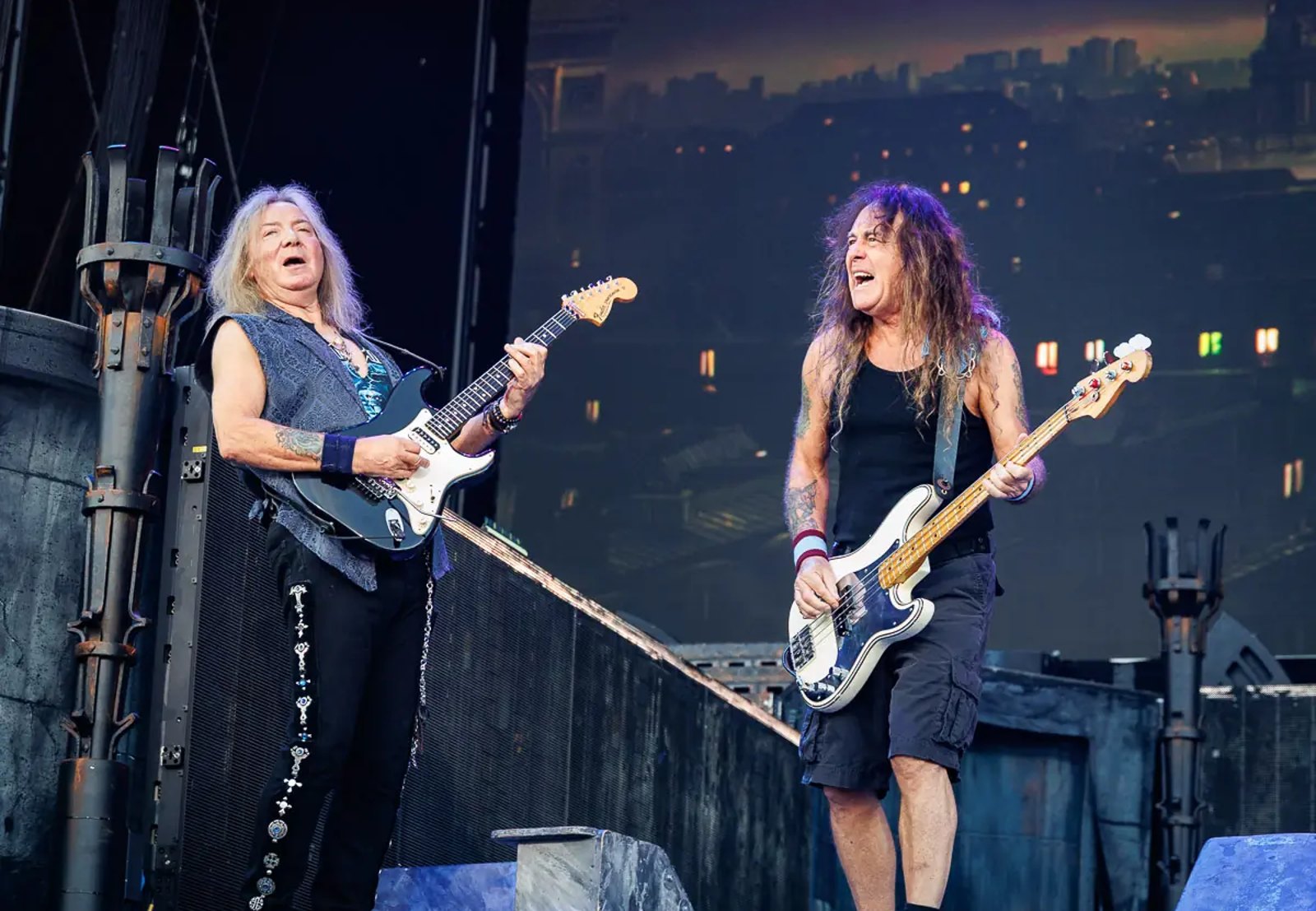
One bass drum, one pedal, a twenty-four inch shell, and a right foot fast enough that most people never think to count.
Filed as heavy metal by every shop and every encyclopaedia, named on the sleeves and in the interviews of half the German bands that later assembled the genre, and fast and heroic enough for the question to come round again every few months, the band whose drummer has worked a whole career off that one pedal is Iron Maiden.
The short answer to is Iron Maiden power metal is no. The long answer is worth the trouble, because the margin is thinner than either side of the argument admits, and because the music this band is being measured against was largely assembled out of parts it supplied.
A chaconne is built on a floor. Eight bars in the bass, set down at the start and repeated without a lift to the last page, the lower strings grinding the same figure under every variation until the bass bar works loose from the belly and the top of the instrument sinks, so that anything at all can be stacked over it and nothing underneath will move. Maiden never laid one. Five players, five lines, and the bottom of the music kept for a tune.
Where the parts of this music came from, and out of whose hands, is the longer account. The narrower question has a yes or a no at the end of it.
Why is Iron Maiden power metal even a question
Because the inheritance is real and nobody involved has ever pretended otherwise. The harmonised twin lead, the long song with movements inside it, the heroic subject and a singer audible over an arena all reached Hamburg and Helsinki inside a Maiden sleeve, and the bands that assembled the genre out of those parts have said as much for thirty years.
Helloween took the twin lead and doubled the tempo of the drums under it. Blind Guardian took the long narrative song and rebuilt it around a refrain that comes back. Gamma Ray and Stratovarius took the heroic subject and moved the harmony into daylight. The progeny went one way with the parts. The band that supplied them stayed where it was.
The first of the genre’s three tests is the voice, and it is the only one this band wins outright. Bruce Dickinson sings in pitch, without distortion, at the top of a tenor’s working range and loud enough for the words to arrive whole, which is the specification the auditions of the following decade were written to.
The other two are where it comes apart, and one distinction saves a great deal of noise. The first two tests are gates. A record that fails either is out of the family at once, and a record that passes both has done nothing more than earn the right to be examined.
The first two tests are gates. Passing a gate is not the same as being inside the building.
The gallop is a figure and not a floor
The second test asks what the kick drums are doing, and here the band’s most famous device gets mistaken for somebody else’s. The gallop is a dactyl: one long note and two short ones, grouped, weighted on the first, the grouping audible every time it comes round.
Beat that dactyl on the boards of a rehearsal room with a conducting staff, drive the ferrule through the planks on every long note, and a room of players will tell you where the bar begins from the far end of the corridor. A power metal drummer does the opposite. Sixteen even strokes to the bar, no weight anywhere, nothing to count, a surface instead of a rhythm, with the riff laid over it like paint on a wall that was standing already.
Maiden have never had the equipment for it and have never asked for it. Nicko McBrain works one bass drum and one pedal, a twenty-four inch shell under a single foot, and Clive Burr before him did the same across the first three records, Iron Maiden, Killers and The Number of the Beast.

“Aces High”, the track that opens Powerslave, cut at Compass Point in Nassau between February and June 1984 and put out by EMI on 3 September, is the song offered as evidence in every one of these arguments, and it is the best evidence there is. It is still a gallop. The kicks punctuate the guitar figure rather than running beneath it, and the instant the riff stops, the bottom of the record stops with it.
Then there is the bass, the quietest of the structural differences and the largest. Steve Harris writes melody down there, a second voice moving against the guitars and often carrying the hook itself, where the genre hires its bass players to double the root and be felt rather than followed. A bass line doing that is not holding anything down. It is singing.
Twin leads that never turn the corner into major
The harmonised third is the other borrowed device, and the borrowing changed it. Two oboe reeds cut from one length of cane, the cane split lengthwise with a knife and the halves bound to different instruments, sound a third apart and cannot be played alone: that is what two guitars do on these records, one gesture in two lines, and the cadence at the end of it goes home to the minor.
The genre took that shape and turned the corner with it. A verse in the minor climbs and the chorus lands somewhere bright, which is the most reliable thing about a power metal song after the voice, and it is the move this band declines record after record. Volume rises. Dickinson rises. The chords stay where they were.
“The Evil That Men Do”, lifted as a single off the 1988 album and a number five in Britain in August of that year, has as big a chorus as the band ever wrote and does not brighten once. The guitars harmonise. The crowd takes the tune off the singer. The key does not move, and the pedigree of that refusal runs back through every record before it.
The long songs walk out and do not come back
Length is not a test at all, which is exactly why it misleads. Both musics write pieces past ten minutes, both put movements inside them, and the resemblance stops the moment anyone asks what shape those minutes take.

Seventh Son of a Seventh Son, out on EMI on 11 April 1988 and a number one in Britain, runs a story across eight songs and gives the title track nine minutes and fifty two seconds of it, while “Rime of the Ancient Mariner”, thirteen minutes and forty five seconds on the 1984 record, had already set the ceiling for everybody.
That title track is through-composed, and the plan is the whole difference. It goes forward. A section arrives, does its work and is cut off behind the band, and the piece finishes somewhere it has not been before. The genre’s epic works the other way. It states a refrain early, travels, and comes home to it three or four times, so that a field of people can meet it on every return. Helloween built thirteen minutes on that plan in 1987. Same minutes. Opposite drawing.
The closest case, and the verdict
The nearest thing to a yes has to be conceded, and it sits on that same 1988 album. “Can I Play with Madness”, released as a single on 14 March 1988 and a number three in Britain, states its chorus inside the first fifteen seconds, hands it over whole, and has been sung back by fields of people ever since, over the first keyboards the band ever put on a record.
Run it through anyway. The voice passes. The chorus passes. One pedal underneath, a cadence that stays minor, and a bass line with opinions of its own: in the judgement of the tests that sort this music, that is a heavy metal single with a very good hook on it.
| Test | What the genre asks for | What the records do | Verdict |
|---|---|---|---|
| The voice | Clean, pitched, words legible over the band | A tenor at the top of his working range, no distortion on the hook | Pass |
| The chorus | Stated early, repeated, inside an untrained crowd’s range | Stated early, repeated, taken off the singer nightly | Pass |
| Where the phrase lands | A bright resolution at the end of a dark verse | Home to the minor, lifted by volume and altitude instead | Fail |
| The kick drums | Even sixteenths, ungrouped, running under the riff | One bass drum, one pedal, figures grouped with the riff | Fail |
| The bass | The root, felt rather than followed | A second melody, and often the hook itself | Fail |
The same sorting is owed to the other British band the genre keeps trying to claim, Judas Priest, and that job is Painkiller and the power metal question, where a faster record and a harder drummer leave the margin thinner still.
So the answer to is Iron Maiden power metal is no on the drums, no on the cadence and no on what the bass is for. The record shows a band that wrote most of the parts this genre stands on and then built something else out of them, which is the larger fact of the two and the one that goes missing every time somebody tries to promote them into a style they had no use for.

