
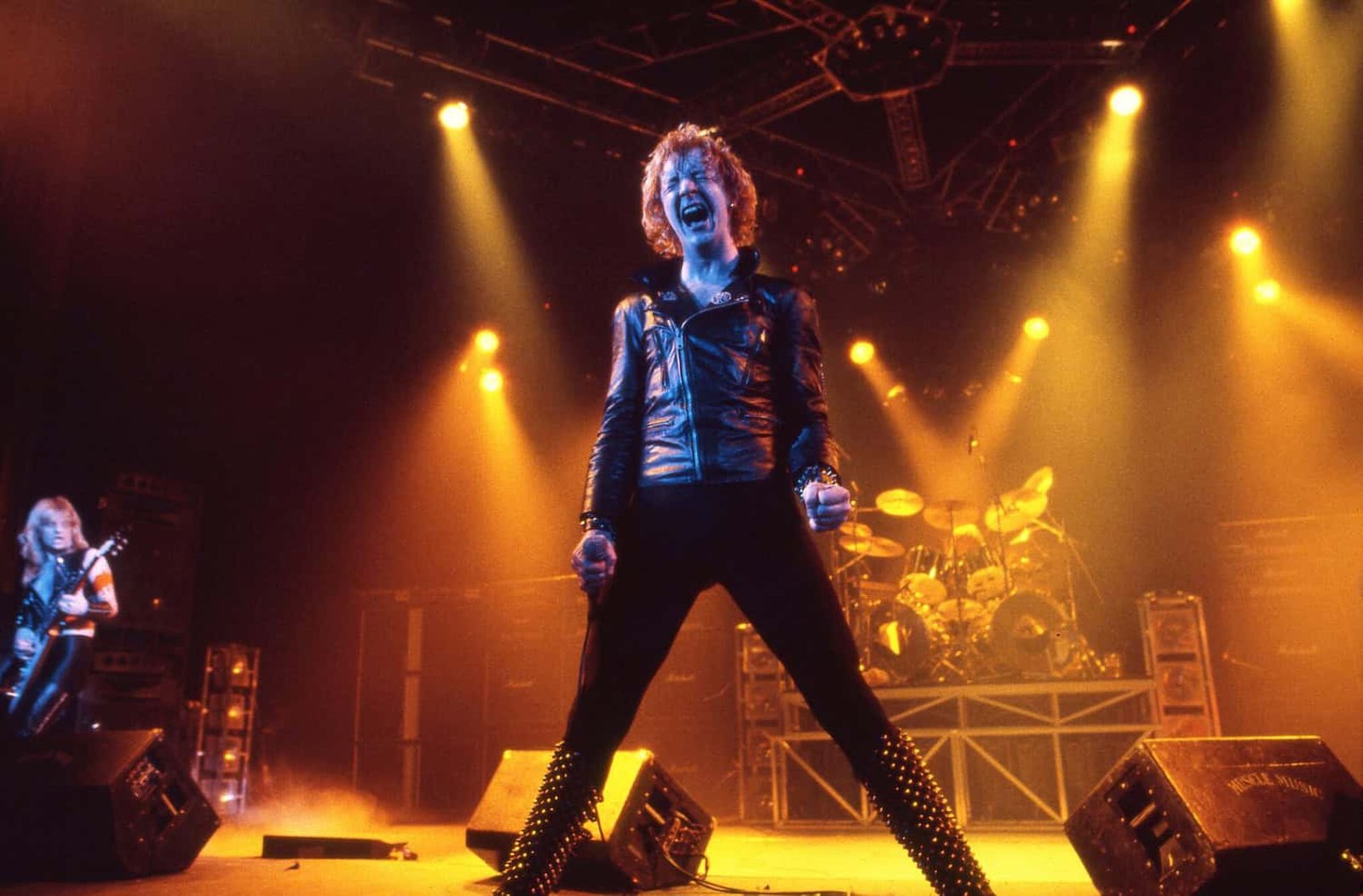
Five studio albums. The West Midlands quintet that had put that many records into the shops by 19 May 1979, the day Sounds printed the phrase new wave of British heavy metal over Geoff Barton's review of three young bands at the Music Machine in Camden, was Judas Priest, and the count settles the matter before anyone has to raise a voice. Is Judas Priest NWOBHM? No.
An orchard explains it better than a family tree. The grafter saws the old rootstock off at the knee, splits the stump with a knife, drives a young cutting into the wound and binds it tight with wax and twine, and from that spring on the tree bears the new variety's fruit on roots that were in the ground years before the cutting was taken. The wave was the cutting. Priest was already in the soil.
The question keeps coming back because the two grew into one trunk so quickly. Between 1979 and 1981 Priest shared bills, chart pages and a good part of an audience with the young bands of the new wave of british heavy metal, and from a distance of four decades the joins are hard to see. Up close they are not.
Is Judas Priest NWOBHM? The dates answer first
Formed out of the Birmingham clubs, joined by Rob Halford in 1973 and by the second guitarist Glenn Tipton in 1974, the band made its debut, Rocka Rolla, for the small Gull label that September, followed it with Sad Wings of Destiny in 1976, and had signed to CBS, one of the largest record companies in the world, before Sin After Sin appeared in April 1977. By then the teenagers who would form the wave were still buying records rather than making them.

Stained Class followed in February 1978 and Killing Machine in October, and by the spring of 1979 the band had toured the United States and Japan, where the live album Unleashed in the East was recorded that February and released that September, reaching number ten in Britain. A band with a major label, a live album and an American touring history is not new. It is the thing the new bands were trying to become.
| Date | Event |
|---|---|
| Sept 1974 | Judas Priest release Rocka Rolla (Gull) |
| Mar 1976 | Judas Priest release Sad Wings of Destiny (Gull) |
| Apr 1977 | Judas Priest release Sin After Sin, their first album for CBS |
| Feb 1978 | Judas Priest release Stained Class (CBS) |
| Oct 1978 | Judas Priest release Killing Machine (CBS) |
| May 1979 | Sounds prints the phrase new wave of British heavy metal |
| Nov 1979 | Iron Maiden press The Soundhouse Tapes themselves |
| Apr 1980 | Judas Priest release British Steel; Iron Maiden release their debut |
A support band and its headliner share a night. They do not share a movement.
What the young bands took from the old one
The pair of guitarists who had worked out, from 1974 onward, how two lead players could trade and harmonise inside a heavy riff instead of simply doubling it were K.K. Downing and Glenn Tipton, and nearly every band of the wave that could afford a second guitarist copied the arrangement. Iron Maiden, Saxon, Diamond Head and Tygers of Pan Tang all ran two guitars. None of them invented the idea.
The uniform came from the same source. From 1978 Halford went on stage in black leather, studs and chains, and within two years the audience of the wave had adopted the look so thoroughly that Saxon could title an album after the clothes. The drummer who opened Stained Class on "Exciter" and drove the double kick drums like a runaway loom in a cotton mill, shuttles flying off the frame faster than any weaver could duck, was Les Binks, and the young bands took that speed home and pushed it further.
1980, the year the lines crossed
Part of the muddle is the name itself. A movement called the new wave of British heavy metal implied an old wave, and the most British and most openly metal band of that older generation was the one about to put a song called "Metal Gods" on an album called British Steel, which made it easy, forty years later, to hear the label as a description of Priest rather than of the bands that came after it.
The calendar did the rest. Recorded early in 1980 with the producer Tom Allom at Startling Studios, the studio at Tittenhurst Park in Berkshire, and released on 11 April, the same day EMI issued Iron Maiden's debut, British Steel reached number four in Britain, and "Living After Midnight" and "Breaking the Law", both peaking at number twelve on the UK singles chart, carried Priest onto the same music programmes as the young bands.
The record did something the wave itself had been doing for a year. It cut the songs down the way a cavalry sabre is ground into a trench knife, shortening the blade until nothing is left but the edge and the point, and made them deadlier at close quarters: most of British Steel runs under five minutes, with none of the long, winding structures of Sad Wings of Destiny. The elder had learned from the pupils. It did not become one.
The same spring put the two generations on one stage. The young London band that opened for Priest when the British Steel tour opened its UK leg at Cardiff on 7 March 1980 was Iron Maiden, and at the first Monsters of Rock at Castle Donington that August Priest played above Saxon on the bill. A support band and its headliner share a night. They do not share a movement.
Priest sold the wave its uniform, its twin guitars and half its record collection, and then in 1980 bought a few ideas back. A shopkeeper who trades with his customers is still the shopkeeper.
Declan Rourke, KaosMetal
Teacher, not classmate
The wave was defined by where its bands came from and how they reached the shops: demo tapes, pub back rooms, independent labels, seven-inch singles pressed in their hundreds, and a debut somewhere between 1979 and 1983. Judas Priest meets almost none of those conditions. It had a major label contract two years before the phrase existed and a catalogue that the wave's musicians had been learning from since school.
The generations were a decade apart in years as well as in records. Halford, Downing and Tipton were born between 1947 and 1951, while the wave was made largely by men born around 1960, and the drummer who joined Def Leppard in 1978, Rick Allen, was fifteen when he did, on his own birthday. Priest's members were touring America while some of the wave's future stars were still in school uniform.
The band's next move confirms it. Point of Entry, released in February 1981 and recorded in Ibiza, turned toward American radio at the very moment the wave was peaking at home, and Screaming for Vengeance in 1982 broke the band in the United States, certified platinum by the RIAA within a year of release. Which is why British Steel sits nowhere among the best NWOBHM albums, however many of the wave's records it outsold.
The closest parallel is Lemmy's band. The trio that predated the wave by four years, fed it throughout and sold records to its audience was Motörhead, counted as a forebear rather than a member for the same reasons. Both bands were in the room when the movement was named. Neither was on the guest list.
The opposite case is the band that opened for Priest in 1980, which came out of the pub back rooms, a self-pressed single and the Soundhouse chart with every credential the wave required, and whether that settles its membership is weighed in is Iron Maiden NWOBHM. The answer there is a different one.
Judas Priest is heavy metal, by common consent the band that did most to define it in the seventies, and it stood as standard-bearer of the whole British line when the new bands came through. It is not NWOBHM. It is the reason the NWOBHM sounded the way it did.
