
On a board laid over two stools in the open air, a dozen pairs of hands would take a length of new tweed, soaked and heavy, slam it down, pass it sunwise and slam it again, and the songs that went with the work were there to hold the blows together, one song to a cloth, until the weave closed and the board split along its grain under the beating. Then the mills took the fulling. The boards went for firewood. The songs did not stop, and they are sung still, in halls, off printed notation, at whatever tempo a singer prefers, with nothing under anybody's hands. That is what a finished practice looks like from the inside. Asked that way, is power metal dead stops being a question about whether the old records still get played and becomes a question about whether anything is still being made to their beat.
By every count that can be taken, nothing of the sort has happened here. The band in clerical dress that sold out the Olympiahalle in Munich in October 2024 and put the recording of that night at number one in Germany sixteen months later is Powerwolf, and three of the seven acts billed as headliners at the 2026 Wacken Open Air, on a field that sells 85,000 tickets, came out of the same style. Nobody has read the last rites. What the countable things show, set side by side, is a trade in better health than it has ever been and an intake of new bands running at a third of its old rate.
Is power metal dead? What would have to be true
A style would be dead if five things failed together: nothing new recorded, no label with money in it, no room that needs a barrier, nothing on a festival bill above the early afternoon, and the old songs played only as repertoire by people born long after they were written. Four of the five can be counted instead of argued. The style was written off in 1992, when the American labels let it go and most of the press stopped setting its name in type, and the decade that followed is power metal in the 90s. Everybody who asks the question now inherited it from a year they did not see.
The nearest thing to a death notice the genre has ever had is power metal in the grunge years, and what went missing even then was contracts and column inches, never records. A dead genre leaves a sepulchre and a repertoire. This one leaves a release schedule, a ticketing calendar and a signing announcement every few weeks.
What the bills say, and which slot the acts get
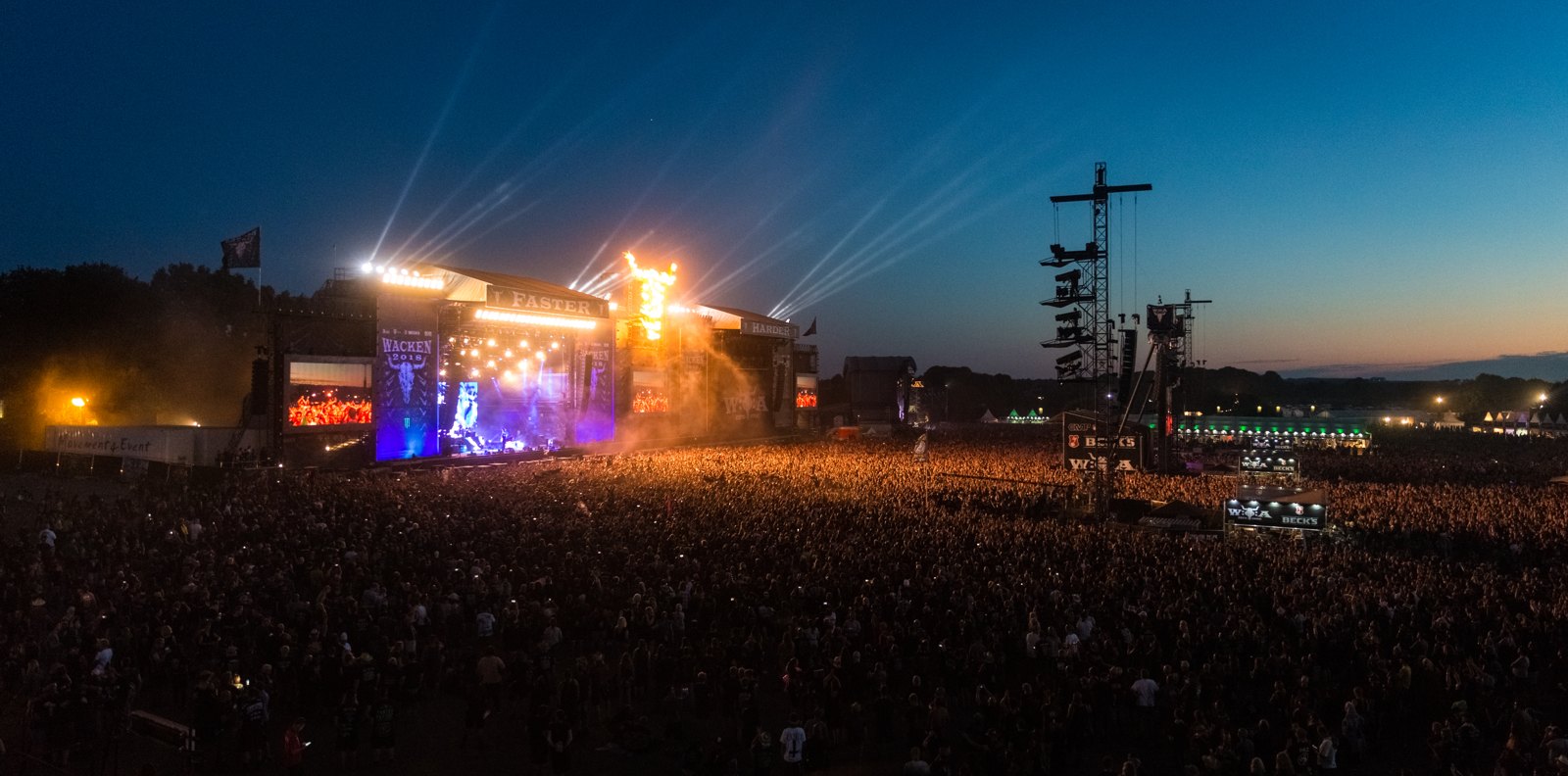
The bill is the easiest of the five to count, because somebody prints it. Wacken Open Air headlined its 1992 edition with Saxon and Blind Guardian, 3,500 people on the field and a ticket at the equivalent of 17.90 euros, and its 2026 edition ran from 29 July to 1 August with around 200 bands, a ticket at 351 euros and seven acts in the headline list, three of them power metal. The same year the style was written off, Wacken put Blind Guardian at the head of its bill. The style that topped the bill when the field held a village tops it now the field holds a small town.
Slot position is where the reading stops being comfortable. Power metal held a place in the Wacken headline list in 2015, 2016, 2018, 2019, 2022, 2023, 2024 and 2026, eight of the ten editions actually held since 2015, and in 2025 it held none: that list ran Guns N' Roses, Machine Head, Saltatio Mortis, Gojira, Dimmu Borgir and Papa Roach. One blank year is not a collapse. It is also not nothing, and a genre whose top acts were a fixture rather than a strong option would not produce one. A long rest is not silence on anybody's part either: it is counted time with a whole entry riding on it, and the player who loses the count comes in a bar early and tears the chord open in front of the hall. That count is still running.
Rooms, rosters and the records that still enter the chart

The Olympiahalle in Munich takes between 12,500 and 15,500 people depending on how a show is set, and the Wolfsnächte tour filled it in October 2024. Wildlive (Live at Olympiahalle) came off that night and entered the German album chart at number one on 20 February 2026 and stayed on it three weeks. A live record carries the night it was taken on: two hours of sticks beat the crack out of a snare head until the backbeat comes back as a thud, a top note lands where a dry throat put it rather than where the part wanted it, and all of it stands on the record exactly as the room took it. A room of that size is a measurement and not an opinion. It is the count of people who bought a ticket for one band on one evening, and no argument about a style running out of ideas moves it by a seat.
A dead genre leaves a sepulchre and a repertoire. This one leaves a release schedule, a ticketing calendar and a signing announcement every few weeks.
Wake Up the Wicked, the studio record that tour was built on, went to number one in Germany on 2 August 2024 and held the chart four weeks. The single Napalm had sent out with a video a record earlier, Sainted by the Storm off Interludium, wears the same church and arena costume the band has worked in for twenty years. The spectacle has grown faster than the writing. That is a complaint about a healthy band, not a symptom in a dying genre.
The act that entered the German chart at number four on 24 October 2025 with Legends and held a place there for eight weeks was Sabaton, and its 2026 and 2027 legs read as two different careers: the Hollywood Palladium in Los Angeles, which holds 4,000, on 12 November 2026, and arenas in Dublin, Glasgow and Lisbon the following April. Both figures are true at once, and a genre can be an arena act on one continent and a 4,000 capacity act on another with nothing wrong in the records.
Rosters point the same way as the rooms. Napalm Records took on three power metal acts inside 2026: Twilight Force and Lovebites in February, and on 30 September a worldwide physical deal outside Japan for a Tokyo band formed in 2018, with Through the Night set for 15 January 2027. The newest name on that roster is Hagane, signed on the back of its European debut at Rockharz that summer, and nobody puts a worldwide physical release behind a band they expect to lose.
The one count that has fallen
Formation is the count that flatters nobody. Bands filed under power metal and formed between 1996 and 2005 number 2,933; for the decade to 2015 the figure is 2,454; for the eleven years from 2016 to now it is 1,037, of which 928 are still listed active and 47 as split up. That is attrition at the entry point and not at the top, and it is the one count a pessimist can use honestly.
| Period | Bands formed | Full-lengths that year |
|---|---|---|
| 1986–1995 | 1,489 | 91 (1992) |
| 1996–2005 | 2,933 | 401 (2005) |
| 2006–2015 | 2,454 | 555 (2015) |
| 2016–2026 | 1,037 | 410 (2025) |
Output has not followed formation down anything like as far. The year the style was written off, 1992, produced 91 full-length power metal albums, and 2025 produced 410, with 292 already on the books by the first of October 2026. So the unbroken line of records runs on at roughly four and a half times the rate of 1992, off a smaller intake of bands, which is what a mature trade looks like, not a dying one.
The age of the acts in the headline slots
The top of the bill is the oldest thing in the genre. The order of an evening has never been a judgement on the music inside it: the first thing played goes out against banging doors and the hinges of a hall still sitting down, with everything written quiet torn off the front of it. That is why an opener that starts on a full chord struck hard survives the slot and a quiet one does not, and the closing slot gets a room with nothing left to do but listen. Not one of the seven acts in the 2026 Wacken headline list was formed after 2004: Sabaton dates from 1999, Powerwolf from 2004 at the latest, and the oldest of the three power metal names on that list, with roots in the late seventies, a first run that ended in 2002 and a return in 2023, is Savatage. The same holds for the six names of 2025, so this is a festival habit before it is a power metal fault, and it is still the fact that keeps the question coming back.

Underneath the headline tier the arithmetic is different. The six piece out of Milan whose sixth album lands nine years after it formed is Frozen Crown, with The Legend of the Six Kings out on 2 October 2026 through Napalm and tours around it with Kamelot and Beast in Black. A band formed in 2017 with five albums behind it, a sixth at the presses and a label tour is not a sign of life. It is life.
Who Wants to Burn in Heaven, the third single off that record, runs three minutes and fifty six seconds and splits the lead between two voices, which is one audible difference between this intake and the one that headlines. Splitting a line between two mouths is the hocket's trick, and the point of the hocket is that neither mouth is left holding the tune: silence one of them and what the other has is holes punched clean through the melody where the partner used to answer. The singing is shared rather than owned, and the chorus is built for a room to take off the singers. Nothing in it would have been written in 1988. Nothing in it hides where it came from.
The viola d'amore carries seven strings over the fingerboard and seven wires threaded through the neck beneath it, which no bow ever touches. Sound a chord on the upper seven and the wires answer underneath, so a room hears more instrument than there are hands in it. Snap those wires and a player works as hard for half the noise. The genre's wires are its back catalogue, four decades of records still on the shelves and on the screens between festival sets, and the only count that answers anything is the one taken with those wires damped.
Damp those wires and what still sounds is 410 albums a year, three headliners of seven and an intake a third the size it was: a low note, and nowhere near silence. Every measure of trade points one way: three headline acts of seven at the largest metal festival in the world, a sold out arena recording at number one in Germany, 410 albums in a year against 91 in 1992, three signings by one label inside twelve months. One measure points the other way, the one about intake, at a third as many new bands a year as the genre was producing two decades ago and nobody in the top slots who started after 2004. That is not death and it is not a boom. It is a genre with a canon, a working trade and no new names at the top of the bill. One test settles the question, whether new work is still being made, and the answer is yes: 410 albums came out in 2025, so power metal is not dead.
