
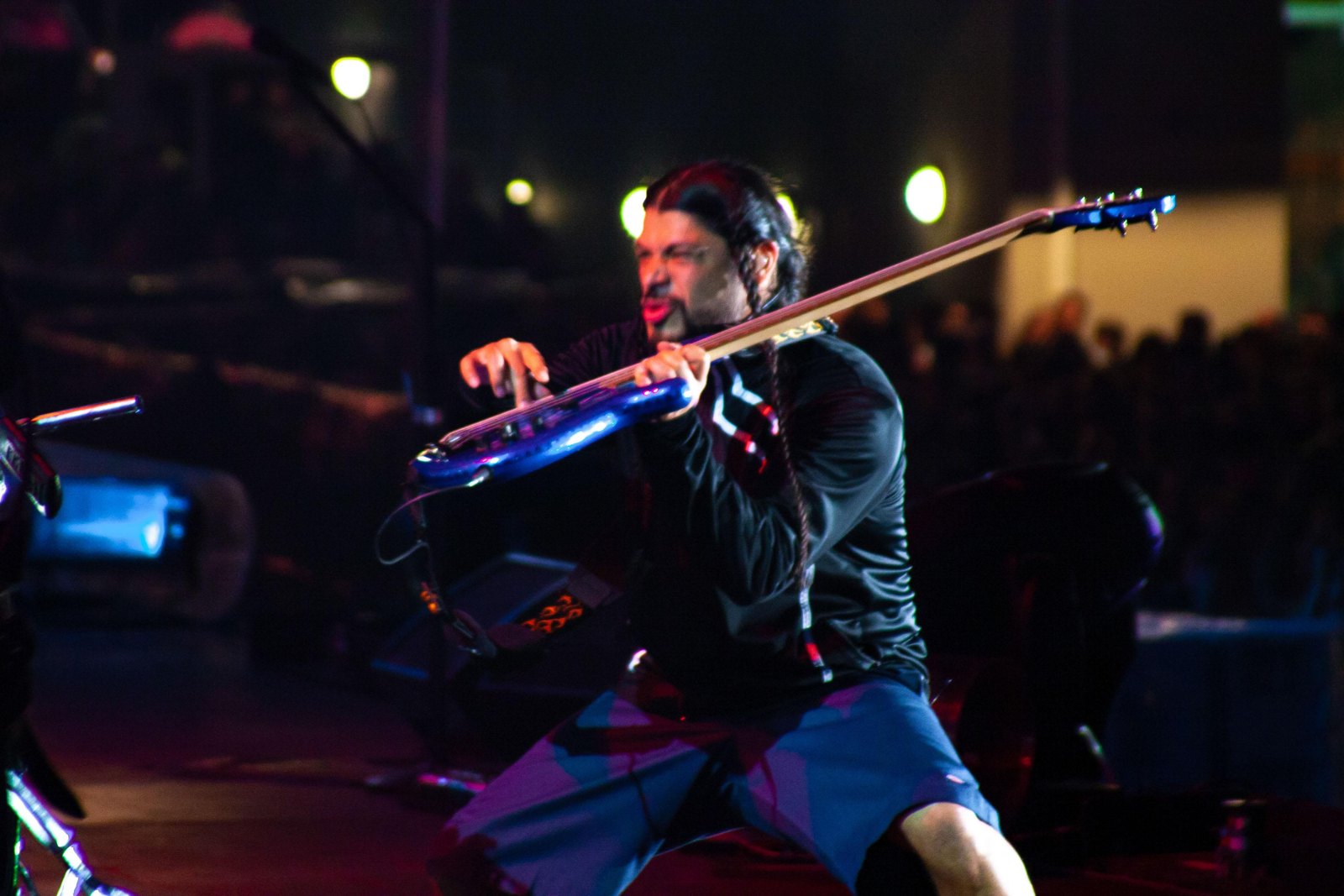
Metallica's "Orion" is the seventh track on Master of Puppets, released by Elektra in March 1986: an instrumental of nearly eight and a half minutes, with no singer anywhere in it, credited to Cliff Burton, James Hetfield and Lars Ulrich, and built from the middle outwards around a bass line that refused to stay underneath anything.
The man who wrote that middle, and who shaped most of what grew up around it, was Cliff Burton on bass. Recorded with the rest of the album between September and December 1985 at Sweet Silence Studios in Copenhagen, with Flemming Rasmussen at the desk as engineer and co-producer, then mixed by Michael Wagener in North Hollywood, the song carries his hand on the slow section from the first note to the last. It has no words. It never needed any.
Nothing about its birth was tidy. It started as one bass part, the middle of the piece, and the band poured everything else around it the way a lava flow runs round a rock that was standing in its path first, burning the grass off the hillside on either side, so that the opening and the close took the shape of a stone that was already there. The name is the constellation's.
How the Metallica Orion song is built
The song does not start so much as approach. It fades up out of silence on Burton's bass, processed until it reads as a small string section rather than one instrument, a chord swelling with no attack on the front of any note, and a listener coming to it cold would not bet a pint on which instrument is making the sound.
Then the drums arrive under a mid-tempo riff, and the riff comes off the guitars like a pack of boarhounds slipped from the leash, the pair of them running as one body, driving the boar out of its wallow and smashing through the hazel scrub after it at a relentless lope that never breaks into a sprint and never once slows to sniff the ground. On a record whose opener and title track had both gone at full tilt, that refusal to accelerate is the first signal that this song is hunting for something other than speed. It is after the middle.
Among the songs on Master of Puppets it is the only one without a vocal, and the arrangement makes up for the missing voice by passing the lead from hand to hand. Burton takes the first of his two bass solos in the second minute, the riff returns, and then the tempo halves and a bass riff at half speed drags the whole band down a gear, hammering the first section's riff flat before anyone has a chance to miss it.
| Section | What leads | What sits under it |
|---|---|---|
| Fade-in | Processed bass | Nothing; it rises out of silence |
| Main riff | The guitars | Drums at mid-tempo |
| First bass solo, second minute | Burton | Rhythm guitar and drums |
| Half-tempo riff and middle section | Burton's bass melody | Guitars harmonised above it |
| Return and close | Main riff again, guitar solos, a second bass solo near the seventh minute | Fade-out |
The slow middle, where the guitars take orders
Here is the reason the song exists. Burton's bass carries the melody and the two guitars climb in above it in stacked harmony, a lead line handed to the instrument thrash had kept in the cellar while the guitars, for once, follow it up the stairs.
"He had more or less all of the ideas himself, and he perfected them in the studio."
Flemming Rasmussen on Burton's bass parts, interviewed by Songfacts, 14 June 2018
For Rasmussen, who sat at the desk for the whole of it, the work on this track was fulfilling precisely because it kept getting better as it went, and the difficulty was never getting a performance out of Burton but choosing which one to keep. Burton worked by ear, so that one take could disappoint and the next be the one, and the job in the control room was waiting for the inspired one to arrive. That is a working method, and it shows on the tape. The middle section does not sound drilled. It sounds chosen.
A lead line handed to the instrument thrash had kept in the cellar while the guitars, for once, follow it up the stairs.
The Metallica Orion bass solo, and how much of it is bass
The Metallica Orion bass solo is three different things on this record, and the record answers each of them separately. The fade-in is bass. The slow melody in the middle is bass, with guitars harmonising above it. And the two passages most listeners mean by the Metallica Orion bass solo, one in the second minute and one late in the piece, are bass as well, and they are the two that a generation of air guitarists has mimed on the wrong instrument.
The tone takes the bass the way a drawknife takes a green ash pole, peeling the round, thick bottom off every note in long pale curls until what remains has an edge and sits up in the range where a guitar normally lives, which is why those two solos sound like lead guitar to anyone who has not watched them played. The first runs for about half a minute from 1:42, the second for under twenty seconds from 6:36, and between them the bass has already opened the song and led the slow section.
The guitars still get their turn, and Hetfield and Hammett both solo before the fade. So the honest answer to "is it a bass solo" is that it is a song in which the bass solos twice, leads the slow section, opens the piece and lends out the rest. Nothing else on the album gives a bassist more to do.
The long silence, and the dates it came back
On 27 September 1986 Cliff Burton was killed when the band's tour bus crashed in Sweden. At his funeral on 7 October, "Orion" was played over the speakers.
What followed was a long absence from the stage. Nineteen years passed before a short version made its live debut at SBC Park in San Francisco on 13 November 2005, and the full piece stayed under seal until the band cracked it open by taking the whole of Master of Puppets on the road for its twentieth anniversary: at Rock am Ring in Nürburg, Germany, on 3 June 2006, the first show of the European leg of the Escape from the Studio '06 tour, "Orion" was played live in its entirety for the first time, with Robert Trujillo playing Burton's parts twenty years after the studio take.
Since then it has come back on dates that mean something. On 10 February 2018, the day Burton would have turned fifty-six, the band sent it into Turin as the vanguard of the encore, the first bass swell tearing across the arena like a gale lifting the thatch off a hayrick. It led the assault on the first date of the M72 World Tour, at the Johan Cruijff ArenA in Amsterdam on 27 April 2023, the first time in nearly twelve years that it had opened a show. Hetfield, for his part, carries the notes of the middle bass part tattooed on his left arm.
Outside the band, four cellos carried it to Hellfest in 2017 in the hands of Apocalyptica, and the version on the soundtrack of Metallica: Through the Never stands apart from the rest of that album, taped at a soundcheck rather than in front of the 2012 crowds. For what ties the eight songs together, a record about control and the strings that work it, "Orion" is the track with nothing to say in words, and it is the one that says most plainly how this band worked in 1985: a bass part wrote the middle, and the rest of the song was arranged around it.
Then it fades, and the record hands straight over to the closer, which opens on a bass intro from Burton before the band throws itself into its attack, so that the album ends the way "Orion" began, with one bass note leaving the speakers and nobody else in the room.
