
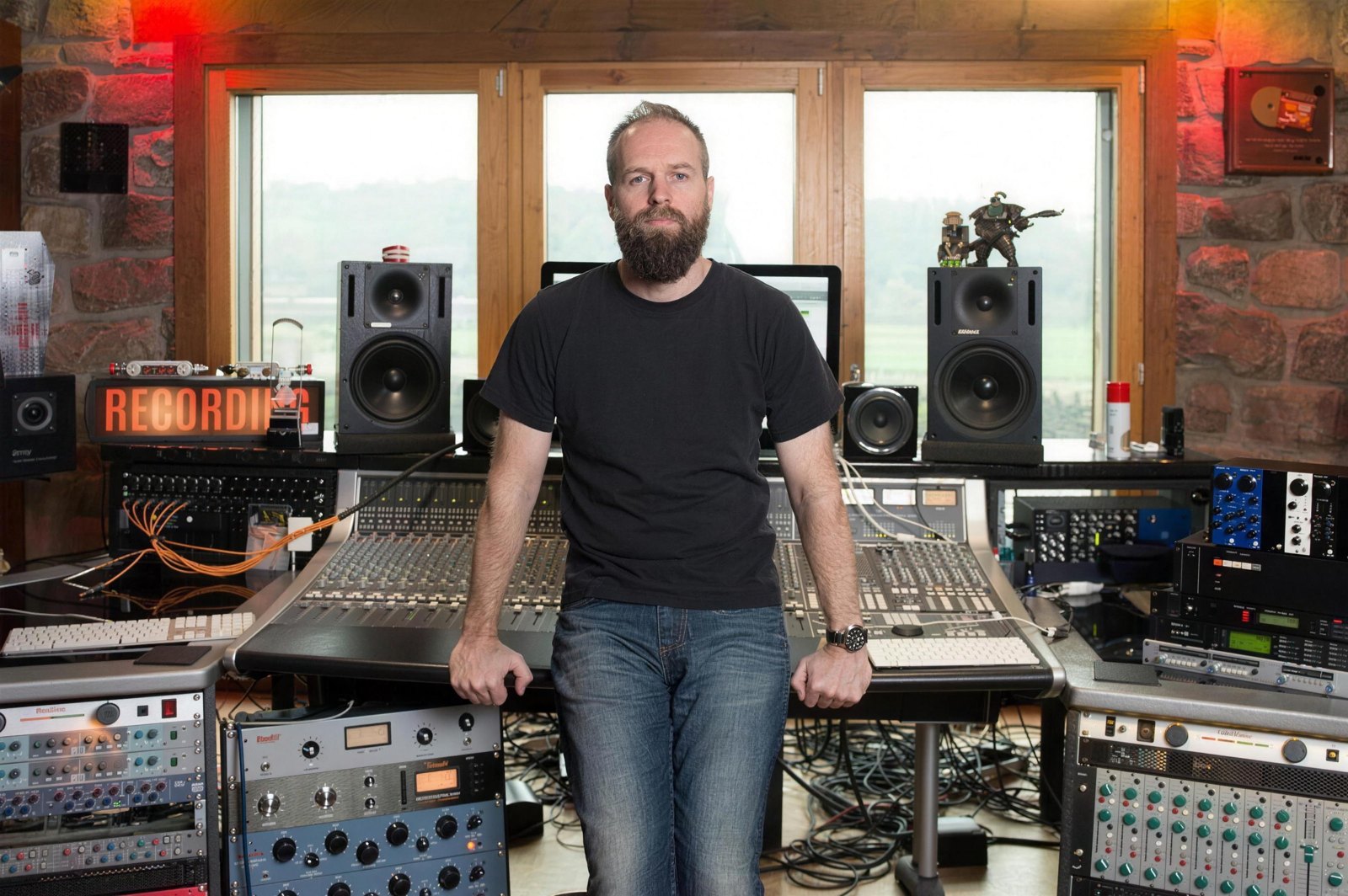
Forty-seven minutes, thirteen tracks run together as one piece, and not a single drum struck in a room while the machine was recording. Released by Nuclear Blast in May 2005, Catch Thirtythree carries drum parts programmed entirely on a computer from Toontrack's Drumkit From Hell library, and the Swedish drummer whose own kit had been recorded hit by hit for that library years earlier, so that in the end the software played his parts back to him, was Tomas Haake of Meshuggah. Nobody could tell by ear. That was the point.
Modern metal production grew out of that possibility. Once the multitrack moved onto a computer screen, the engineer's job turned from catching a band to assembling one: the drummer plays, the engineer chops the take into hundreds of single hits and drags every kick onto the grid, a plug-in rips the real snare out of the track and fires a sample in its place, and the guitars go down as bare electrical signal to be dressed in an amplifier weeks later. The performance is raw material. The record is built afterwards.
A street tarred over its granite setts has not lost them. The stone is still down there under a skin of asphalt no thicker than a thumb, every cart rut and every hollow the horses wore into it, while the new surface runs so flat that a bicycle crossing it makes one continuous hum where there used to be a rattle. Then comes a hot August, the asphalt creeps at the edges and the granite breaks back through in patches. The modern metal record is surfaced the same way. The drummer's hands are still under it, and every late kick and early snare has been filled, rolled and covered over.
Modern metal production and the grid
The editing came first. Digidesign added Beat Detective to Pro Tools in 2001, and what had been an afternoon of razor work on tape became a few clicks: the software finds the attack of every drum hit, cuts the track at each one and snaps the pieces to the tempo grid, then crossfades the joins so no gap can be heard. A drummer who rushed a fill by twenty milliseconds on Tuesday arrives on the record perfectly on time.
Sample replacement followed. Programs such as Drumagog, on the market since the early 2000s, and Slate's Trigger a decade later listen for each hit above a set threshold and fire a prerecorded drum in its place, and the better sample libraries record the same snare dozens of times at every strength and cycle through them, round robin, so that a fast roll does not repeat one identical hit over and over, the flaw engineers call the machine-gun effect. The kick drum became a click with tonnage behind it. The dynamics arrive hammered flat.
To gild refined gold, to paint the lily, / To throw a perfume on the violet ... / Is wasteful and ridiculous excess.
William Shakespeare, King John
The guitar that never met an amplifier
The guitars changed next. On a modern session the guitarist plays through a direct box that splits the signal, one feed to an amplifier for monitoring and one straight into the computer as a clean, untreated recording of the strings, so that the tone can be chosen or changed long after the player has gone home. Sending that recording back out through a real amplifier later is called reamping.
A shoemaker carving a last shapes one block of maple to a single foot, every curve of the instep and every millimetre of the heel cut once and cut for good, and the leather that goes over it afterwards is somebody else's decision, taken later: black calf for the office, oiled hide for the hill, the same foot both times and not a shoe a stranger would call the same object. The clean guitar track is that last. The playing is carved on the day; what gets pulled over it is chosen in the mix.
Then the amplifier itself became software. Line 6 put a modelling unit shaped like a kidney bean on the market in 1998, Fractal Audio's Axe-Fx arrived in 2006, and the German company whose Profiler, shown at Musikmesse and NAMM in 2011, could measure a real amplifier and hand back a copy of it that most players could not tell apart from the original in a blind test turned out to be Kemper. The four-by-twelve cabinet and its microphone shrank to an impulse response, a file a few hundred milliseconds long that reproduces how one speaker in one room answers a single click. The whole wall of amplifiers fits on a laptop now.
The playing is fixed on the day; what it gets printed through is chosen in the mix.
The old guard in the new room
The veterans of heavy metal met all this with the suspicion of men who had made their best records on two-inch tape. The English producer who had played guitar in the thrash band Sabbat in the late eighties, and who spent the next two decades as the exponent of the tight, loud and precise modern metal record with Testament, Megadeth and Exodus, is Andy Sneap.

The Solingen veterans who hired him for their first album with the American singer Mark Tornillo, Blood of the Nations, released by Nuclear Blast on 20 August 2010, were Accept, and Sneap put Wolf Hoffmann's riffs through every tool in the chain. The guitars are welded to the grid, the kick drum is even from the first bar to the last, and the record sounds like the band rebuilt to a drawing rather than remembered.
"Teutonic Terror", the single, is the method in four minutes: a riff that could have come off Balls to the Wall, played to a tempo that never drifts by a beat per minute, with drums so even that a metronome would sound careless beside them. It worked. The album debuted at number four in Germany, the band's best showing there since Russian Roulette in 1986.

The subtlest version came in 2018. The Birmingham band that put Sneap at the desk beside Tom Allom, the last producer to have made a Judas Priest record on his own, 1988's Ram It Down, so that the modern engineer handled the precision while the old one listened for the band, was Judas Priest, and Firepower came out on Epic that March. It entered the Billboard 200 at number five, the band's highest American chart position.
"Lightning Strike" shows the compromise. The drums are tight and even, the guitars dense and bright in the modern way, but Rob Halford's voice keeps its rasp and its strain, and nobody has tuned the lead breaks into glass. Allom kept the grain. Sneap kept the grid.
Iron Maiden went the other way entirely. The producer who took over the band's records with Brave New World in 2000, and who has recorded it ever since with the six musicians playing together in one room rather than stacking parts on a grid, is Kevin Shirley. Brave New World was made that way at the Guillaume Tell studio in Suresnes, outside Paris, with Steve Harris beside Shirley as co-producer, and the band went back to the same building for the records that followed. The tempos breathe. The long songs speed up and settle the way a band does on stage, and nobody drags them back onto a grid afterwards.
What the screen cost
The price of modern metal production is sameness. When a few sample libraries and a few modelled amplifiers sit on thousands of hard drives, the same snare and the same guitar tone turn up on records from different countries, and a decade of releases can sound as if one engineer had made all of them in one sterile room. Critics have a word for the result. Players have a harsher one.
A counter-current runs alongside it. Bands with the budget and the nerve now book a big room, set the whole group up facing one another and keep the takes where the drummer pushed the chorus, because a listener who has never heard of a tempo grid still hears the difference between a band and a spreadsheet.
None of it is new in principle. Mutt Lange was splicing bars of tape together in 1983, and the rooms, the tape and the men who ran them are the ground covered in heavy metal production; the computer only made the splice cheaper and invisible. What changed is that the decision to fix a performance is now free, and anything that costs nothing gets done to every track.
Almost every tool in the modern chain serves the guitar in the end, the reamp, the profile, the impulse response, the edit that lines the rhythm parts up to the millisecond, and the sound they are all chasing is the heavy metal guitar tone. A record can be perfect on the grid and still have none. The ear finds out in the first bar.

