
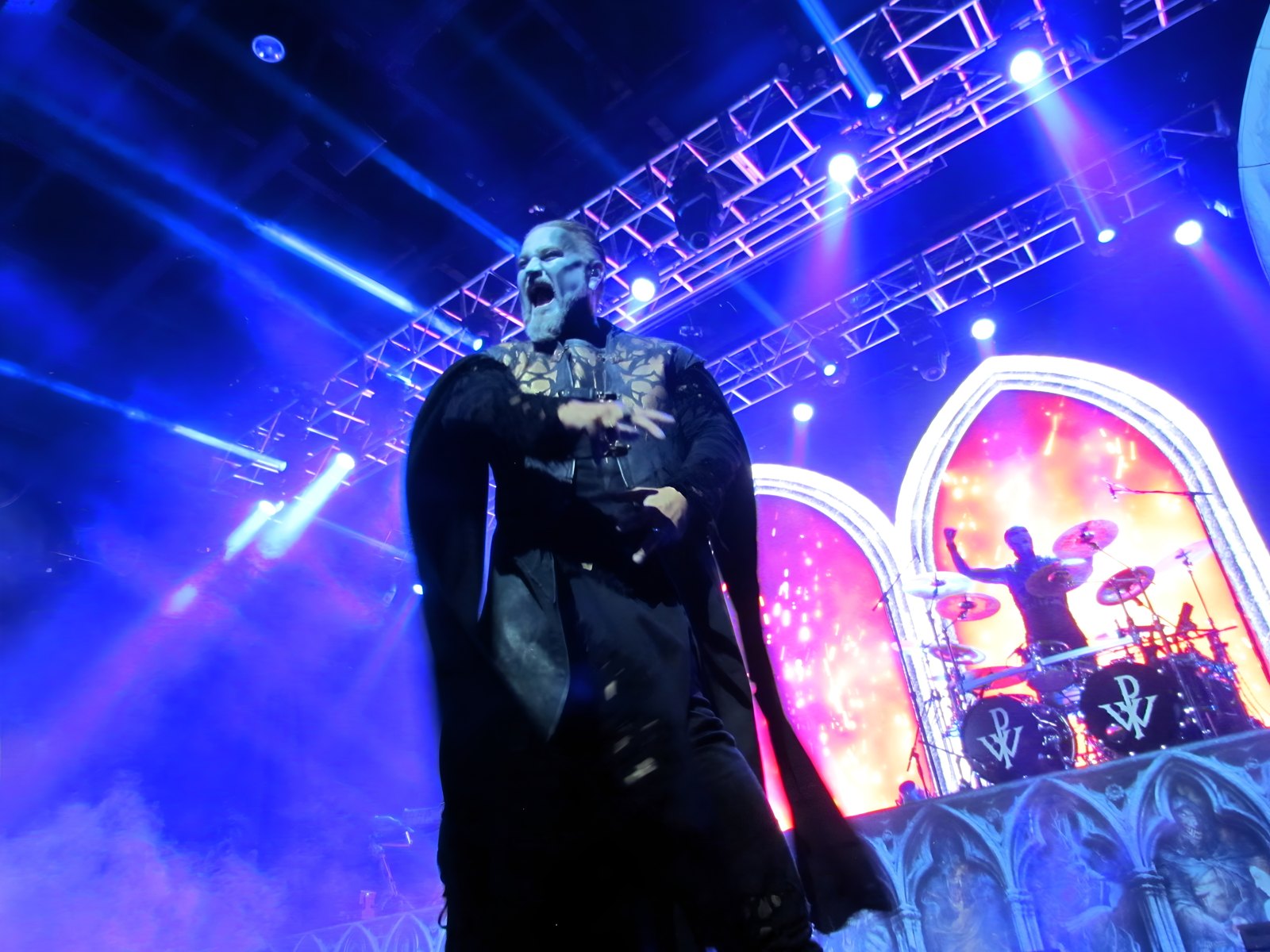
On 2 August 2013 the German album chart had Preachers of the Night at number one, a record of organ chords, Latin song titles and sing-along choruses, and nobody who bought it in its first week needed a sticker on the sleeve to say what kind of music was inside.
The German five-piece whose keyboard player works a church organ sound like a second rhythm guitar is Powerwolf, and the answer to what genre is Powerwolf is power metal, of the heavy, anthem-built strand that sits nearer to Accept and Grave Digger than to the sprinting tenors of early Helloween, filed that way on Metal Archives and, by common consent, by the press that has reviewed the band's studio albums.
The objections all come from the vestments. The organ suggests gothic metal, the choirs suggest symphonic metal, and the singer's operatic delivery suggests a theatre rather than a rehearsal room. None of it touches the part of a song that decides its genre.
Late in 1990 the dance single that lifted a choir's recorded plainchant into a sampler and nailed it over a slow drum loop taken from Soul II Soul, the Latin cut to the bar the loop demanded, was Sadeness (Part I) by the studio project Enigma, and it climbed to number one across much of Europe and took the dance charts as well as the pop ones, because the loop under the chant decided where the record lived and the chant decided only what it looked like.
Powerwolf runs on the same principle with heavier machinery. The organ, the Latin and the choirs are the chant. The drums, the riff and the shape of the chorus are the loop, and the loop is what classifies the band.
Every branch of the family carries something on the outside that tempts a listener to sort it by the surface, and the section that covers it maps those branches by what each one adds to the song shape Hamburg settled in 1987. Powerwolf adds a palette of sounds. The frame of the song stays exactly where Hamburg left it.
What genre is Powerwolf, measured in tempo
Released by Metal Blade in 2011 as the calling card of Blood of the Saints, We Drink Your Blood moves at a marching pace, slower than the single that opened the record, which is how the anthem school spends its weight and the opposite of what the speed school does with it.
The catalogue shows the sprints too. Fire & Forgive, from The Sacrament of Sin in 2018, is a fast track by the verdict of its reviewers, and power metal has never asked its bands to keep one speed.
Mid-tempo was never burned out of this genre. The heavy lineage of power metal, the one that runs through Grave Digger's anthems and the marches of Sabaton, built its whole case on weight rather than velocity, and a song that hits harder at 130 beats a minute than at 190 is still built from the same parts. By weight rather than velocity, Powerwolf belongs to that lineage.
The organ does a rhythm guitarist's job

Played by Falk Maria Schlegel and already in the arrangements on Return in Bloodred, the Metal Blade debut of 2005, which holds a song for organ and voice alone, the keyboard part of a Powerwolf song is a church organ sound, and its job is plain once you stop staring at the pipes: by its player's own account it layers with the guitar, makes the atmosphere and holds up the melodies that the singer carries.
The band has run the obvious experiment in public. The Symphony of Sin, a bonus disc of the earbook edition of The Sacrament of Sin in 2018, put existing songs into a full orchestral setting, and all twelve came through under their own titles and in the album's own running order. That is what happens to a power metal song with an orchestra bolted on. It never happens to a symphonic metal piece, whose score is the song.
First heard on that 2005 debut and rewritten and recorded again in 2019 as a single of its own, Kiss of the Cobra King is one song dressed for two eras, and it shows the division of labour at its plainest: the organ is the dressing, the song is the song. Take the organ out and the song loses its colour. It keeps its drums, its riff and its chorus.
Take the organ out and the song loses its colour. It keeps its drums, its riff and its chorus.
A choir that sings underneath the tune
In a Russian Orthodox choir the lowest men, the oktavists, hold a line an octave beneath the basses, a note pitched so low that nobody in the building hears it as a tune; what the congregation hears is the whole choir going hollow the moment the oktavists stop.
Powerwolf's choirs stand in the same place in the arrangement, behind the lead rather than in front of it, adding mass to the bar rather than height to the melody. That is the reverse of Blind Guardian, where overdubbed vocals stack around Hansi Kürsch's lead and carry the melody itself up and out over the band.
Neither arrangement leaves the genre. Choral backing is standard power metal equipment, and what settles the matter is that the melody still sits on a clean lead voice. The choir pushes from below. The singer carries.
A trained voice in the middle of the range
The baritone whom the writers who have covered the band call operatic, and who carries every chorus the band sings from the middle of the range, a long way below the register that made the genre's signature, is Attila Dorn.
That is a different instrument from the high tenor of the Hamburg records, and it scorches a new colour into every chorus. It does not change the job. The genre's catechism asks its singer for a clean, pitched, sustained line that a melody can be hung on, and Dorn supplies exactly that, more theatrically than most and lower than Michael Kiske.
Fire & Forgive carries the whole formula in one compact single: an organ figure up front that drops away for the verse and comes back before the song is out, a lead vocal in the middle of the range, and a chorus to follow. Organ, verse, chorus, organ again. It is the form Hamburg standardised, sung by a baritone dressed for Mass.
The liturgy in the lyrics is theatre, and what it says about faith belongs to the lyric sheet rather than to the genre.
Gothic, symphonic or heavy: the labels, tested
Gothic metal is the label the imagery invites, and the music refuses it. The style that Paradise Lost, Type O Negative and Theatre of Tragedy built in the nineties drags the tempo down toward doom, sets melancholy in the harmony and, in its Norwegian strand, splits the voice between a soprano and a growl. Powerwolf has the candles and none of the sound.
The Swedish band that dresses its records and its stage the same way, organ, clerical robes and a liturgical show included, is Ghost, and nobody files Ghost under power metal, because underneath the robes the band unarguably plays hard rock and pop hooks. Same robes. Different music.
| Label | What the label needs from the music | What the records do |
|---|---|---|
| Gothic metal | Doom-paced tempos, melancholy harmony, often a soprano set against a growl | One clean male lead, no soprano set against a growl, no growl at all |
| Symphonic metal | An orchestral score that writes the song, with the band placed inside it | A band arrangement with organ and choir added; the orchestral versions issued separately as bonus discs |
| Heavy metal | Riffs and a clean lead, double kick optional | The parent genre, true and too wide to describe the records |
| Power metal | A clean sustained lead, a driving kick, a climbing chorus built to be sung back | A clean lead and sing-along choruses; filed as power metal by Metal Archives and Wikipedia |
The clearest sign comes from other people's hands. On Communio Lupatum, issued with The Sacrament of Sin in 2018, ten Powerwolf songs were given to other bands, among them Epica, Heaven Shall Burn, Kadavar and Eluveitie, who work in symphonic metal, metalcore, stoner rock and folk metal respectively, and the band picked its guests from every one of those camps. A tune does not carry a genre. A rhythm section does.
The same test settles the neighbouring argument about the Finnish band whose keyboard player wrote its songs for a classically trained voice, and the answer to is Nightwish power metal turns on the year as much as on the band, because its early records pass the same test at the kit and its later ones hand the drive to the orchestral score.
Powerwolf passes on every count that comes from the music. The weight is that of the heavy German strand, the lead voice is clean and sustained, and the chorus is built to be returned by a crowd. The organ, the choirs and the Latin are colour laid over that, distinctive enough to make the band recognisable in an instant and irrelevant to the question of what it plays. Reach for gothic or symphonic and the records contradict you. Say power metal and they agree.
