
In August 2007, across two pages of Trucking, a British magazine for the lorry trade, Shaun Connors reviewed a German concept album about a demon loose on a wrecked earth in the year 3051, admitted he had nearly thrown the disc in the bin on the strength of the press release, and then gave it a Desert Island Disc rating and filed it as more flower metal than power metal.
The German band that had set out in 1998 with the declared aim of making happy metal was Freedom Call, and the record was Dimensions, released by SPV on 20 April 2007. Anyone asking what is flower metal can start there, in a lorry magazine, because that one review holds the whole problem: a term that arrived as a sneer and was used by a man who loved the record.
Scored in 1910 with a line at the very top of the page marked luce, light, Alexander Scriabin's Prometheus: The Poem of Fire calls for a keyboard that sounds nothing at all, only colour, each key of the harmony throwing its own tint, in the staging most accounts describe, onto a screen hung before the audience, the yellow Scriabin heard in D flooding the screen. Hold one chord there for a single flute and the screen turns yellow. Hold the same chord for ninety players at full cry, the brass splitting the air of the hall and the timpani beaten through their heads, and the screen turns exactly the same yellow. The light reports the key. It has no way to report the force.
Flower metal is that screen. It reads one quantity, and it reads it well.
What is flower metal, and where did the name come from?
Nobody has claimed the coinage. No first use has been dated, and the origin stays unsettled. What the record does show is the shape of the joke. Power names a force; put a flower in its place and the joke lands squarely on the sweetest records in the genre, the ones with rainbows in their titles, keyboards on top of the mix and a tenor somewhere above the stave.
We wanted just to piss people off and send everybody home. And that can't be, like, flower metal.
Jeff Becerra of Possessed, in Albert Mudrian, Choosing Death (Feral House, 2004)
The phrase also had a life far from power metal. The singer and bassist who says he named death metal is Jeff Becerra of Possessed, and when he told the story he set his new name against its opposite, the thing a band trying to be the heaviest act on earth could never be. In that mouth the words point at no band in particular. They mark the far end of the scale from violence, wherever the speaker happens to stand.
Released in May 1999 and opening with a song called "Over the Rainbow", Freedom Call's debut Stairway to Fairyland came out of Germany into the thick of the movement the tag was later pinned on, a movement centred not there but on Stratovarius in Finland and Rhapsody of Fire, then still called Rhapsody, in Italy, both hauling keyboards and choirs further forward in the mix than the Hamburg records of the eighties had ever dared.
By January 2011 a Metal Archives forum thread was arguing over who belonged under the tag, one poster naming Stratovarius in its prime the best the tag had to offer, another refusing the label for Kamelot. The argument has never closed. The tag sits at the bright end of the family tree, and that whole tree has its place in the story of how one Hamburg template split into a dozen branches.
| Band | Record or period | Where | What was said |
|---|---|---|---|
| Stratovarius and Rhapsody | The trailblazing years of the style | Coagulopath, May 2021 | Named as the bands the style centred on |
| Freedom Call | Dimensions (2007) | Trucking, August 2007 | More flower metal than power metal, meant as praise |
| Stratovarius | The band in its prime | Metal Archives forum, January 2011 | Named the best of the tag in its prime |
| Kamelot | The band as a whole | Metal Archives forum, January 2011 | Called flower metal by some, disputed by the poster |
| Sonata Arctica | Ecliptica (1999) | Coagulopath, May 2021 | Its fast double kick already a flower metal cliché |
The bands it lands on

Founded by Chris Bay and Dan Zimmermann during a pause in the touring schedule of Gamma Ray, where Zimmermann sat behind the kit, and sent out on Steamhammer with Crystal Empire on 22 January 2001, the band whose cheerfulness was its own manifesto before critics turned it into a sneer is the purest case the tag has, because Freedom Call never needed the insult explained. Track and album titles do the work. "Over the Rainbow", "Fairyland", "Shine On" and "Hymn to the Brave" on the debut; a crystal empire on the follow-up.
Around that centre the tag drifts outward in rings. The tag sticks to two Finnish bands of the late nineties for their keyboard leads and a tenor that climbs until the tone thins to a thread: Stratovarius first, then Sonata Arctica, whose Ecliptica came out on Spinefarm in 1999. Rhapsody of Fire catches it for the fairy tale cycle printed across its sleeves, though the sheer tonnage of the Italian orchestrations shoves it toward the symphonic shelf instead. Kamelot, whose Epica and The Black Halo are built on Goethe's Faust, catches it only from listeners standing a long way off.

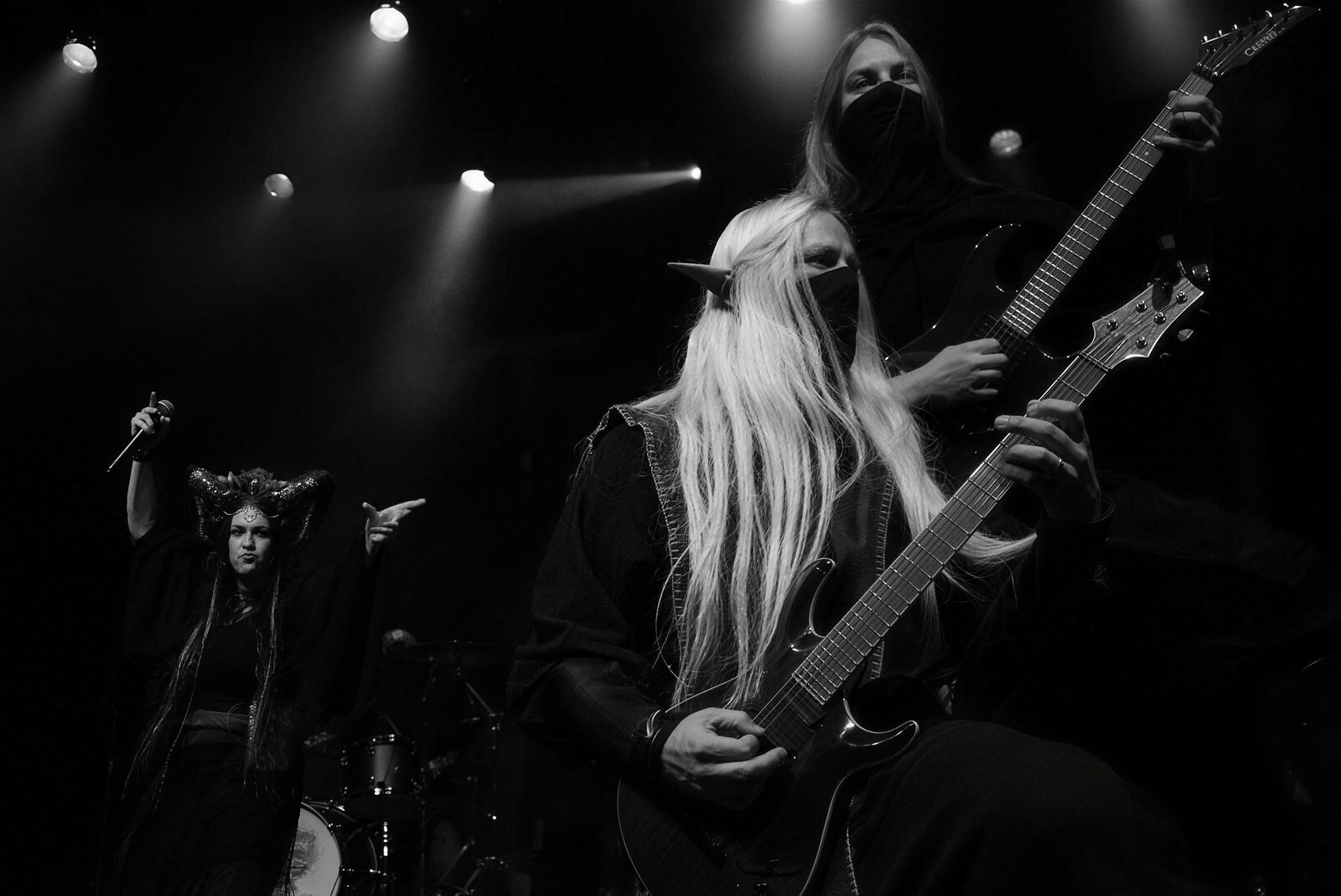
The Swedish band that took the fairy tale wing furthest after 2010 is Twilight Force, whose debut Tales of Ancient Prophecies came out on Black Lodge in June 2014 with a red dragon spitting fire across the sleeve, its members playing under character names in costume on stage. Nobody had to pin the tag on that band. It walked in already wearing it.
What the label actually measures
Strip the sneer off the term and what is left is a working gauge, and an accurate one. It takes four readings, all of them from the top of the arrangement. The first is mode: a flower record leans on major-key choruses and lets them sit there in the open. The second is register, the tenor and the lead keyboard both parked high, so the melody sits well above the riff instead of on top of it. The third is timbre, the clean keyboard patches of strings, bells and harpsichord placed level with the guitars or over them. The fourth is vocabulary, the rainbows, kingdoms, crystals and holy knights of the lyric sheet.
A record can be fast, loud and hammered by a double kick from the first bar to the last and still read as a flower.
Picture the lead sheet clipped to a dance band's stand, one stave to a song and nothing else on the page: the tune, the words underneath it and a row of chord names above it, major or minor spelled out in letters, while the bass player and the drummer get no line at all and play the number by ear, the drummer driving his sticks into the snare until the head splits along the rim, and not one stroke of it ever reaching the paper. Three of the four readings are printed on that sheet: the chord names give mode, the tune gives register and the words give vocabulary. The rhythm section is not. That sheet is the evidence the flower label works from, which is why a band can bury a hall under kick drum and still be filed by its tune.
Play "Enchanted Dragon of Wisdom" from the Twilight Force debut and the four readings arrive at once. The keyboards carry the hook, the singer sits high and clean, the subject is announced in the title. What the gauge does not record is what the drummer is doing under all of it, which is the measurement nobody making the joke ever bothers to take.
What the tag cannot hear
Speed proves nothing either way. The fast double kick that one critic called a flower metal cliché on Ecliptica turns up just as readily under Iced Earth, whose thrash-bred rhythm guitars grind where flower records shimmer, and the tag is seldom pinned on that band. Fast on both sides, opposite verdict. Weight that never reaches the lead sheet is invisible to the gauge.
So is distance, or rather the gauge has no fixed zero. To a death metal listener raised on Possessed, almost everything with a clean chorus can read as flower, Blind Guardian and Helloween included. To a power metal listener the needle barely moves until the dragons crowd onto the sleeve. The same record measured from two chairs gives two readings, and both are honest. That is why the Kamelot argument on the forum could not settle: the poster who refused the label for Kamelot and the people he was answering were standing in different rooms.
The far edge of the scale proves the point from the other side. Bolt growls and blast beats underneath a bright, sung chorus and the result goes by a name the term has stretched to cover, extreme power metal, and the flower tag rarely survives the first blast, however sweet the melody riding over it. Nothing in the chorus changed. What changed sits underneath it, in the drum stool and the throat, and that is precisely what the label was never built to weigh.
Wearing the label
Released as a promotional video on 2 November 2016, nine days before its parent album Master of Light reached the shops on Steamhammer, Freedom Call's "Metal Is for Everyone" turns the covenant the band signed in 1998 into a slogan, a chorus built to be roared back by a field that knows exactly what the critics call this music and has decided not to care. That is the honest answer to the insult, and the best one the genre has found.
The music can take the joke, since everything the joke reads sits in the music: the keys, the keyboards, the kingdoms. The people who play it were never the proper target.
Taken as a description, the term earns its keep. It tells a listener, more precisely than melodic power metal does, that a record resolves its choruses upward, puts its keyboards on top, keeps its singer high and writes about kingdoms rather than wars, and the bands that wear it openly, every disciple of the fairy tale wing, would recognise that account of its own work. Taken as a verdict, it says little reliable about how hard a band plays, how fast or how well, which is the part of the music the joke was never equipped to judge. Any epigone that copied the formula without the songs earned its mockery on its songwriting, not on its harmony. The rest earned their audiences the same way.
