
When did deathcore start? In 2005. Not in December 1996, when a British monthly printed the word for bands that built their sets on the mosh part and left the blast beat to the death metal shelf; not in 1998, when a Texas record put death metal riffing and a hardcore breakdown on the same disc and then watched its own makers drift off toward something lighter; and not in 2007, when the Billboard 200 caught up with what a few thousand profile pages already knew; but in the year a shape hammered out in Montreal and Oakland since 2002 was finished, signed, reissued and copied by strangers.
Signed worldwide to Century Media in January 2005 and in North American shops on 5 April with The Healing Process, a record that rips out of blast beats into breakdowns a hardcore floor could use and passes the microphone back and forth between a growl and a squeal, the Montreal sextet whose second full length bolted the template together was Despised Icon. The drafts were over.
Picture a stone chip in the windshield of a band's van, kicked up by a gravel truck on the interstate in 2002, a star no wider than a thumbnail that crept a little further across the glass every time the van hauled a breakdown home, the low open string still humming through the frame and walking the fracture along, until by 2005 it ran from one pillar to the other straight through the driver's line of sight, and in 2007 the whole sheet caved in onto the dashboard at seventy miles an hour.
The insurance form wants one date. Any mechanic would write down the middle one: the glass was broken on the day nobody could see the road through it, not on the day the stone hit and not on the day it fell in.
When did deathcore start? Four dates, four rulers
Every date that gets offered is measuring something different, and most of the arguing comes from people holding different rulers against the same music. The word in print measures what writers thought they heard. The first records measure what a few bands did by instinct. The template measures the moment a sound could be learned and repeated by a kid who had never met the people who made it. The breakout measures the day the audience turned up with its wallet open. All four are attested. Only one of them dates the music.
| Date | What happened | What it measures | Where it falls short |
|---|---|---|---|
| December 1996 | Terrorizer prints "deathcore" for Earth Crisis and Merauder | The word | It named metallic hardcore, not the later sound |
| 1998 to 1999 | Embodyment, Embrace the Eternal; Eighteen Visions, Yesterday Is Time Killed; Prayer for Cleansing, Rain in Endless Fall | The first fusion on record | None of the three bands kept making it |
| 2002 to 2005 | Despised Icon and All Shall Perish form; The Healing Process; Job for a Cowboy, Doom | The template | A window, not a single day |
| 2006 to 2007 | Job for a Cowboy signs to Metal Blade; Genesis, The Ills of Modern Man, The Cleansing; the first Summer Slaughter | The breakout | It dates the audience arriving, not the music beginning |
Read the last column from top to bottom and three of the four dates fall at the same fence. Each one measures something standing next to the genre: a word aimed at other bands, a fusion nobody carried forward, a crowd arriving at a party that had been running for years. The template is the only ruler laid against the thing itself.
The word and the first records, 1996 to 1999
The oldest date on the list is the weakest one. In the December 1996 issue of Terrorizer, Nick Terry offered deathcore as a name for the metallic hardcore of Earth Crisis and Merauder, two bands whose records were built round the two-step and the chug. The word existed. What it would end up describing did not.
Ask why is it called deathcore and the trail runs further back than that issue and further forward than anyone in 1996 could have guessed, which is a story with its own dates in it. For the calendar, 1996 proves only that the label was printed before the music arrived to wear it, and a name with nothing underneath it starts nothing.
The second date has real music under it. Put out in 1998 on Solid State, an imprint of Tooth and Nail, Embrace the Eternal by Embodyment carried death metal riffing and a growl into songs that still stopped dead for the hardcore breakdown; Eighteen Visions followed in March 1999 with Yesterday Is Time Killed, and Prayer for Cleansing in June with Rain in Endless Fall. Three states and under eighteen months, and three crews who had never compared notes all doing the same rough surgery, sawing the slow part off a death metal song and bolting it under a hardcore set to see whether the floor would hold.
It held. Nothing followed. A start date has to be the first link of a chain, and the chain snaps right there: Embodyment changed singers and lightened up on the very next album, Prayer for Cleansing broke up in 2000, and Eighteen Visions were singing choruses by 2002. The bills those bands played and the rooms around them fill chapter one of the history. On the calendar the fact that matters is what came after, which is no successors at all. The 1998 records started no bloodline anyone can trace.
The bands that would chart in 2007 were mostly founded between 2002 and 2006, several of them by teenagers, Job for a Cowboy's founders fifteen and sixteen in 2003, who were children of about ten when Embrace the Eternal came out. The one thread that does run unbroken out of the nineties belongs to the Bay Area, where Antagony formed at the end of the decade and shared a guitarist with a new Oakland band. Who deserves the credit for that thread is a separate argument. For the calendar it means the nineties are not empty, only thin.
2002 to 2005: the template gets cut
Formed in Montreal in January 2002 and releasing Consumed by Your Poison that October; formed in Oakland the same year out of three Bay Area bands and pressed in 2003 by Amputated Vein, a Japanese label, with Hate . Malice . Revenge; the two bands that turned an accident into a method were Despised Icon and All Shall Perish, and between them they settled the order of the parts.
Order is the whole point. Blast and tremolo first, a growl answered by a squeal, then the bottom dropping out into half time on the lowest string, a breakdown written to open the floor rather than to give the drummer a rest. Once that sequence existed it could be copied the way a hardware store copies a house key, the blank clamped in the jaw and the cutting wheel screaming as it chews the notches out and spits hot brass shavings across the counter, every notch a hit of the breakdown, and a kid three states away walking out with a key that opens the same door without ever having seen the lock. That is what a template is. It survives the people who cut it.
The formation dates crowd into the same window, and that is the strongest evidence any calendar can offer. Suicide Silence started in Riverside, California, in 2002; Job for a Cowboy in Glendale, Arizona, in December 2003, four months after MySpace went live; Carnifex in San Diego in 2005; and Whitechapel in Knoxville, Tennessee, in 2006. Count the two Montreal and Oakland bands in and six of the names every account of the next decade begins with were founded inside five years, every one of them after the last of the 1999 records was in the shops.
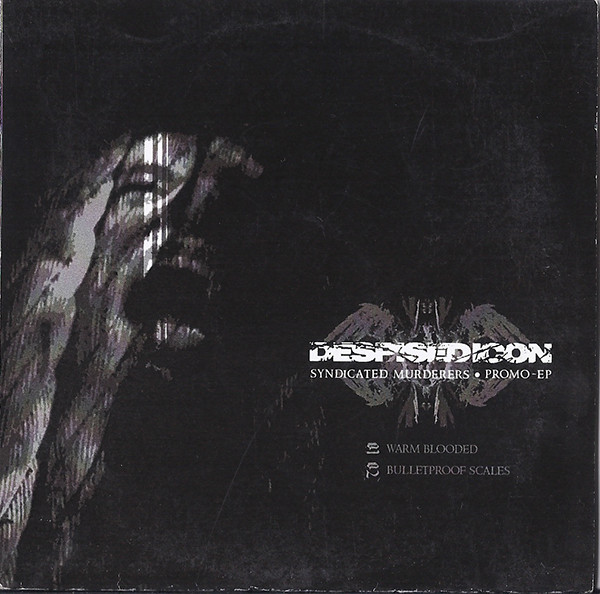
The Montreal band spent 2004 tightening the bolts. Alex Erian had left the drum stool to take the second microphone beside Steve Marois, the self-financed Syndicated Murderers EP put the new line-up on tape, and by January 2005 Century Media had signed the band for the whole world, which handed a sound written for hardcore matinees to a label whose distribution reached every metal shop in Europe and North America. The siegeworks were a worldwide Century Media contract and a finished record. Everything after, from the Oakland reissue to the Arizona EP, was ordnance wheeled into place.
Then came the year itself. The Healing Process landed that spring with Alex Pelletier's blasts smashing straight through the verses into the drop, Nuclear Blast put the Oakland debut back on the shelves that same year, and in December a band of teenagers from the Phoenix suburbs put out an EP called Doom on a small Arizona label. A sound that could be signed by a death metal label, put back into print by another and copied by a band in the desert inside one year was no longer an accident. It was a genre.
2006 and 2007: the breakout, and what it actually dates
The fourth date is the loudest one. Signed by Metal Blade in 2006 on the strength of an EP and a profile page, and on the Billboard 200 at number 54 with Genesis, out on 15 May 2007, the Arizona quintet whose first record had done its touring on other people's screens was Job for a Cowboy. After that the year went off like a string of firecrackers flung down the stairwell of a parking garage, every bang doubled by the concrete: Despised Icon's The Ills of Modern Man on 22 May, an MTV News headline on 8 June in which the Montreal band said it wanted nothing to do with the word, the first Summer Slaughter tour that same month, Whitechapel's The Somatic Defilement on 31 July and Suicide Silence's The Cleansing on 18 September.
Released by Siege of Amida, a small British label, on 31 July 2007, The Somatic Defilement came from a Tennessee band that had only existed since 2006, and the speed matters more than any review. A band does not reach a finished debut a year after its first rehearsal by inventing a genre. It gets there by working from a drawing somebody else already made, and the drawing was dated 2005. "Vicer Exciser", the song from that debut Metal Blade put up with an official video in 2013, when it reissued the record remixed, came from players who had nothing left to invent between the spring of 2005 and the summer of 2007. They only had to be heard.
"Unanswered", the second track on The Cleansing and one of three songs from it with an official video on Century Media's channel, is where the breakout is easiest to hear. When the squeal lets go and the drop arrives it comes down like a forklift dropping a ton of stage sandbags off its forks onto the concrete behind a club, the whole load landing in one dead thud that knocks the dust off the walls, and the record carrying it entered the Billboard 200 at number 94 on 7,250 copies in its first week.
That chart position is the date most people reach for, and it is the wrong one for the question. A breakout needs something to break out. What reached the charts in 2007 was the 2005 template at scale: more money, wider distribution, a bigger crowd, the same order of parts. The year 2007 is when deathcore became public property. It is not when it began.
A genre starts on the day a stranger can copy it on purpose.
Why 2005 is the answer
Put the four dates side by side and ask each one the question a start date has to answer: does an unbroken line run from this point to the bands filling halls today? The word of 1996 fails because it pointed at other music. The records of 1998 and 1999 fail because the line snaps inside three years and the one thread that survives belongs to another band and is thin. The breakout of 2007 fails from the other end, because by then the line was already five years long. Only the stretch from 2002 to 2005 holds at both ends.
Inside that stretch 2005 is the year the shape was finished and fixed by people outside the bands that made it: Century Media signing it in January and shoving it onto death metal shelves on two continents that spring, Nuclear Blast hauling the Oakland debut back into print, and a band of Arizona teenagers putting it onto an EP in December. A genre starts on the day a stranger can copy it on purpose, and 2005 is the first year anyone could.
The earlier dates still count for something. Without Earth Crisis there is no word, and without the Texas, Orange County and Raleigh records there is no proof that the two halves fit. They are where deathcore came from. The narrower question is when it existed, and the narrow answer is 2005.
