
Cut at Sunset Sound in Hollywood from late August to early October 1977, with most of the songs played live by four men facing one another and little laid over them afterward, the debut that Warner Bros. released in February 1978 put its single guitar slightly to one side of the stereo picture and hurled the echo of that guitar, pulled from the studio's live chamber, across to the opposite speaker cone.
The engineer who made that call, on the plain reasoning that a guitar placed dead centre with everything else leaves the whole band in mono, was Donn Landee. The quartet whose one guitarist needed the width of two was Van Halen, and "Runnin' with the Devil", the opening track, is the whole arrangement in three and a half minutes: the guitar leaning to one side, its room answering from the other, the band in between. Nobody doubled anything. Nobody had to.
Analog heavy metal recording worked that way from the first reel to the last, the decision made at the moment of printing and no road back from it. A barber of the old school stropped his cut-throat razor on a leather belt, laid the blade against a stranger's neck and drew it down in one stroke, knowing that the only thing standing between a clean shave and an opened artery was the steadiness of his own wrist. Two-inch tape put that razor in an engineer's hand every working day. The master was the throat. There was no second one.
The rooms, the machines and the producers of the period as a whole belong to the chapter above. The tape asked for something narrower and harder. It asked for nerve.
Analog heavy metal recording and the price of a track
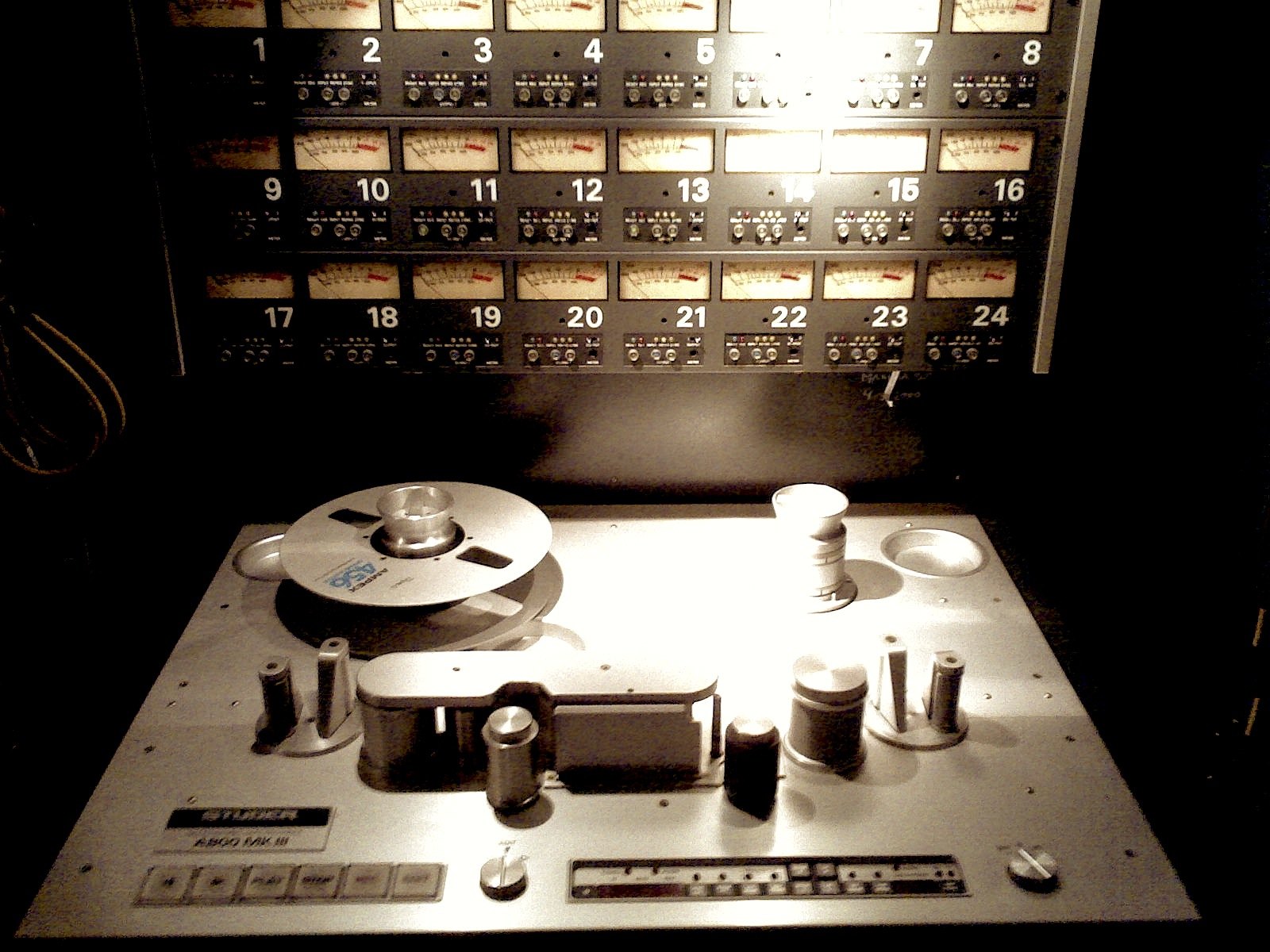
A professional machine of the late seventies and the eighties gave an engineer twenty-four tracks on a reel of two-inch tape that ran out after roughly sixteen minutes at thirty inches per second, and every one of those tracks had to be fought for. A drum kit alone could swallow eight of them. Two rhythm guitars, a bass, a lead vocal and a stack of harmonies ate most of the rest before a single solo arrived.
When the tracks ran out, the engineer bounced: he mixed several of them down onto one spare track and then wiped the originals to record something else in their place. A Hollander beater in an old paper mill did the same to a cartload of linen rags, the blades of its roller chopping shirts, sheets and sailcloth into a grey slurry that was lifted out on a wire mould as one sheet, and nobody has ever pulled a shirt back out of a sheet of paper. A bounce was that sheet. The balance between four backing vocals, settled at two in the morning, was the balance on the record for good.
The Danish producer who found a way through that ceiling for Master of Puppets, locking two twenty-four track machines together with a synchroniser so that the band had forty-six tracks to work with at Sweet Silence Studios in Copenhagen from September to December 1985, was Flemming Rasmussen. The two missing tracks carried the timecode that kept the reels in step, one given up by each machine. He has described the rest of the method bluntly to MusicRadar in 2022: there was not a computer in sight, so there was no editing, and everything on the record was played.
Slowing the reels down
Played means played, and the downpicked riffs of that record had to lock across four musicians like the teeth of a single gear. The band that wanted them tighter than any four pairs of hands could manage in a room was Metallica. Rasmussen's answer was a dial rather than a computer: as he later told Mix, he had them tune down slightly and play along to a slowed tape, then ran the machine back up to speed, so that every part came home in tune, a shade faster than it had been played and cleaner at the edges.
Varispeed, the control that altered a tape machine's running speed, was a pitch control, a tempo control and a quality control in one knob. It is the oldest trick on the reel. On Master of Puppets, released by Elektra in March 1986, it did the work that a grid would do twenty years later, and it left every note exactly where a human hand had put it.
The limits of the room ran the other way too. For Ride the Lightning, cut at the same studio in about three weeks early in 1984, the drums went partly into an adjoining warehouse that Rasmussen heated with gas heaters for a bigger natural sound, a salvo of reflections no reverb unit of the day could fake. The size was real. So was the bill for the warehouse.
The edit block
Editing meant a blade. An engineer found the edit point by rocking the reels back and forth by hand across the playback head until he heard the front of the note, marked the back of the tape with a chinagraph pencil and laid it into a grooved metal edit block. Then he sliced it at a diagonal forty-five degrees with a single-edged razor and joined the two ends on the back with a strip of splicing tape.
The Moving Finger writes; and, having writ, / Moves on: nor all thy Piety nor Wit / Shall lure it back to cancel half a Line, / Nor all thy Tears wash out a Word of it.
Edward FitzGerald, Rubáiyát of Omar Khayyám
On a two-inch master every cut went through all twenty-four tracks at once. Take a bar of drums out and the bass, the guitars and the vocal over that bar went onto the floor with it, so the practitioners of the craft learned to cut on a downbeat, where every instrument was starting something together, and to hang the offcuts on a hook in case the edit failed on playback. Most did not fail. The ones that did were heard by everybody.
Two years after Master of Puppets the same producer edited the same drummer's performance bar by bar again. The player whose parts for ...And Justice for All, recorded at One on One in Los Angeles between January and May 1988, went under the blade bar by bar, by Rasmussen's own later account of a great many edits, was Lars Ulrich, and every one of those joins is a physical splice through the master, attested by a strip of sticky tape on the back of a reel. It is the far edge of what a blade could do.
Rooms that lied
The monitors were part of the tape as well, because an engineer could only print what he could hear. In May 1983, at the Manor, the residential studio in the Oxfordshire countryside owned by Richard Branson, Black Sabbath began a record with a new singer and with Robin Black, the engineer of Sabotage eight years earlier, sharing the production.

The singer who, by Tony Iommi's account in his autobiography, played the backing tracks back so loud that he blew the tweeters in the studio speakers, without anyone in the building noticing, was Ian Gillan. From then on every guitar and every cymbal on Born Again was weighed by ears listening through speakers with their high end torn out, an account Iommi later gave in his autobiography, Iron Man.
The bassist who played the rough tapes in his hotel room, found them muffled and unclear, and was assured it would all be put right in the mix, was Geezer Butler. It was not put right. Released by Vertigo on 12 September 1983, the album reached number four in the UK, its flat, clouded sound the band's own members have complained about ever since, and Butler has said since that this is what happens when a band does not hire a proper producer.
"Trashed", the opening track, is the place to hear what a dead tweeter does to a heavy record. Gillan wrote it about wrecking Bill Ward's car on the track in the Manor's grounds after a night at a nearby pub, the riff and the drums are enormous, and the mix leaves the cymbals sitting behind a wall of murk that more than one listener has since called underwater, while Iommi himself has called the finished sound simply muffly. The songs survived. The top end did not.
The master was the throat. There was no second one.
What the tape kept
None of it could be undone, and on any honest reading that is the whole of what the era handed down. A take was printed or it was not, a bounce was final, a splice ran through every instrument at once and a blown speaker went straight into the grooves. The bands of that lineage leaned into the microphone as if every pass might be the last, because on a finite reel with a bounce waiting it very often was.
That is the sound the later machines were built to imitate, and whether they managed it, and at what cost, is the argument of analog vs digital metal production. The reels themselves are still in the vaults. Some of them no longer play.

