
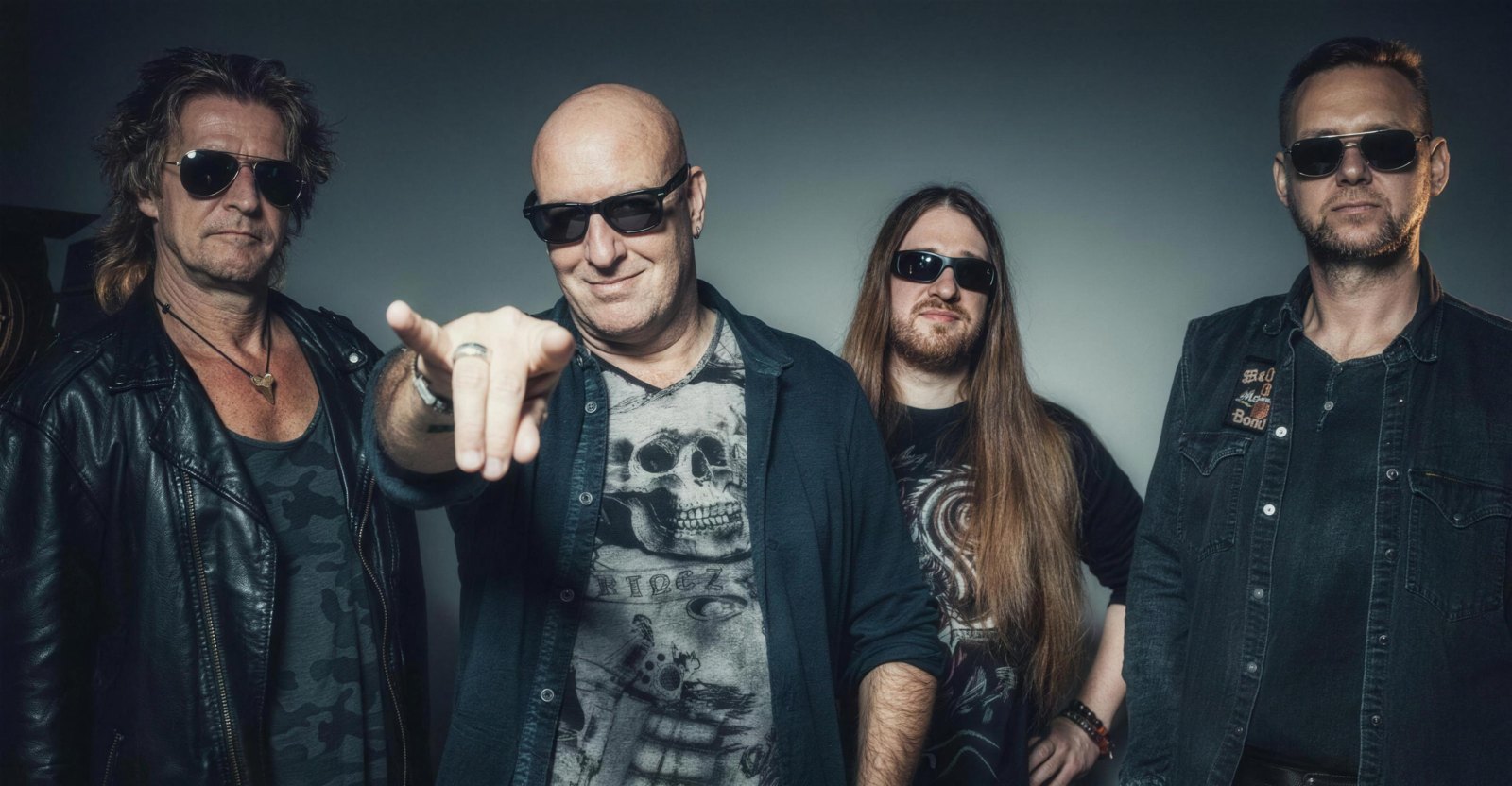
Four bands shared one compilation sleeve in 1984, and two of them, between them, could not muster a dozen players.
Rehearsing in cellars a tram ride apart and signed to a label at the other end of the country, the pair of groups from the northern port that got the place onto vinyl before anybody had a word for the music were Helloween and Running Wild. They were put on a train to somebody else's studio every time a record fell due, and the conditions those two worked under are the reason Hamburg power metal names a method rather than a postcode.
A scene is not a list of addresses. It is a set of working conditions, and conditions leave marks on an arrangement that outlast every band that suffered them.
A Hanseatic council used to license its wind players by the half dozen and keep their instruments locked in one banded chest in the town hall, so that the shawm a boy finally got his hands on at the end of seven years had already been worn out of true by four dead men's mouths and the reeds were cut to one master's gouge. The tower calls went out into open weather off a parapet where no conductor could be heard and no second attempt existed, until the cold split the cane between a player's teeth and the next man took the same instrument up an hour later. Music written under that discipline travels. It has no choice.
The order of the records and the dates of them belong to the eighties in Europe. What sits underneath the chronology is the city.
A city too small to keep its bands apart
Six or seven names carry the whole of this story, and they carry it through five different bands. Kai Hansen, Michael Weikath, Markus Grosskopf and Ingo Schwichtenberg were inside one of them by 1984. Rolf Kasparek had been running the other since 1976, under the name Granite Heart until 1979, when he took the title of a Judas Priest song from the year before and kept it for the next four decades. Piet Sielck, born in the city in November 1964, never joined either group and ended up putting half of it on tape.
Distance is what normally keeps two bands from converging. In Hamburg the distance was a tram fare. Whatever one group tried out on a demo, the other had heard inside a fortnight, and the corrections were made where everybody could watch them being made, which is the difference between a town that has bands in it and a scene: in a scene, a weak idea is killed off by somebody else's record before it ever reaches an album of your own.
| Band | Started | Founding figures from the city |
|---|---|---|
| Running Wild | 1976, as Granite Heart; renamed 1979 | Rolf Kasparek |
| Helloween | 1984 | Kai Hansen, Michael Weikath, Markus Grosskopf, Ingo Schwichtenberg |
| Gamma Ray | 1989 | Kai Hansen |
| Iron Savior | 1996 | Piet Sielck, Kai Hansen |
Why Hamburg power metal was written before it was recorded
The port had the players and almost none of the apparatus. Berlin held the paperwork, since the label that signed them ran its business from there, the engineer who put most of that catalogue onto tape worked in the same city, and the studio where the two Keeper albums were cut stands in Hanover. Not one of the rooms that turned these songs into records was inside the city that wrote them.
That sounds like a handicap and it worked as a discipline. A band with a studio down the road can leave a middle eight unresolved and settle it on the day, because the day costs nothing it has not already spent. A band that has to board a train with borrowed cases, on studio time bought by the twenty four hours from a label with no money, settles everything first: the key, the harmony line, which bar the modulation falls on, who sings which half of the chorus and what the other three do underneath him. What arrived at the studio door was not a bundle of ideas. It was a score.
What arrived at the studio door was not a bundle of ideas. It was a score.
The record shows the consequence rather than the intention. An arrangement finished in a cellar by four people who cannot afford to argue in front of a meter is an arrangement a stranger can lift off the vinyl in Tampere or Trieste and get right at the first attempt, because every decision in it has already been made and nothing has been left to the room. Portability was never anybody's plan. It is what poverty and a railway timetable produced.
Two templates out of one square mile
The city did not settle on one model, which is the second thing the map of German metal usually gets wrong about Hamburg power metal. It settled on two, and they are barely compatible.

Released on 26 September 1988, Port Royal is organised around a single subject the way an oratorio is organised around a single text, a harbour and the men who worked out of it, and the habit it established has outlived almost everything else the band did: the themed album, researched, sequenced and sleeved as one object, is by common consent the format half the genre now works in. Kasparek did not invent the concept record. He proved a metal band could build one out of history and sell it.
The title track shows what the second model does with a melody. Take the part books of a wind band, rule a blade through the top line and hand the tune down to the second voice, where a man with a worn throat can still shout it at the end of a long night, and you have the Hamburg alternative to a trained tenor: a melody pitched where a crowd already lives, carried on a downstroke that never lets go of the beat. Nothing about it reaches upward. Everything about it holds.
Both models left the city and both are still visible on the map of the scenes, usually in different countries. The high clean voice went north and south, to Finland and to Italy. The lower marching one went to the bands who wanted a subject and a chorus a football ground could take over.
The same names, in other bands, for forty years
The proof that a city had built something transferable arrived when it came apart. Hansen started Gamma Ray in 1989, and its debut already carried Sielck's hand: second engineer, keyboards and backing vocals, credited work rather than a favour returned. The arrangement survived the split intact. The songs did not have to.
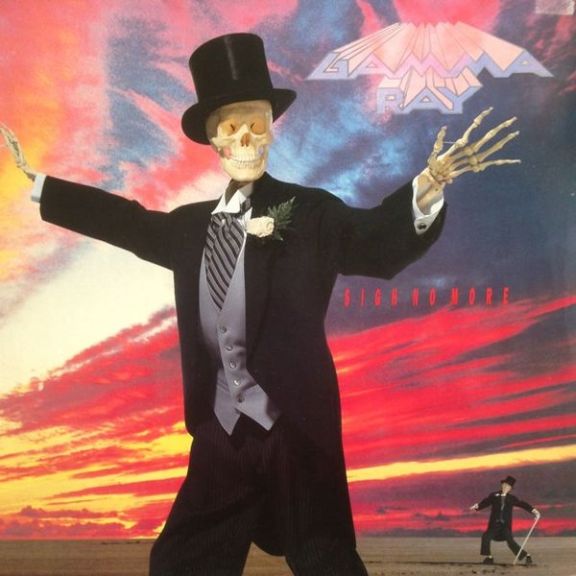
Sigh No More followed in 1991 on the same Berlin label, and the pattern underneath it is the pattern of the cellar years: an arrangement locked down before anybody spent a mark on tape. What had changed by then was the ambition of the writing, not the method of it.
Then the city stopped exporting its recording. Hansen began building a room of his own in 1992, first used the following year for Gamma Ray's Insanity and Genius, and Sielck's Powerhouse was already open for Iron Savior's first sessions in 1996. From the middle nineties on, the bands that had spent a decade working to somebody else's clock owned the clock. It is an unglamorous fact and it changed more than any line up did.
Somewhere Out in Space, from 1997, was cut at Hansen's Hamburg studio between March and June, produced by Hansen himself alongside Dirk Schlächter, and the title track is the sound of a band that can keep a part on the desk for a week and still come back to it. Nobody outside the band is watching a meter.
Sielck is still at it in the same city, and "Our Time Has Come", released as a single on 19 October 2020 ahead of the album Skycrest, is recognisably the same construction the port was making thirty five years earlier: a chorus that arrives where the ear is already waiting, a guitar line doubled a third above it, and a rhythm guitar that refuses to swing. The inheritance is attested in the parts, not in the biographies.
What the port actually exported
English writers eventually found a word for all of it and used the word badly, stretching Teutonic power metal across bands from Gladbeck to Krefeld to Herne who had nothing in common with each other except a border. Grave Digger sang in a rasp the Hamburg model forbids. Rage kept a thrash edge nobody in the port wanted. The one thing they did share came from the coast, and it was not a sound.
Hamburg did not give the style its melodies. The Ruhr had melodies, Hanover had better ones, and Krefeld was writing choirs before anybody asked for them. What the port supplied was a way of settling a piece of music between four people in a rented basement until there was nothing left in it to argue about. That method is what the rest of Europe took, and it is why the same shapes keep surfacing in countries where nobody ever saw these bands play. The tunes were always negotiable.
