
Over the Easter weekend of 1964 nothing much happened at Clacton. A few hundred teenagers with nothing open to go into scuffled along the front, broke some windows and were rounded up by the police, and by the Monday morning the national papers had a wild invasion by rival gangs of mods and rockers on their front pages. The sociologist who turned that wet weekend into a theory eight years later was Stanley Cohen, and the phrase he coined for it, moral panic, is now attached to heavy metal in America more often than to anything else.
In the pub yards of Oxfordshire the game of Aunt Sally is still played to the old rules. A wooden head, the dolly, sits on an iron spike between two and a half and three feet off the ground, each player throws six short sticks at it from ten yards, and a throw counts only when the head is knocked clean off; hit the iron and the throw is wasted, and whatever happens the dolly goes back on its spike for the next man. The British youth cult has always been the dolly. It is set up to be knocked off, it costs the thrower nothing, and the one rule of the game is that the post the whole thing stands on is never to be struck.
Britain never had the metal moral panic UK readers were promised every few years by a Sunday headline. It had a letter of complaint, a petition to the Home Secretary and a comedy troupe. How the American version was run, with its hearings and its lawsuits, sits under heavy metal and censorship. The British version is shorter, stranger and, by common consent of everyone who lived through it, funnier.
A letter, a petition and a bunch of flowers
The Detroit-born singer who gave Britain its first taste of the reflex, in the summer of 1972, was Alice Cooper. "School's Out" went to number one that August, and the former art teacher who had founded the National Viewers' and Listeners' Association in 1965 to clean up television, and who now set about getting the BBC to keep the song off Top of the Pops, was Mary Whitehouse. Cooper sent her flowers. He has credited her ever since with making him a household name in Britain.
Parliament took one sortie at him too, a year late. The Labour member for Pontypool who asked the Home Secretary in May 1973 to revoke the permit that let the band perform in Britain, on the ground that the show peddled the culture of the concentration camp, was Leo Abse, and the written answer was that no permit existed and nobody had applied for one. Nobody passed a law.
That was the whole British muster against the loudest music of the decade: one letter, one member of Parliament and a bouquet. No newspaper ran a campaign. No council closed a hall. When Black Sabbath's debut came out in February 1970 with an inverted cross printed inside the gatefold, the cross had been put there by the sleeve's makers without asking the band, and the record went to number eight regardless.
The metal moral panic UK style: Thursday teatime on BBC1
Until 26 September 1968 every play staged for money in Britain had first gone to an office in St James's Palace, where the Lord Chamberlain's examiners read the script and struck out with a blue pencil whatever was blasphemous, indecent or unkind to a living person, and a theatre that spoke a cut line could lose its licence. The Theatres Act put the pencil down that autumn. Black Sabbath's first album came out seventeen months later, and the music arrived in a country that had just dismantled the one office ever built to cut it.
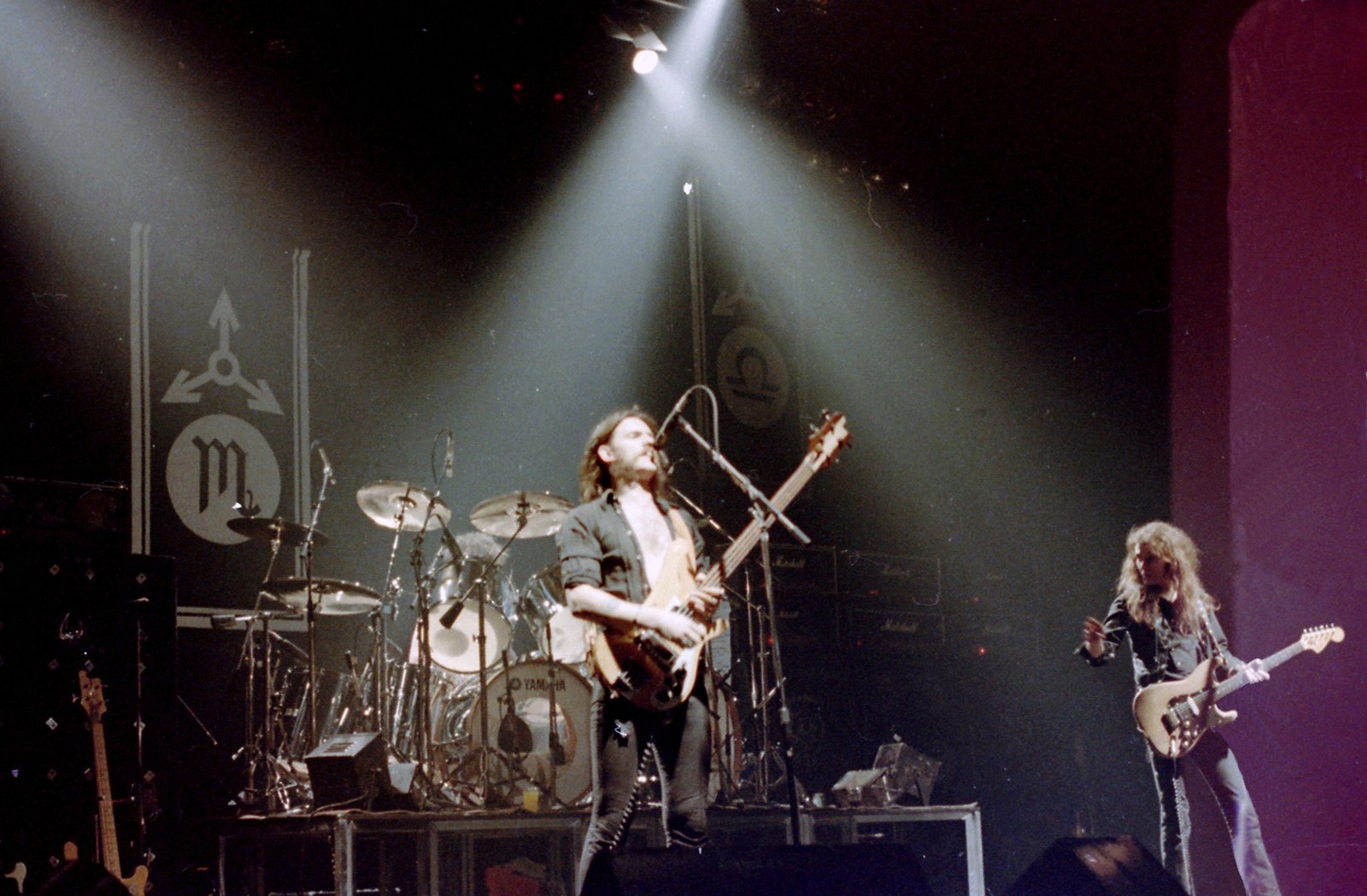
The garrison that should have manned the wall booked the enemy instead. Top of the Pops put the new wave of British heavy metal on BBC1 at Thursday teatime through 1980, Iron Maiden in February, Saxon in April, and the London trio that stood in the studio that October and played "Ace of Spades" to an audience of children eating their tea was Motörhead. The same corporation kept a Maiden single off daytime radio ten years later and still had to read it out at number one. That is the sum of the BBC's war on the music.
The whole wave went out under the corporation's own lights without a single question in the House, and the reason was not tolerance. The British press was busy elsewhere, and it had been busy elsewhere since 1964.
Where the panic actually went
Every panic Britain did run had a body in the street or a tape on a shop counter, and each one ended in an Act. After the Sex Pistols swore at Bill Grundy on Thames Television on 1 December 1976, punk got a police visit to a Nottingham record shop and a prosecution over the word bollocks, which the shop won on 24 November 1977. The press campaign against video nasties in 1983 produced the Video Recordings Act of 1984, which sent every cassette in the country through the censor's office. The acid house summers of 1988 and 1989 produced the Entertainments (Increased Penalties) Act of 1990, with a fine of twenty thousand pounds for an unlicensed party. Heavy metal produced nothing.
| Panic | Years | What set it off | What the law did |
|---|---|---|---|
| Mods and rockers | 1964 | Seaside fights at Clacton, Margate and Brighton | Amphetamines brought under the Drugs (Prevention of Misuse) Act, 1964 |
| Punk | 1976–1977 | The Grundy interview, the Bollocks sleeve | A prosecution in Nottingham, lost |
| Video nasties | 1982–1984 | A list of banned tapes and a tabloid campaign | Video Recordings Act 1984 |
| Acid house | 1988–1990 | Warehouse and field parties | Entertainments (Increased Penalties) Act 1990 |
| Heavy metal | 1970–2007 | A letter, a petition, a T-shirt | Nothing; a voluntary sticker from 1995 |
When the country finally had a satanic panic of its own, in Rochdale in 1990 and on Orkney in 1991, it ran through social workers and family courts, the accused were parents, and the folk devil was a supposed ring of adults rather than a band. The one place the law bit a metal fan in Britain was a T-shirt. The Suffolk band whose 1993 shirt, a nun on the front and an obscenity about Christ on the back, put its wearers before magistrates for a decade and more, a £150 fine in London in 1996, a shirt burned by court order in Norwich in 2004, eighty hours of community service for a nineteen year old in Weymouth in 2005, was Cradle of Filth. A sticker on a sleeve never did that. A shirt on a teenager did.
We know no spectacle so ridiculous as the British public in one of its periodical fits of morality.
Thomas Babington Macaulay, Edinburgh Review (1830)
The joke, and the one real victim
What Britain did to its heavy metal, instead of prosecuting it, was laugh at it, and laugh in the same accent. The fictional four whom the Comic Strip sent up the motorway in a broken van in Bad News Tour on Channel 4 in 1983, then put on the Donington bill on 16 August 1986 to be bottled by the real crowd for More Bad News, were Bad News, and their 1987 album, with its cover of "Bohemian Rhapsody", was produced by Brian May. A year after the first film, This Is Spinal Tap put a British band in front of an American camera and gave the whole world its joke about the music. Britain wrote the punchlines. America wrote the subpoenas.
Britain wrote the punchlines. America wrote the subpoenas.
The victim came late and from the other direction. On 11 August 2007 Sophie Lancaster, twenty, was attacked with her boyfriend in a park in Bacup, Lancashire, for the way the two of them dressed, and she died of her injuries on 24 August. Two of her attackers were convicted of murder in 2008. The foundation set up in her name campaigns against attacks on people from alternative subcultures, and since 2009 the second stage at the Bloodstock festival in Derbyshire has carried her name.
Forty years after Clacton, the country that invented the moral panic finally had one about heavy metal, and it was a panic on the fans' behalf. No quarter was ever asked for the music in Britain, because none was ever needed; the pulled singles and the radio lists that make up the banned heavy metal songs were drawn up almost entirely on the other side of the Atlantic. Britain's contribution to the charge sheet was a T-shirt. Its contribution to the defence was a joke that ran for thirty years.
