
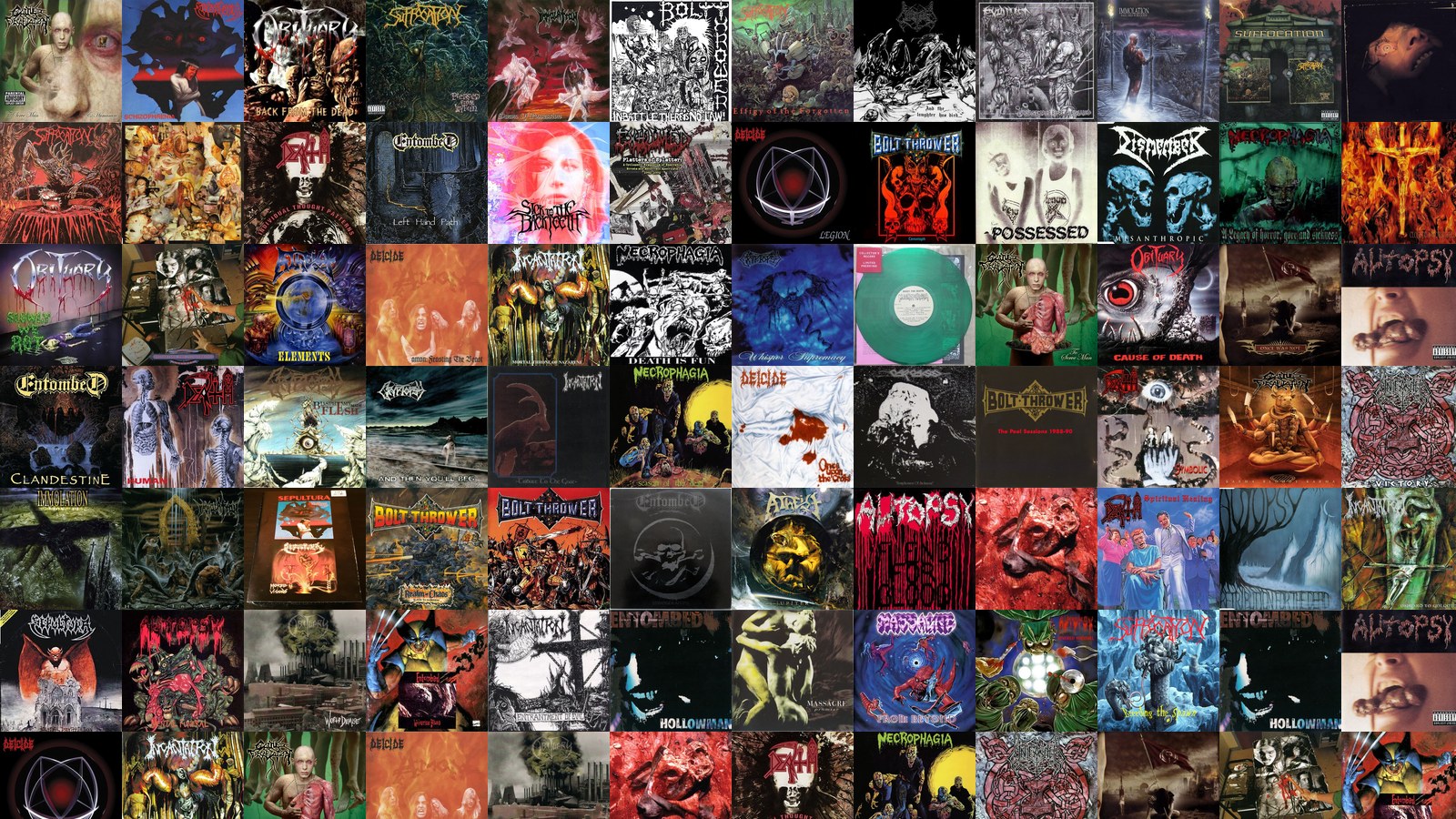
In 1984 a band in Altamonte Springs, Florida stopped calling itself Mantas. The word had come off a Venom sleeve, where it belonged to somebody else's guitarist, and by that summer the group had a new demo in the tape traders' mail chain: Death by Metal. Before the year was out the band carried only the first word of that title. No interview has ever tied the name to the tape. The order of events is all there is.
Nobody in that room was naming a genre, and almost nobody else in this music ever was. The words now stamped on four decades of spines were picked in an afternoon, by teenagers, out of whatever was within arm's reach. This music did not compose its vocabulary. It stripped it off other people's property, a Venom sleeve here, a newspaper column there, and cut the back pages of a medical dictionary into song titles.
That last part is not a figure of speech. The Liverpool trio traces back to a D-beat crust project called Disattack, which became Carcass as the sound and the lyrics changed, in 1985 by some accounts and 1986 by others, with nothing left in writing to settle it. The lyric sheet is not in doubt: Jeff Walker wrote from his sister's nursing dictionary, and by the time the band handed Earache Reek of Putrefaction in 1988 that habit had left death metal a word bank it is still spending forty years later.
A dictionary of pathology is not a book of poems. It is an inventory of everything that can be done to a body, set out alphabetically, and this genre went through it the way a bone saw goes through a sternum, taking the nouns and leaving the definitions behind. The demo covers, the flyers and the contracts that make up that part of the history are where those words were fixed in place.
The words were in the dictionary before the bands were

The second Carcass album, out on Earache in November 1989, carries titles nobody sat down and invented: "Exhume to Consume", "Cadaveric Incubator of Endoparasites", "Crepitating Bowel Erosion". Every one of those words was already in print, in books by people who had never heard a distorted guitar. The band did not coin a language. It went shopping in one. A textbook index runs from skin to marrow in one flat voice, and bands came away with a term cut clean off the page.
Necrophagy, the eating of the dead, is a real term in zoology, in print long before Frank "Killjoy" Pucci founded Necrophagia in 1983. Autopsy, put together in the Bay Area in 1987 after Chris Reifert left Death, is the name of a procedure. Obituary is a column in a newspaper. Massacre, Exhumed and Dismember are what they say they are.
Inside two years, and inside a hundred miles of New York, three bands reached for a noun that names an act rather than a thing: Immolation, which had been Rigor Mortis until early 1988; Incantation, formed in 1989; Suffocation, put together on Long Island in 1988. Nobody was copying anybody. They were all reaching into the same drawer, the one marked things done to a body or a soul, and the drawer was not large. A name was a label on a shelf, and its job was to tell a stranger what kind of damage was on the tape.
A name is a tool, and Nihilist used one to change a line-up
Stockholm, 1989. Nihilist had two years of demos behind it and a guitar sound half of Sweden was already copying. Nicke Andersson's account, given in Albert Mudrian's oral history Choosing Death, has him ending the band himself, because his working relationship with bassist Johnny Hedlund had gone sour. The rest re-formed at once under Entombed and put Left Hand Path on Earache in 1990, while Hedlund started Unleashed and had Where No Life Dwells out on Century Media in May 1991.
The Tampa band that had been Executioner since 1984 scrapped its name twice. Drummer Donald Tardy has told it plainly in interview: a Boston thrash act already held the name, so the Florida band dropped the "E"; when Xecutioner was still not far enough from the Boston band, the label sent them back again, and by early 1988 the contract said Obituary. Slowly We Rot followed in 1989.
Amon went the same way, for a label's own housekeeping. Roadrunner's A&R man, Monte Conner, asked the Tampa four to drop the Egyptian god's name: label mate King Diamond had just put a song called "Amon Belongs to Them" on Conspiracy in 1989, which was more overlap than the label would wear. The band already had a song of its own called "Deicide". It became the new name in 1989, and the self-titled Deicide album followed on Roadrunner in 1990.
| Band | Shipped its first tapes as | Changed | What the change was for |
|---|---|---|---|
| Death | Mantas (1983) | 1984 | The old name belonged to a Venom guitarist |
| Carcass | Disattack (c. 1985) | 1985 or 1986 | A change of line-up and musical direction |
| Atheist | R.A.V.A.G.E. (1985) | 1987 | The acronym was dropped for a plain word |
| Obituary | Executioner, then Xecutioner (1984) | 1988 | A same-named Boston band, at the label's insistence |
| Deicide | Amon (1987) | 1989 | Too close to a King Diamond song on the same label |
| Entombed | Nihilist (1987) | 1989 | A change of line-up done by dissolving the band |
| Cryptopsy | Necrosis, formerly O.C.D. (1988) | 1992 | A style change and another band already named Necrosis |
Nothing in the underground was ever that tidy again.
One Portuguese word, taken out of a Motörhead lyric

The best documented naming in the genre is a teenager's homework. Max Cavalera's own account has him working through "Dancing on Your Grave", off Motörhead's 1983 album Another Perfect Day, turning the words into Portuguese one at a time, until the word that came back for grave was sepultura. Sepultura formed in Belo Horizonte in 1984, and the split with Overdose, Bestial Devastation, went out on Cogumelo the following year.
One word of Portuguese, pulled out of an English lyric like a bullet out of muscle, and it outlived the band's entire original line-up.
The band that formed in Coventry in 1986 went nowhere near a dictionary. It tore its name out of a wargame rulebook instead, off the list of war machines in Games Workshop's Warhammer settings, and came back carrying Bolt Thrower, two flat English nouns for a device that throws something heavy and pointed. A machine like that does not dart. It is cranked into position, aimed once and let go. After the band's second BBC Peel session went out in November 1988, Games Workshop offered cover artwork for the next album, and the 1989 record arrived as Realm of Chaos: Slaves to Darkness, titled after the company's own 1988 sourcebook of that name, which is how a wargame supplement and a death metal album ended up sharing a jacket.
A death metal name is the cheapest decision a band ever makes and the only one it can never take back once the tapes are in the post.
Rafael Quintero, KaosMetal
The joke that outlived the joke
Some gags had to be carried for thirty years by men who had stopped laughing. The Florida band that began life in 1985 as R.A.V.A.G.E. had an acronym for a name, Raging Atheists Vowing A Gory End, the kind of thing teenagers write on a rehearsal room wall. By 1987 the acronym had been cut away and the first word kept, which is how the most harmonically adventurous band in the genre ended up answering to Atheist, a flat declarative noun on the front of Piece of Time in 1990.
The San Diego band that has spent its career on the abattoir floor of the meat industry got there in reverse. Travis Ryan's account has bassist Dave Astor naming Cattle Decapitation in 1996 after a Locust song called "Cattle Mutilation", meaning the new group to be a vegetarian band; the founding line-up was in fact vegetarian, and the joke curdled into a position on animal agriculture the band has had to explain ever since.
Montreal went a stranger way. The band whose tapes had read Necrosis since 1988, and O.C.D. before that, was carrying a word it no longer owned and no longer fitted, another group holding the same name and its own playing having moved off whatever the old label advertised, so in September 1992 vocalist Dan "Lord Worm" Greening cut Necrosis off the spines and welded crypt to autopsy in its place: Cryptopsy. The vault and the blade that opens what is carried out of it. No dictionary holds that word and none ever will. Nobody had to take it off anybody.
What the name was actually for
A name in this music is poured before the first riff is written and sets hard around everything that comes after. The music can change beyond recognition and the word stays: Carcass went from pathology to melodic leads in five years and kept it. Nothing here is sung either, so the word had to hold its shape coming back out guttural and again in six point type on a spine.
The dead names stay collectible for the same reason. A tape that says Nihilist or Xecutioner on the spine is the record of a band that stopped existing under that word, pressed in a run nobody counted at the time, disinterred out of lofts decades later, and the kind of artifact that turns up in the Death Metal Records Collectors Chase.
A medical dictionary, a translation exercise, a wargame rulebook, a newspaper column and a joke on a rehearsal room wall. Not one of those names came from a marketing department, which is more than most genres can say about the words on their own sleeves.
