

That is not dead which can eternal lie, And with strange aeons even death may die.H.P. Lovecraft, The Nameless City, 1921
Painted by Derek Riggs onto the headstone of a grave that the mascot of Iron Maiden is tearing open from below on the sleeve of Live After Death in 1985, the couplet above went round the world on a double live album before most of the teenagers holding it had read a page of the man who wrote it. The engraving swaps Lovecraft's "and" for a "yet" and names no author, and the line has stayed the best-known sentence in the whole of Lovecraft heavy metal ever since.
The writer the style keeps digging back up, a recluse from Providence, Rhode Island, who died in 1937 at forty-six with his fiction scattered across the pulp magazines, was Howard Phillips Lovecraft. His stories have no heroes worth the name. A man reads the wrong book, sees the wrong shape at the wrong window and loses his mind, while something older than the planet goes on sleeping under the sea.
Under the Malheur National Forest in eastern Oregon a single bootlace fungus, Armillaria ostoyae, has spread through the soil across some 2,385 acres, its black cords wrapping the roots of one fir after another and rotting them from below, invisible for most of the year. Then autumn pushes clusters of tawny caps up through the needles in places that look unconnected and are one organism. The Mythos lives in heavy metal like that. Every Lovecraft song is a cap above ground, and the body underneath is the same.
A mythology built to be borrowed
The man who invented it meant it to be shared. Lovecraft let his correspondents, Clark Ashton Smith, Robert E. Howard, Robert Bloch and the young Frank Belknap Long among them, take his gods and his forbidden books into their own stories, and he borrowed theirs in return, on the reasoning that common allusions built up a background of evil verisimilitude. The name came afterwards. The Wisconsin writer who called the whole thing the Cthulhu Mythos after Lovecraft's death, and kept him in print through Arkham House, the imprint he founded with Donald Wandrei in 1939, was August Derleth.
That openness is the reason heavy metal could walk in and take what it wanted. The Mythos was a pantheon designed from the start to be carried off by other hands. Its gods carry names built to break the tongue, Cthulhu, Yog-Sothoth, Nyarlathotep, and a band could print them across a sleeve without asking anybody. Nobody ever asked.
The Necronomicon aches in the style like a phantom limb, cut away before it ever existed and throbbing still. Named for the first time in "The Hound", published in 1924, and credited to the Mad Arab Abdul Alhazred, whose words had already been quoted in "The Nameless City", the book was never written by anybody, and bands have spent forty years clawing at the empty place on the shelf where it ought to be.
How the rest of the library reached the lyric sheet, from Tennyson's cavalry to the pass into Mordor, is set out in the longer account. Lovecraft stands apart from all of it. The other writers handed the bands a story. He handed them a whole cosmos and no story at all.
Metallica and the Lovecraft heavy metal canon
The bassist who carried the paperbacks onto the tour bus and passed them round the rest of the band was Cliff Burton. Released by Megaforce on 27 July 1984, Ride the Lightning closed with "The Call of Ktulu", close to nine minutes without a word sung, its spelling bent because nobody could pronounce the original. Its working title had been "When Hell Freezes Over", and its opening arpeggio went back to Dave Mustaine, credited on the song though gone from Metallica before a note of it was taped. The piece is built the way Lovecraft built the story, a quiet figure repeated until the weight behind it becomes unbearable, bass and guitars piling in layer on layer until the whole band is roaring at something it never names.
A thing that cannot be described is best left unsung. Metallica left it unsung.
Two years later the monster got a lyric. "The Thing That Should Not Be", on Master of Puppets, released by Elektra on 3 March 1986, goes down to Innsmouth, the decaying Massachusetts fishing port of Lovecraft's novella of 1936, where the townsfolk have bred with the Deep Ones out past the reef and their children grow into the sea, and its riff wades ashore at a crawl heavy enough to flatten the harbour wall.
The novella is also a story about the terror of mixed blood, written by a man whose letters are full of that fear. Metallica took the fish people and left the rest behind.
| Source | Writer | Song or sleeve | Band | Year |
|---|---|---|---|---|
| "The Call of Cthulhu" | H.P. Lovecraft | "The Call of Ktulu" | Metallica | 1984 |
| "The Nameless City" | H.P. Lovecraft | The Live After Death headstone | Iron Maiden | 1985 |
| "The Shadow over Innsmouth" | H.P. Lovecraft | "The Thing That Should Not Be" | Metallica | 1986 |
| Abdul Alhazred and the Necronomicon | H.P. Lovecraft | "The Mad Arab" | Mercyful Fate | 1994 |
| Abdul Alhazred and Cthulhu | H.P. Lovecraft | "Kutulu (The Mad Arab Part Two)" | Mercyful Fate | 1996 |
| "The Hounds of Tindalos" | Frank Belknap Long | "All Nightmare Long" | Metallica | 2008 |
| "The Call of Cthulhu" | H.P. Lovecraft | "Dream No More" | Metallica | 2016 |
The band came back twenty-two years later through a side entrance. The friend whose story supplied the creatures of "All Nightmare Long", on Death Magnetic, released on 12 September 2008, was Frank Belknap Long, and "The Hounds of Tindalos", printed in Weird Tales in 1929, sends hunters through the angles of time after anyone who looks too far back. Lovecraft folded the hounds into "The Whisperer in Darkness" two years later.
The video, directed by Roboshobo, leaves the band out entirely and runs as a mock Soviet documentary about an organism found at Tunguska in 1908 that raises the dead, ending with the Russians dropping it on America from balloons. Not one member of the band appears in it.
"Dream No More", on Hardwired... to Self-Destruct in November 2016, finally names the sleeper and wakes him, thirty-two years after an instrumental that could not even spell him. The monster had not changed in the meantime. The band had.
The other writers handed the bands a story. He handed them a whole cosmos and no story at all.
The Mad Arab gets a biography
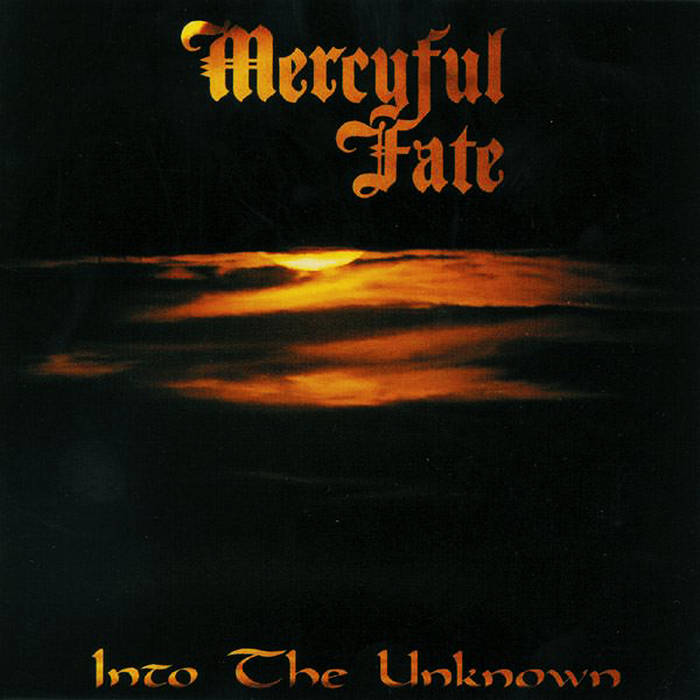
The Copenhagen band that gave the author of the Necronomicon a life story in two episodes was Mercyful Fate. "The Mad Arab", on Time in 1994, the second album after the band re-formed, follows Abdul Alhazred out into the desert and the madness that wrote the book, and "Kutulu (The Mad Arab Part Two)", on Into the Unknown in 1996, picks him up where the first song dropped him and carries him down to the sunken city where the sleeper lies.
Hank Shermann and Michael Denner cut the riffs under both songs in the band's old twin harness, the guitars hacking the melody into short sharp blocks while the singer climbs above them. The Mythos had found its most devoted apostle, and the apostle sang in falsetto. It suited the Mad Arab better than anyone could have guessed.
Further down the lineage the Mythos went underground with the extreme bands. The Swiss trio that put a Lovecraftian night terror into "Nocturnal Fear" on Morbid Tales in 1984, in a song that tears through its verses at a speed the old heavy metal bands had never tried, was Celtic Frost, and a whole generation of death and black metal followed it down to the drowned city.
Why the Mythos fits the riff
The older stories hand a band a hero with a sword and a monster that can be killed, which is the whole business of Greek myth and Arthurian legend in metal. Lovecraft hands it neither. His universe does not hate anybody. It does not notice them.
For a music built on riffs too large for the rooms they are played in, that indifference is the most useful thing any writer ever left behind, and the heresy of it, a cosmos with no god watching and no devil either, sits better with a detuned guitar than any Satan the style ever borrowed from the church. Nobody wins in Lovecraft. The riff does not need anybody to.
