
Anon out of the earth a fabric huge rose like an exhalationJohn Milton, Paradise Lost
A hundred watt valve head standing on two cabinets of four twelve inch speakers is about six feet of furniture, and Marshall's own spec sheets put that head and its two cabinets at ninety four kilos between them, the better part of two hundredweight, and for the first ten years of its life none of that was decoration. The drum teacher with a shop in west London who began building amplifiers because his customers kept asking for something louder than the American imports they could not afford was Jim Marshall.
A dovecote was a machine for producing meat in winter. Five hundred nest holes cut into the inside of a stone drum, a ladder turning on a central post so that a boy could reach every one of them, and a colony that fed itself the whole year round on land belonging to somebody else: the birds stripped the seed corn out of the tenants' furrows and the tenants were forbidden by law to lay a hand on them. Then winter fodder arrived, fresh meat could be had in January, and the building stopped being a larder. It stayed up anyway. Owning one had always been the point.
The Marshall stack has had exactly that career, and the turn came earlier than most people think.
What the Marshall stack was built to do
Work out what the room sounded like in 1966 and the tonnage stops being a pose. The public address systems in British halls carried vocals and nothing else, out of two column speakers the size of a wardrobe door, so the guitar, the bass and the drums reached the back of the room under their own power or they did not reach it. A guitar speaker of the kind Marshall loaded into those cabinets turns one watt into ninety eight decibels at a metre, Celestion's own figure for the Greenback, which sounds enormous and is not, because a hall full of people soaks up the top end and a drummer is louder than the arithmetic suggests.
So the answer was more cones. Four twelve inch speakers in a sealed box move four times the air of one, two boxes double that again and add a few decibels of coupling in the low midrange where the cones are close enough to work together, and the top cabinet was built with its baffle angled upward to throw sound over the heads of the people pressed against the stage rather than into their chests. None of that is mythology. It is geometry, and it is why the boxes were stacked rather than lined up along the wall.
The other half of the design was a limitation that turned into a style. The early hundred watt heads had no master volume, which meant the only route to a distorted output stage ran through full output, and full output in a club was a physical event: the notes hold, the harmonics pile up, and the guitar stops behaving like a plucked instrument and starts behaving like a bowed one. Players learned to ride the guitar's own volume control because it was the only control left. The amplifier was loud or it was clean. There was nothing in between.
The wall that was mostly furniture
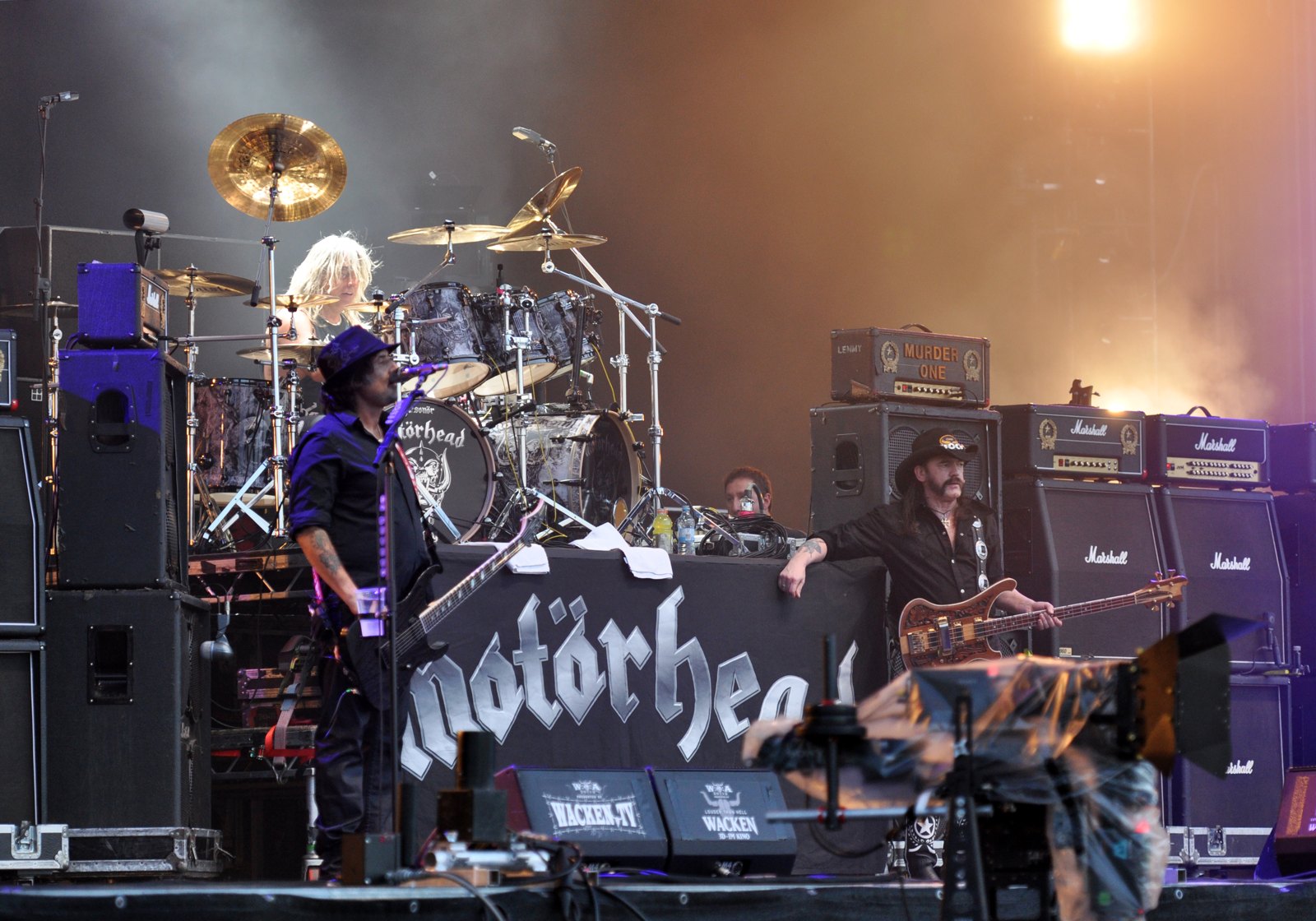
By the middle of the seventies a touring front of house rig carried the guitars, the bass and the kick drum as well as the voice, which quietly removed the stack's original job. The wall did not come down. It multiplied, and the bassist who drove a bass guitar through equipment built for guitarists, at a volume that tore the calibration out of more than one hall's meters, was Lemmy Kilmister, running a 1976 Marshall Super Bass head he called Murder One for three decades, standing in front of a bastion of black Tolex that photographed better than any lighting rig Motörhead could afford.
Television made the point without meaning to. A band miming on a Thursday evening stood in front of the same cabinets it used on stage, and not one of them was carrying a single watt, because the sound came off a tape. The audience never noticed, which is the whole finding. By 1980 the stack was doing two jobs, one acoustic and one heraldic, and the second one was the job that got it bought.
By 1980 the stack was doing two jobs, one acoustic and one heraldic, and the second one was the job that got it bought.
The spectacle had a grammar and everybody learned it. One stack behind each guitarist was a band that worked; three across the back was a band with a crew; a full wall meant an arena, and from the middle of that decade a good half of any wall was empty boxes, hired in, bolted together and lit from below. Nobody in the fifteenth row could tell. Nobody in the fifteenth row was meant to.
The master volume, and what it removed

In 1975 the 2203 arrived with a master volume control, and the fifty watt 2204 followed it, which meant a guitarist could drive the preamp into distortion and then decide, separately, how much of the result to let out of the speakers. The Yorkshire band whose live album caught that British stage before anything digital touched it was Saxon, and the guitar sound on it is the tail end of the old arrangement, where the amplifier is set once at the start of the night and left alone. What that generation of amplifiers did to records rather than to halls belongs with heavy metal record production.
Then came the JCM800 in 1981, and with it the decade: the initials were Jim Marshall's own, James Charles Marshall, stamped on a range launched the year his distribution deal with Rose-Morris ran out. The guitarist who took a modified one, pushed a graphic equaliser in front of it and cut the rhythm tracks of the loudest records of the middle eighties with it was Kerry King, whose relationship with that amplifier eventually got a signature model of its own. The same head, set differently, is attested under half the thrash and half the heavy metal of the period. A stack is not a tone. It is a quantity.
The man who took the same amplifier into an arena and then built a career on making it audible over a band twice the size of any club act was Zakk Wylde, and the Ozzy Osbourne stages of the early nineties are the last period at which the wall behind a guitarist still bore a straightforward relationship to what the audience heard. After that the relationship became a matter of taste. The boxes stayed the same height.
What a stack cannot give you
The proof that the box is not the sound is sitting in plain view across the whole catalogue. Tony Iommi built the heaviest guitar tone of the seventies on a Laney, Eddie Van Halen got his by starving an old Marshall of mains voltage, and most of the thrash records that mattered were cut through Mesa/Boogie heads with the middle scooped out of them. Four guitarists can plug into identical stacks and arrive at four different records. The cabinet decides how much air moves. The hands, the pickup and the equaliser decide what is in it.
What the stack did decide, and decided permanently, was the shape of the stage and the volume floor underneath every band that stood on one. A drummer plays harder in front of a wall. A singer pushes into the head voice because nothing quieter will get over it. A bass player is pressed into a narrow band of the spectrum between the kick drum and eight twelve inch speakers, which is a large part of the reason a whole generation of records ended up asking where did the bass go.
The equipment has moved on and the furniture has not. A touring guitarist now carries a head the size of a hardback book, or no head at all, and the amplifier is a rack unit under the stage or a profile on a laptop. The boxes on stage are still there, still stacked in pairs, still lit from below, and on a good many of those stages there is nothing inside them. Half the boxes on any arena stage are wired to nothing, and in fifty years no crowd has asked to look inside one. They go up in pairs because they have always gone up in pairs, they weigh what they weigh, and the two hands carrying each one up the ramp are paid the same whether the box is loaded or empty.

