
Sketched in the spring of 1999 on the tour behind Edguy's Theater of Salvation, recorded at Rhoen Studios between October 1999 and June 2000 and released by AFM Records on 22 January 2001, the record that printed the words metal opera across the front of a power metal sleeve was built partly on the witch trials of Fulda and Mainz and around other people's voices, and the Edguy singer who wrote it was Tobias Sammet, trading as Avantasia.
He sang the young novice himself. Everything else went out to hire.
The hiring tore the band photograph off the back of the sleeve and nailed a roster of hired throats up in its place. Michael Kiske, out of Helloween since 1993, took the part of Lugaid Vandroiy; André Matos of Angra sang an elf and Kai Hansen of Gamma Ray a dwarf; David DeFeis of Virgin Steele was a friar, Sharon den Adel of Within Temptation was Anna Held, and a bishop, a bailiff and a pope went to three more throats. One writer, ten named parts, nine of them sung by somebody else.
The procedure is older than metal, and its clearest statement was written down in 1935. At Potsdam in May 1747 Frederick the Great handed Johann Sebastian Bach a theme, and Bach built a six-part ricercar on it; nearly two centuries later Anton Webern, orchestrating that ricercar, sawed the king's theme into shards and threw each shard to a different instrument, a trombone first, then a horn, then a trumpet, so that the line is never left in one mouth long enough to belong to it and a listener follows the music by its colour changing owners.
Not one note of Bach is altered. The changes of colour are the composition: each one marks where a phrase begins and where it breaks off, and the whole architecture of the piece is written in who plays next. That is the device the metal opera runs on, and it is why the form exists at all.
Filed on the family tree as the branch measured by its casting sheet rather than by its tempo, which is where the wider story of the subgenres hangs it, the metal opera is easier to prove from its records than from its name. A name only says that somebody intended grandeur. The records show what a cast of singers can do and what a band, however ambitious, cannot.
Before Avantasia: a cast drawn from eight ages
The record usually named among the first metal operas came out more than five years ahead of Sammet's, in 1995 on Transmission, with more than a dozen singers sharing its parts, and the guitarist and producer who wrote it, cast it and assembled it was Arjen Lucassen, working under the name Ayreon. The record was The Final Experiment. The guest list was already the point.

Released in 1998 and subtitled A Space Opera, Into the Electric Castle is where the casting stopped being a guest list and started doing the writing. Eight characters are pulled out of eight different ages, a Highlander, a Knight, a Roman, an Egyptian, an Indian, a Barbarian, a Hippie and a Futureman, and each is handed a different singer: Fish of Marillion as the Highlander, Damian Wilson as the Knight, Anneke van Giersbergen of The Gathering as the Egyptian, Sharon den Adel as the Indian, Lucassen himself as the Hippie, with Death split between two harsh voices and Peter Daltrey as the disembodied Voice that turns them loose inside the castle.
The eight ages arrive before the words do. A listener with no booklet hears eight bodies rather than one actor in eight hats, which is the single thing a band with one singer can never give him, however good the singer. The stakes were real, too: after Actual Fantasy sold below expectations in 1996, Lucassen said he would have closed Ayreon down had the double album failed. It did not fail.
What a metal opera does that a concept album cannot
The American quintet that made the most celebrated one-band concept record of the eighties was Queensryche, and on Operation: Mindcrime, released by EMI in 1988, it ran straight into the wall every such record hits. Geoff Tate could carry the narrator, his anger and his grief for a whole hour, but at the point where Sister Mary had to answer him in her own voice, the band reached outside its own line-up and brought in Pamela Moore.
That borrowed voice is the seed of the whole branch. A concept album by one band has one throat at the centre and a story told about other people. A metal opera has the other people in the room.
The plainest proof on The Metal Opera is "Farewell", six and a half minutes in which Kiske's Lugaid Vandroiy and den Adel's Anna Held share one song, two characters who could never have been one throat. "The Glory of Rome" does the same work with villainy: three hired voices, Ralf Zdiarstek as the bailiff, Rob Rock as the bishop and Oliver Hartmann as Pope Clement VIII, crowd one song inside five and a half minutes, and the bailiff, the bishop and the pope are three different people because they sound like three different people.
The closer, "The Tower", crowds five guests into a single piece and hands Timo Tolkki of Stratovarius, a guitarist, the small part of the voice of the tower itself. No band of five musicians can stage a trial in which the accused, the bench and the witness all sing. A cast can, and that is the plainest case for it.
A concept album by one band has one throat at the centre and a story told about other people. A metal opera has the other people in the room.
Lucassen turned the device inward on The Human Equation, released by Inside Out in May 2004 and on the Dutch album chart by the end of that month: a man lies in a coma after a car crash for twenty days, one song for each day, and the voices fighting inside his skull are cast as singers, James LaBrie of Dream Theater as the man himself, Mikael Åkerfeldt of Opeth as Fear, Devin Townsend as Rage and Heather Findlay as Love. On "Day Eleven: Love" the emotions crowd round LaBrie in the same song, and a quarrel that would split a single throat down the middle is hammered out loud by several people.
A repertory company of a dozen throats
The singer who had been out of Helloween since 1993 appeared on the first Avantasia album credited under the name Ernie, and that singer was Michael Kiske. The credit was a pseudonym. The pull of his name on the roster was not.
Sold on its cast, the all-star record turns a fan's knowledge into part of the music: Kiske arrives trailing the Keeper years, Matos trailing Angra, Hansen trailing Gamma Ray, and the listener hears the voice and its history in the same breath. That is the honest reason for the word all-star, and it is also the trap, because a cast hired for its fame can sink a weak song under the weight of names nobody can afford to waste on it.
| Singer | Ayreon | Avantasia | Aina | Timo Tolkki's Avalon |
|---|---|---|---|---|
| Michael Kiske | The Metal Opera (2001) | Days of Rising Doom (2003) | The Land of New Hope (2013) | |
| Sharon den Adel | Into the Electric Castle (1998) | The Metal Opera (2001) | The Land of New Hope (2013) | |
| André Matos | The Metal Opera (2001) | Days of Rising Doom (2003) | ||
| Damian Wilson | Into the Electric Castle (1998) | Days of Rising Doom (2003) | ||
| Rob Rock | The Metal Opera (2001) | The Land of New Hope (2013) | ||
| Tobias Sammet | Elected (2008) | every record | Days of Rising Doom (2003) |
The kin records prove how small the pantheon is. Days of Rising Doom, issued in 2003 on Transmission under the name Aina, was formed by the producer Sascha Paeth, with a story and words by Amanda Somerville and music by Robert Hunecke-Rizzo, and it hired Glenn Hughes, Michael Kiske, André Matos, Candice Night, Marko Hietala of Nightwish, Damian Wilson and Sammet himself, one of its two narrators. Ten years later, on 17 May 2013, Frontiers released The Land of New Hope under the name Timo Tolkki's Avalon, with Kiske, Russell Allen of Symphony X, Elize Ryd, Rob Rock, Sharon den Adel and Tony Kakko of Sonata Arctica.
Read across the table and the same handful of names keeps resurfacing, a repertory company of perhaps a dozen voices passed from one producer to the next, its progeny printed on sleeve after sleeve. Most of them come out of the high, clean, bright end of the genre, the tenors and sopranos of melodic power metal and the happy metal tag, which is why a metal opera so often sounds like a festival bill folded into a single disc.
The company changed its accent over time. From The Scarecrow in 2008 onward Sammet's casts leaned toward hard rock, with Jørn Lande, Bob Catley, Ronnie Atkins and Eric Martin returning record after record, and Geoff Tate, the one throat at the centre of Operation: Mindcrime, eventually turned up as a hired voice on Ghostlights in 2016, in the very format his old band had needed a guest to approach.
The cast that could not share a stage, until it did
Written in 1993 and first flown at the Holland Festival in 1995, Karlheinz Stockhausen's Helicopter String Quartet put the four players of the Arditti Quartet into four separate helicopters of the Dutch air force's Grasshoppers display team, the rotor roar mixed into their tremolos in mid air, none of them able to hear the other three and the quartet existing as one piece only at a mixing desk in the hall below, where the sound and the picture were sent down.
Four people who never share a room, joined where the cables meet a desk. In this branch that is not a stunt. It is how the schedules have to work.

Avantasia was planned as a studio-only project of two albums, and The Metal Opera Part II carried the story on in 2002 with a cast drawn from bands that each had tours, contracts and calendars of their own. Dragging ten singers off ten other calendars and onto one stage on one night smashes the schedules of half a dozen bands, and for years neither of the two founding projects attempted it.
Ayreon waited twenty two years after The Final Experiment. The first official Ayreon concerts, announced in November 2016 as Ayreon Universe, were held at the 013 in Tilburg in September 2017, with sixteen vocalists on the bill and the dates sold out almost as soon as they went on sale. Two years later, from 13 to 15 September 2019, the same hall staged Into the Electric Castle in full, "Amazing Flight" among it, and the recording came out on 27 March 2020 as Electric Castle Live and Other Tales.
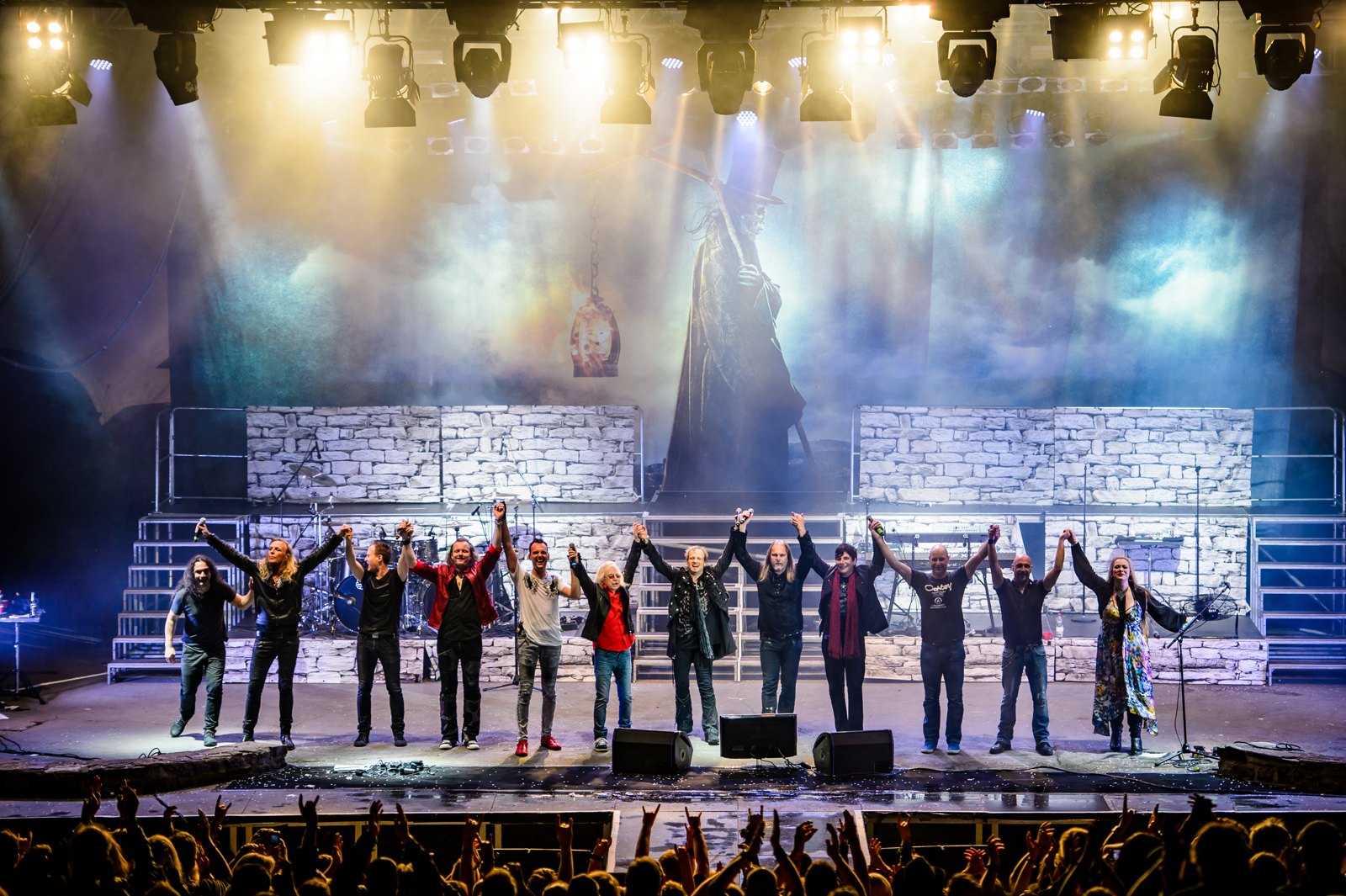
Sammet took the other road and desecrated his own founding plan, the one that said the project would never leave the studio. The first Avantasia tour followed The Scarecrow in 2008, thirteen shows between 5 July and 13 August with Wacken Open Air at the top of them, and from then on the project toured with a rotating crew of guests, twenty nine concerts on the Moonglow tour of 2019 alone. In the succession of those tours the cast stopped being a rare event and became the act.
So the test for any record sold as a metal opera is narrow and practical. Take the booklet away and listen to a single track: if several singers on it are answering each other, arguing, accusing, consoling, something has happened that no band with one singer could have made, and the record has earned the name. If they are only taking turns at a chorus, it is a concept album with a long guest list, and the famous names are doing the job a good tune should have done.
