
Read not to contradict and confute; nor to believe and take for granted; nor to find talk and discourse; but to weigh and consider.Francis Bacon, Of Studies (1625)
The courts had tried to confiscate the weapon and the pulpits had tried to exorcise it, and it took the universities to do what neither camp had thought of, which was to fire the round into a block of ballistic gelatin cast to the density of muscle, let it rip its channel open, and measure the wound with a steel rule instead of reading about it in a tabloid. Metal studies began there. It measured.
The first scholar to publish those measurements at book length, in Heavy Metal: A Cultural Sociology, issued by Lexington Books in 1991 and revised for Da Capo in 2000 as Heavy Metal: The Music and Its Culture, was Deena Weinstein of DePaul University, and her sharpest tool was a sorting of the lyrics onto two poles. On one side stood the Dionysian, wine, sex and the loud night. On the other stood the chaotic: monsters, war, death, and cities flattened to the kerb. Neither pole is Satan. In 1991 that counted as heresy.
What metal studies measured first
The audience was the second finding, and the less comfortable one for her colleagues. Where the hearings had described a menace, Weinstein described a crowd, young, overwhelmingly male and white and largely working class in the America of the 1980s, bound together by volume and by a code of loyalty that turned on any band caught trimming the distortion off its guitars for the radio. A catechism, in other words, not a cult. The difference matters to anyone sitting on a jury.
Method was the real break with the decade. The scholars clamped the music into a machine rest, the steel cradle a gunsmith bolts to the bench so that the shooter's pulse, his flinch and his dread of the recoil are stripped out of the test, and whatever the barrel does afterwards is the barrel's own doing. The Senate hearing of September 1985 had been all flinch. The books were built to have none.
The Senate hearing of September 1985 had been all flinch. The books were built to have none.
The universities came late, and the lateness has an irony built into it. The school that had made British youth tribes a respectable subject, the Centre for Contemporary Cultural Studies at the University of Birmingham, worked a few miles from the Aston streets that produced Black Sabbath, and through the 1970s its scholars wrote about mods, skinheads, punks and Rastafarians while the longhairs in the next postcode went almost unrecorded. Dick Hebdige's Subculture: The Meaning of Style of 1979 is a book about punk. Nobody at the centre wrote the metal equivalent.
Nothing on those shelves was written in a vacuum. Each book reads as a reply to the heavy metal controversies, and each chose a different discipline to reply with, which is why the field still argues with itself about what it is for. A sociologist counts people. A musicologist counts bars.
The musicologist and the stadium chorus
The musicologist who carried the analyst's tools into the stadium, publishing Running with the Devil: Power, Gender, and Madness in Heavy Metal Music with Wesleyan University Press in 1993, was Robert Walser, and the idea from that book that has lasted longest sits in its pages on gender. Walser found four strategies at work in the songs and the videos: misogyny; exscription, which writes women out of the picture altogether; androgyny; and romance. The fourth filled the stadiums.
His second provocation was to insist that the meaning lived in the sound rather than on the lyric sheet the prosecutors kept waving. Walser read the riffs through their modes, hearing the Aeolian and Phrygian scales as the grammar of threat and gloom, and he read the guitar solo as a single figure hacking his way out through the grinding machinery of the rhythm section. The lyric sheet had been the only exhibit at every hearing. He barely needed it.

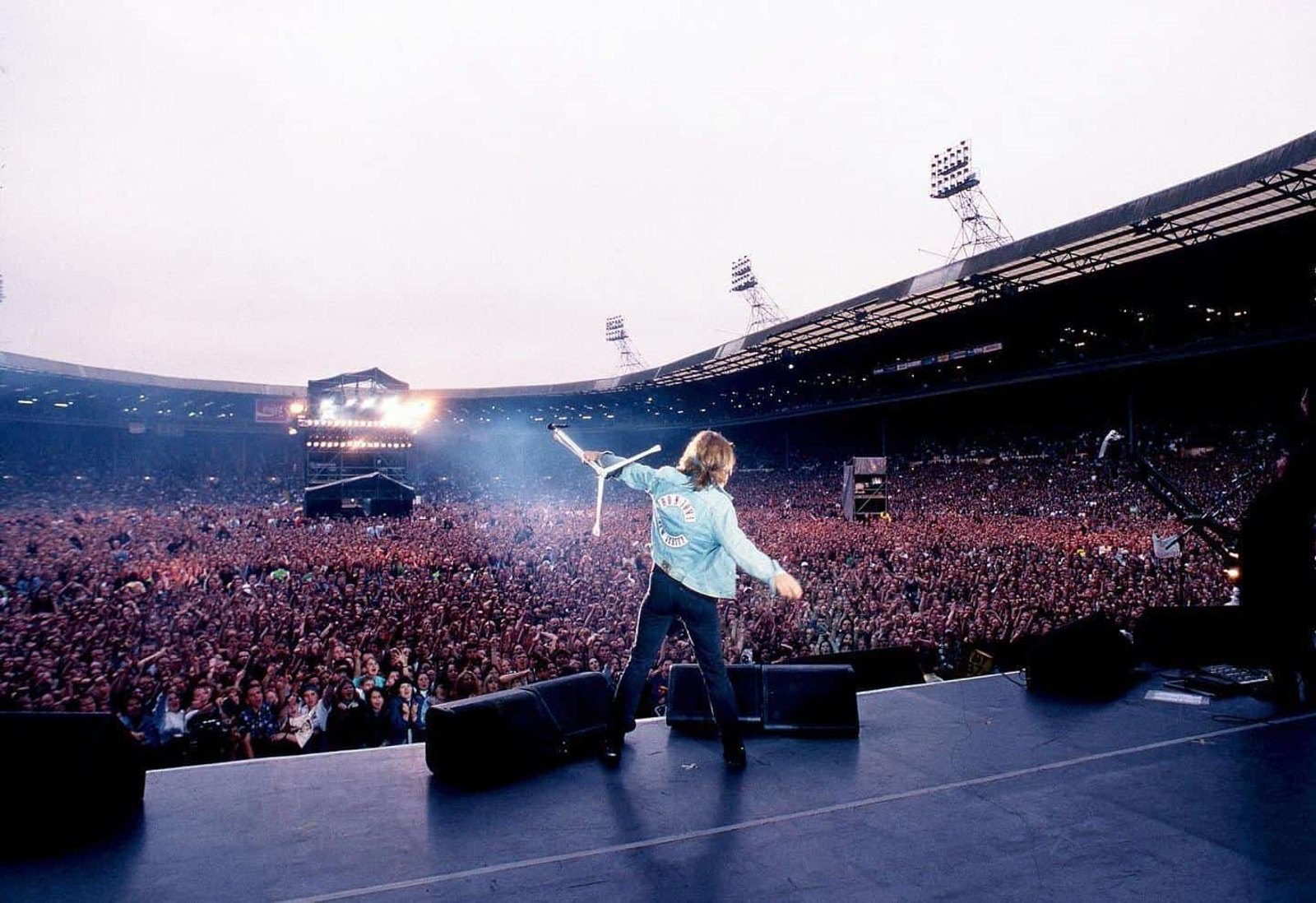
Romance had its bridgehead in New Jersey. Released by Mercury in August 1986, Slippery When Wet sat at number one on the Billboard 200 for eight weeks, and the five-piece that turned hard rock into a love story with a guitar solo nailed into the middle of it was Bon Jovi, with Richie Sambora's talk box doing the work a snarl used to do and the riffs rounded off enough to play at a wedding.
"Livin' on a Prayer" is where Walser set the song on the bench and took the casing off. It reached number one on the Hot 100 in February 1987 and held the spot for four weeks, and its last chorus lurches into a higher key so that the whole crowd is shoved upward at once, a gear change built for eighteen thousand throats. A working couple, not a conquest. The argument sits in a single modulation.
| Year | Book | Author | Discipline |
|---|---|---|---|
| 1991 | Heavy Metal: A Cultural Sociology | Deena Weinstein | Sociology |
| 1993 | Running with the Devil | Robert Walser | Musicology |
| 1999 | Metal, Rock, and Jazz | Harris M. Berger | Ethnomusicology |
| 2007 | Extreme Metal | Keith Kahn-Harris | Sociology |
| 2008 | Heavy Metal Islam | Mark LeVine | History |
| 2011 | Metal Rules the Globe | Jeremy Wallach, Harris M. Berger, Paul D. Greene (eds) | Ethnomusicology |
The extreme scene on the bench
The British sociologist who asked how an extreme scene lives with its own worst members was Keith Kahn-Harris, and his Extreme Metal: Music and Culture on the Edge, published by Berg in 2007, gave the habit a name, reflexive anti-reflexivity. The scene knows about the racists at its fringe and about the Norwegian church fires of the early 1990s. It chooses, as a matter of daily practice, not to look at them too closely. That is the most quoted diagnosis in the field, and the least flattering.
Kahn-Harris also split the scene's currency in two. Mundane subcultural capital is earned slowly, by knowing the records, trading the tapes and turning up for years; transgressive subcultural capital is seized in a single stroke, by going further than anyone else in sound, image or statement. Most of the scene runs on the first kind. The headlines run on the second.
The writer who had gone straight to the fans of the most notorious branch of the family four years before him, surveying death metal listeners for Death Metal Music: The Passion and Politics of a Subculture, published by McFarland in 2003, was Natalie J. Purcell, and she found readers of horror fiction and viewers of gore films rather than the killers of the tabloid front page. The panic had drawn the audience from its record sleeves. Purcell drew it from a questionnaire.
Scenes beyond the West, and the objection from inside
The historian who carried the question out of Europe and North America was Mark LeVine of the University of California, Irvine, whose Heavy Metal Islam of 2008 followed scenes from Morocco to Pakistan, and three years later Duke University Press published Metal Rules the Globe, edited by Jeremy Wallach, Harris M. Berger and Paul D. Greene, with chapters reaching from Indonesia and Nepal to Brazil. The garrison had never stood in one country. The scholars simply arrived late at the other gates.
The field has its own quarrel, and it is an honest one. Almost every scholar in it is a fan, and the charge from inside the academy is that metal studies has too often drafted the defence brief for its own record collection, praising transgression where a sociologist of anything else would ask who pays for it. The conferences kept coming regardless, from a meeting on heavy metal and gender in Cologne in 2009 to a gathering at Bowling Green State University in Ohio in 2013. Nobody walked out.
What the scholars settled, by common consent, is narrower than their critics admit and wider than the fans once hoped. The music does not do what the courtrooms said it did, the audience keeps a code of its own, and a riff can be taken apart with the same tools as any other composition, bar by bar and mode by mode. Thirty years of work bought that much. It came late, and the institution that never came round at all is the business of why radio ignored heavy metal.
