
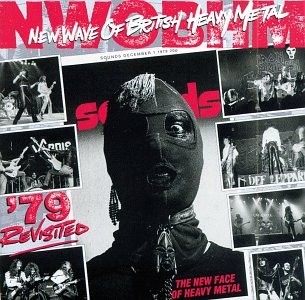
In 1990 Vertigo pressed a gatefold double album of twenty-four songs, all of them recorded in Britain between 1979 and 1981, and put on its front a page of Sounds, the weekly whose May 1979 headline had given the movement its name, showing a hooded, masked figure above the words "the new face of heavy metal". The page was already over a decade old. It still looked new.
The Danish drummer who chose the songs, working from a collection of British singles he had been buying on import since his teens, was Lars Ulrich of Metallica, and the writer credited on the back as having "assisted and inspired" him was Geoff Barton, whose reviews in Sounds had given the movement its name in the first place. NWOBHM '79 Revisited is the new wave of British heavy metal written up by its most famous customer, a year before Nevermind flattened the racks it was filed in.
What Ulrich did with his shelf is what a luthier does with a rack of old fiddles bought in one lot from a dead man's attic, tapping each belly for the dead ones, pulling the warped necks off the two worth saving, fitting new pegs and a soundpost, and drawing a bow across a box that has not spoken since the war. The tone had never gone. Nobody had strung it.
Twenty-four songs on four sides
How the movement rose and broke between 1979 and 1983 is the wider story. The compilation tells a narrower one, and it tells it through the running order, which on vinyl opens and closes with the same band.
The Stourbridge four who start side one with "It's Electric" and end side four with "Helpless" were Diamond Head, and the placing is a statement of rank from a compiler whose own band had already recorded "Helpless" on The $5.98 E.P.: Garage Days Re-Revisited in 1987. "It's Electric" runs on a boogie riff that Brian Tatler plays with the swing sanded off it, bright and jumpy, closer to a pub band at full tilt than to anything Birmingham had built. The heavier song closes the set.
The big names come in by the side entrance. Iron Maiden is represented by "Sanctuary", not "Running Free"; Def Leppard by "Getcha Rocks Off", from the EP the Sheffield band paid for itself in 1979, not by anything Mutt Lange touched; Saxon by "Motorcycle Man", the opening salvo of Wheels of Steel, not by "747 (Strangers in the Night)". Every choice reaches for the earlier, rawer song. The hits were left where they were.
The joke inside that choice is the Sheffield one. By 1990 the biggest selling band anywhere on the four sides, with Hysteria still shifting copies by the million in America, was Def Leppard, and the compiler reached past every one of those records to pull out a song from the EP the band pressed itself in a run of one thousand copies in January 1979. The session drummer on that recording was a hired hand, Frank Noon, borrowed for the weekend days before the band settled on the fifteen year old Rick Allen for good. The platinum was left in the frame. The rough edge went on the record.
The London four whose contribution is "Demolition Boys", from their 1980 debut Demolition on Bronze, were Girlschool, and the song does what their best records do, a short, blunt riff taken at a sprint, Kim McAuliffe and Kelly Johnson locking their two guitars together, and no solo allowed to outstay its welcome. It sits on side two between Samson and Witchfynde. It needs neither.
The bands only a collector had kept
The middle of the running order belongs to the bands that nearly made it. The London trio that gives the set "Extermination Day", a riff that circles like a dog guarding a yard before the chorus lunges, was Angel Witch, and beside it the Edinburgh five represented by "Death or Glory" rather than their better-known "Heavy Metal Mania" were Holocaust. The Whitley Bay band that turns up with "Killers" was Tygers of Pan Tang, heard before John Sykes arrived. All three were a single good break from a career. None of them got it.
The real work is done by the names nobody in 1990 could have found in a shop. The Newcastle trio that turns up on side three with "Angel Dust", first cut in the band's own fifty pound demo session of April 1980 before it reached a shop properly on Welcome to Hell in 1981, is Venom, and around it sit Gaskin, Sledgehammer, Trespass and Vardis, bands that had pressed a single or two, played every club that would book them and gone back to work.
| Band | Song | Where it sits |
|---|---|---|
| Paralex | White Lightning | Side one |
| Weapon | Set the Stage Alight | Side two |
| Hollow Ground | Fight with the Devil | Side two |
| Gaskin | I'm No Fool | Side three |
| Sledgehammer | Sledgehammer | Side three |
| Trespass | One of These Days | Side four |
| Vardis | If I Were King | Side four |
| A-II-Z | Treason | CD only |
| Dragster | Ambitions | CD only |
| Black Axe | Red Lights | CD only |
Getting those songs onto a compact disc was restoration work more than compiling. The tracks from Paralex, Weapon and Hollow Ground had spent a decade in lofts on seven-inch singles and cassettes before mastering engineer Howie Weinberg, then rising through the ranks at Masterdisk in New York, got to them. Some of the paper is still brown. It opens all the same.
The compact disc ran to thirty tracks, adding Witchfinder General, A-II-Z, Black Axe, Praying Mantis and Dragster, and the Tyneside band whose "S.S. Giro" closes the whole set on a joke about the dole that no American buyer could have decoded was Fist. Most of those songs had first been sold as seven-inch singles on labels that no longer existed by 1990, a trade traced through the NWOBHM singles and the independent labels. The labels were gone. The grooves were not.
Every choice reaches for the earlier, rawer song. The hits were left where they were.
Why NWOBHM '79 Revisited still sets the canon
Released in the gap between ...And Justice for All in 1988 and the album Metallica would put out in August 1991, the compilation carried the endorsement of a drummer whose band was filling arenas, and a teenager who owned every Metallica record could now hear, on one double album bought in a chain store, the forebears his favourite band had been paying tribute to since 1984. The lineage came with a map. The map came with a name on it.
The limits are the compiler's. Nothing recorded after 1981 made the cut, which leaves out Satan's Court in the Act and the fastest records Neat pressed in 1982 and 1983, and the thrash drummer's taste shows in the weighting, heavy on speed and riff, light on the polish Praying Mantis and the later Def Leppard aimed at American radio. On any honest reading it is one fan's shelf. It happens to be the shelf that won.
The customer as curator
The label that carried the double album into American shops was Caroline, and in 1990 an American fan who wanted Blitzkrieg's "Blitzkrieg" in its original form rather than in Metallica's version had very few other places to look. The track sits on side four of the vinyl. The band had never released an album while the wave lasted.
Metal Blade later reissued the set with the tracks rearranged across its two discs, and the reissue trade that has spent the years since digging out whole catalogues, one forgotten band at a time, works from the running order Ulrich drew up. Of the twenty-four names on the vinyl, several now have box sets and anniversary editions. A few still have only this.
In Britain in 1990 the whole movement was about as fashionable as a flared trouser, a decade of old singles that reviewers treated as a joke on the people who had bought them the first time. The double album tore that joke off the sleeve. It was sold, in effect, on the word of an American arena act about a scene the British press had buried.
The faithful who argue today about whether Hollow Ground or Paralex deserved a place are arguing inside the frame a Danish drummer and a Sounds writer built in 1990. Nobody has drawn a better one. Nobody has really tried.
