
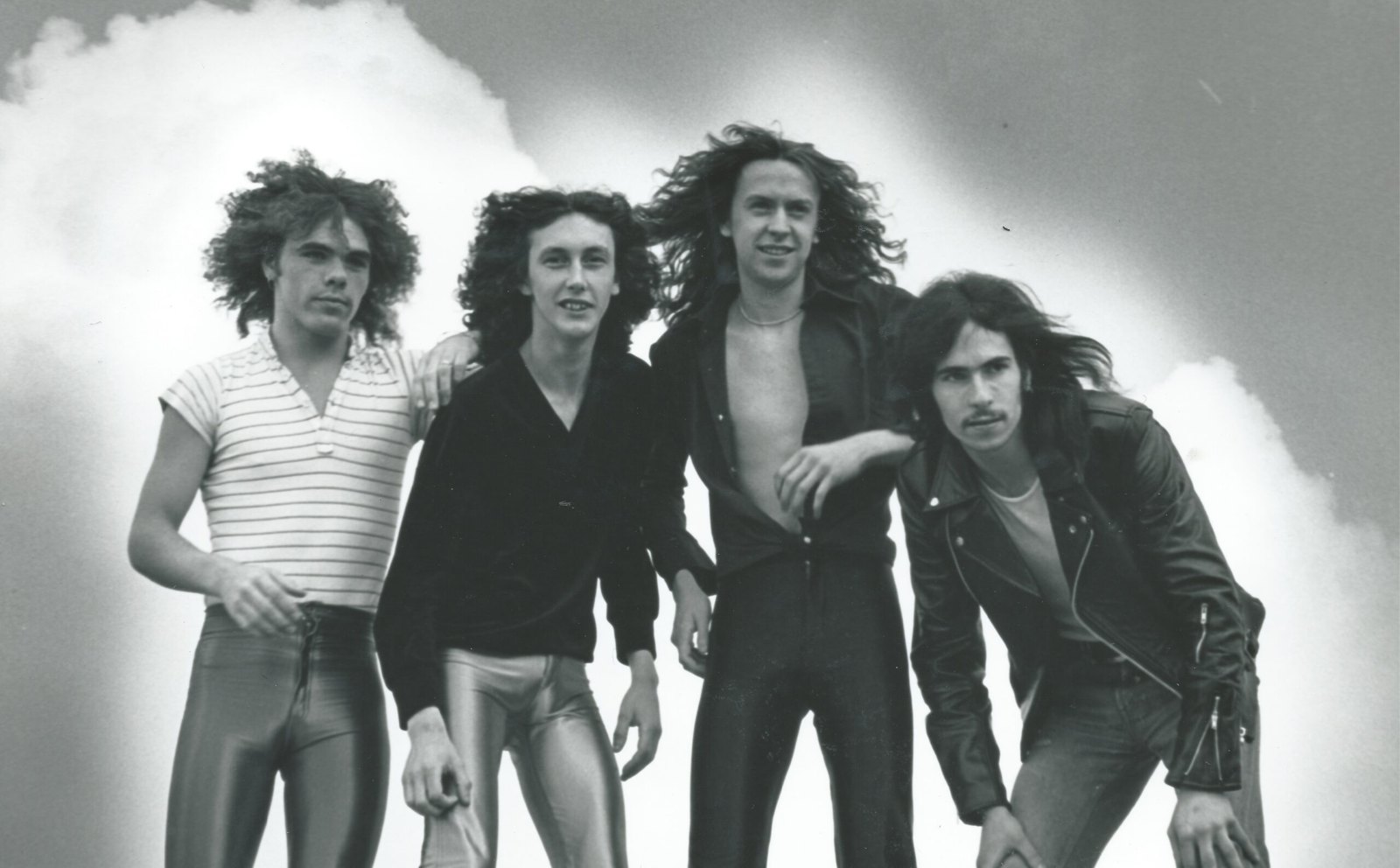
A thousand copies, white sleeves with nothing printed on them, signed by hand and sold at gigs or by post for three pounds fifty.
The West Midlands quartet that could not get a record company to return a call and pressed the thing itself was Diamond Head, and Lightning to the Nations, out on Muff Murfin's Happy Face label on 3 October 1980 with no cover art, no distributor and a six week advertisement in Sounds the band had never paid for, is the plainest lesson available in how British records reached other countries at all. They reached them as objects. One at a time, in envelopes.
The NWOBHM influence on power metal starts with that envelope and not with a scene. A teenager in Hamburg or in Los Angeles between 1979 and 1983 did not receive a movement. He received a disc, now and then a photocopied page about a disc, and almost never the room the disc had been made for.
What crosses a border in that condition is a score and nothing besides. One chapel in Rome held a setting of the Fiftieth Psalm that could be heard twice a year and nowhere else on earth, the copies chained in the vestry with the penalty printed on the flyleaf and the singers' own ornaments never written down at all, until a boy of fourteen sat through two performances and put the whole thing on paper in a rented room. It was engraved in London within a year, the ban torn off the cupboard door like wet paper. Every choir in Europe could sing it afterwards. Not one of them sounded like the chapel. What crossed the Alps was the notes, and what stayed behind was the building, the voices, and everything those voices did that the page could not hold.
Where the whole inheritance came from, part by part, is traced in its place in the story. The narrower question is mechanical: how the records arrived, what a foreign ear could hear on them, and which habits died in transit.
How the records crossed the water
Three channels carried them and nothing else mattered much. The import counter, the small ad, and the cassette.
The Newcastle label working out of Impulse Studios in Wallsend and pressing singles for bands no London company would answer was Neat, and Raven, Venom, Blitzkrieg and Satan all went out through it: four Tyneside acts no major would sign, each one later named on the American side as a direct influence on the thrash bands that came after.

The Diamond Head record proves the traffic twice over. Its master tapes went to a German label, Woolfe Records, which issued it with a world map on the sleeve, and those tapes then went missing for years. An album cut in an English studio for almost nothing ended up, physically, in Germany.
"Am I Evil?" is the song the record is known by: seven minutes, an opening figure drawn from Gustav Holst's "Mars, the Bringer of War", three changes of scenery before it ends. What a German listener took from it was not the riff. It was the permission to travel that far from where the song started and still land on a chorus.
The cassette did the rest of the work. A record costing three pounds fifty in England, and roughly twice that as an import abroad, cost a blank tape and a stamp between two people who had agreed to swap, and by 1982 that arrangement reached anyone who could write a letter. Tape hiss ground the top off the cymbals. The chorus came through anyway.
The page arrived before the band did
Print moved faster than vinyl and cost less to post. Sounds put the phrase into circulation on 19 May 1979, Kerrang! spun off the same paper as a one-off supplement on 6 June 1981, and between them they handed every foreign reader a catalogue of bands he had no way of hearing and a vocabulary for wanting them.
Germany then built a press of its own within four years. Rock Hard appeared in Dortmund at the end of 1983 under Holger Stratmann, a German edition of Metal Hammer followed in 1984, and Karl-Ulrich Walterbach's Noise imprint, grown out of a Berlin punk label, signed the bands raised on the imports: Helloween, Running Wild, Grave Digger, Rage.
America ran on a shop counter and a photocopier. The teenager behind the till of a rock shop in the San Fernando Valley who began importing British singles because customers kept asking for them was Brian Slagel, and The New Heavy Metal Revue, the fanzine he started in 1981 to write about Iron Maiden, Def Leppard and Diamond Head for readers who could not buy them, is the American distribution system of those years in a single staple.
What the counter turned into matters more. Metal Massacre, the compilation Slagel put together in 1982, sold out its five thousand copies, and Metal Blade, the label that grew out of it, went on to press debuts by Warlord, Omen, Fates Warning, Attacker and Liege Lord. The American reading of this style came out of a shop that sold British imports. On any honest reading the lineage is that short.
Tours, television and the bands who came in person
On 18 December 1983 the Westfalenhalle in Dortmund held Iron Maiden, Judas Priest, Scorpions, Ozzy Osbourne, Def Leppard, Quiet Riot, Michael Schenker Group and Krokus on one bill, taped by ZDF and held back until broadcast on 4 February 1984. A country that had been buying this music one envelope at a time watched most of its front rank in an evening, free.

Iron Maiden's own contribution is clearest on "Flight of Icarus", the single lifted off Piece of Mind in 1983: a mid-paced verse, a subject out of myth, and Bruce Dickinson at a height he holds without strain for the whole chorus. That is a parish organ voiced a whole tone above the pitch the choir learned on, the singers hauled up to meet it and never let back down, throats scraped raw by the third Sunday. Every German band that followed hired on that basis. The tenor stopped being a specialism and became the entry requirement.
Traffic ran the other way as well, and earlier than the tidy version allows. Raven's All for One, out on Neat in 1983 and cut at Pineapple in London, was co-produced by Michael Wagener and by Udo Dirkschneider of Accept, which puts a German engineer and a German singer inside a British record two years before Hamburg pressed one of its own. "Break the Chain" carries the evidence in its rhythm section. The riffing is Tyneside. The clipped, drilled attack underneath it is not.
What the NWOBHM influence on power metal came down to
Set the two catalogues side by side and the sorting is unsentimental. Some habits survived the crossing intact because they lived in the notes. Others needed a room, a week and an accent, and the page could not carry any of it.
| On the British records, 1979 to 1983 | What power metal did with it |
|---|---|
| Two guitars carrying the tune a third apart | Kept whole, and made compulsory |
| The gallop | Kept, then run faster and set over two kick drums |
| Songs in several sections, past six minutes | Kept, and stretched past thirteen |
| Myth, legend and history as subject | Kept, and enlarged until it needed a choir |
| A chorus pitched for a hall to shout back | Kept, and made the reason the song exists |
| The self financed single as the way in | Kept, in the form of the German demo tape |
| The blues shuffle under the riff | Dropped, read off the record as straight time |
| One kick drum | Dropped inside five years |
| The regional accent and the local subject | Dropped, unusable outside its own postcode |
| Minor key hooks left unresolved | Dropped for the major cadence |
The second column is the more telling one. The British bands swung, and much of what makes Saxon or Tygers of Pan Tang sound like 1980 is a shuffle inherited from bar bands and boogie records. Their pupils abroad read it off the vinyl as straight time, which is an editor taking a blade to the dotted rhythms of a dance suite and printing them as even quavers, the swing shaved off the page and burned with the proofs. Nothing in power metal shuffles. Nothing in it ever has.
Some habits survived the crossing intact because they lived in the notes. Others needed a room, a week and an accent, and the page could not carry any of it.
The same filter took the lyric. Saxon wrote about the week its own audience had actually had, the motorway and the machinery and the denim, and that kind of writing needs a shared postcode to land in. Myth and history do not. The receiving bands took the dragons and the last stands and left the working week behind.
The single kick drum went the same way, though its replacement arrived later and from somewhere else entirely: a second pedal board cut into the case of an instrument built without one, the joinery sawn through to make room for it. Where that second pedal came from, and what it did to the tempo once it was installed, is from speed metal to power metal.
Which leaves the debt smaller and clearer than the usual account allows. The British forebears supplied a melodic vocabulary, a method for writing two guitars as one line, a song form long enough to hold an argument, and a subject matter out of legend. They did not supply the velocity, the altitude as a rule rather than a feat, or the major cadence the style now resolves on. Those were added at the receiving end, by people working from a recording and a page, unable to know what they had failed to hear. The epigone builds from what survived the crossing and nothing else. Now and then that is how a genre gets made.

