
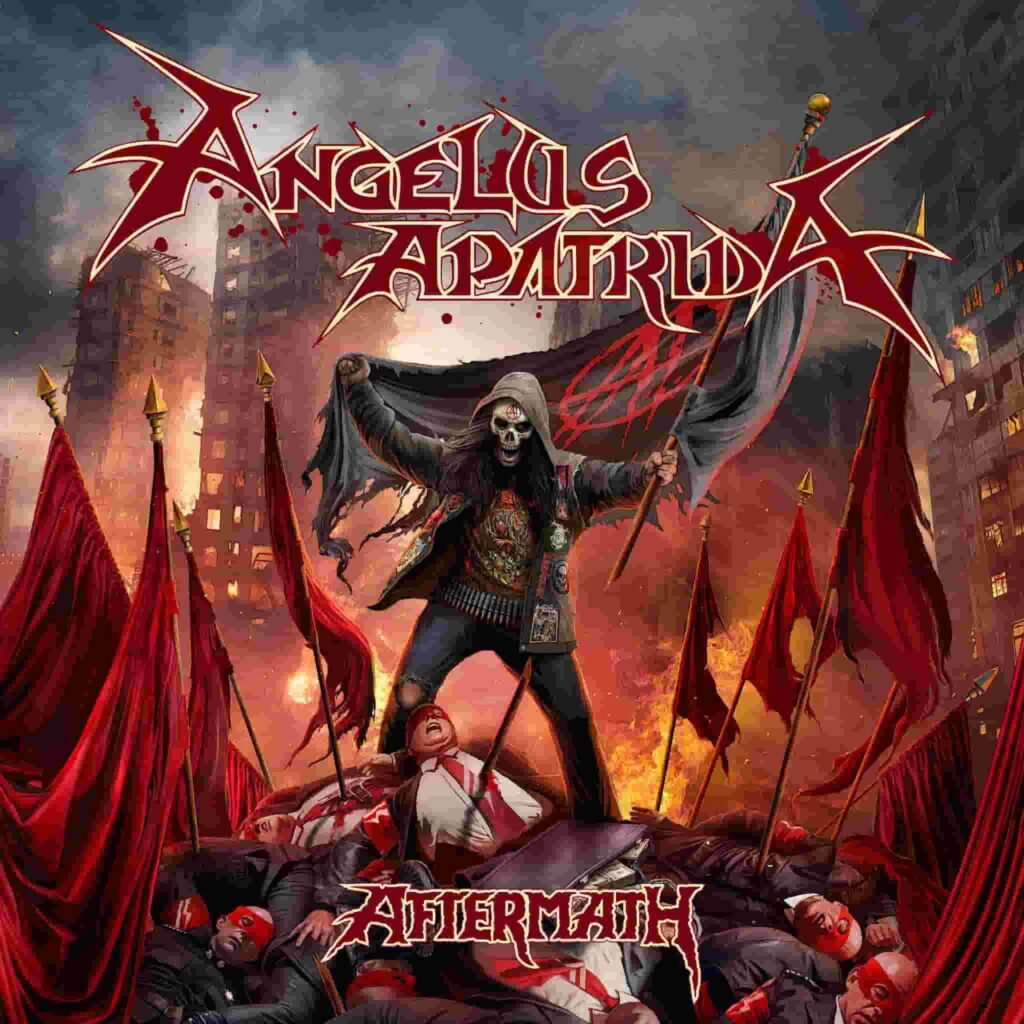
The four thrashers from Albacete went into Baboon Records in their home town with Juanan López at the controls, produced the record themselves, called in Jamey Jasta, Todd La Torre, a WarCry guitarist and a rapper from Zaragoza, and released Aftermath through Century Media on 20 October 2023, the most varied record of their career and the one that chased the Rolling Stones up the Spanish chart in its first week. Not bad for a band from La Mancha. Not bad at all.
Guillermo Izquierdo sings and plays guitar, David G. Álvarez plays guitar, José Izquierdo bass and Víctor Valera drums. Gyula Havancsák painted the cover. It entered the Spanish album chart at number four, a step down from the number one their self-titled record had reached two years earlier, and a long way up for thrash metal in any country in 2023.
One of the most complex, personal, deep and solid songs we've ever written.
Guillermo Izquierdo on "To Whom It May Concern", Time for Metal, September 2023
The headline is variety. Angelus Apatrida made their name on fast, sharp thrash in the Bay Area mould, and this album keeps that engine running while bolting on more melody, more groove and, here and there, a flirtation with metalcore. The guests are there to add colour, not to carry the songs, and the band never once leans on them.
"Cold" is the one to start with: verses that grind like a lathe through sheet metal, dissonant and Slayer-dark, and then a big melodic chorus that lands like the roof coming off a sports hall. It is the best summary of what the album is trying to do, and it does it in under six minutes.
"Snob" brings in Jamey Jasta for a crossover blast hammered out with a hardcore swagger, and you can feel the skateboard under it. "Fire Eyes" opens on ballad-like verses, a slow fuse burning down to a riff that blows the windows out, and Pablo García's guest solo is the best lead playing on the record. "Gernika", about the bombing of 1937, carries a wah-wah solo and a chorus built for a festival field to shout back.
Some editions close with live versions of "Indoctrinate" and "Give 'Em War", the band at speed with no guests at all, a reminder that they can still play it straight and have simply decided they do not always have to.
Verses that grind like a lathe through sheet metal.
Two songs are the record's gambles. "What Kills Us All" hands a verse to the rapper Sho-Hai, partly in Spanish, and whether that works depends on your patience; to my ear it works better than it has any right to. "To Whom It May Concern" runs eight and a half minutes, slows to a ballad like a truck cutting its engine on a long dark descent, and finds Guillermo singing cleanly about the darkest subject on the record. It drags for a few minutes in the middle. It is still the bravest thing they have done.
"Vultures and Butterflies" closes with Todd La Torre of Queensrÿche on vocals and is the most purely heavy metal song in their catalogue, leaning toward prog in its structure. It is a curious place to end a thrash record and a good one.
Variety has a cost. Spread across this many styles, the album is less of a single blow than the self-titled record before it, and fewer of the songs stay in your head once it stops. The opener rushes. The production is big and clean enough to keep every instrument in its lane, though some of the old rawness has been sanded away with it.
For thrash fans who think the genre stopped evolving in 1990, this is the counterargument, made by a band that clearly still loves the old records. "Cold" is the door in and "Fire Eyes" the proof; "To Whom It May Concern" deserves a proper listen before anyone judges it, and the rap verse can be left to settle on its own. Most of the doors this album opens lead somewhere worth going.