
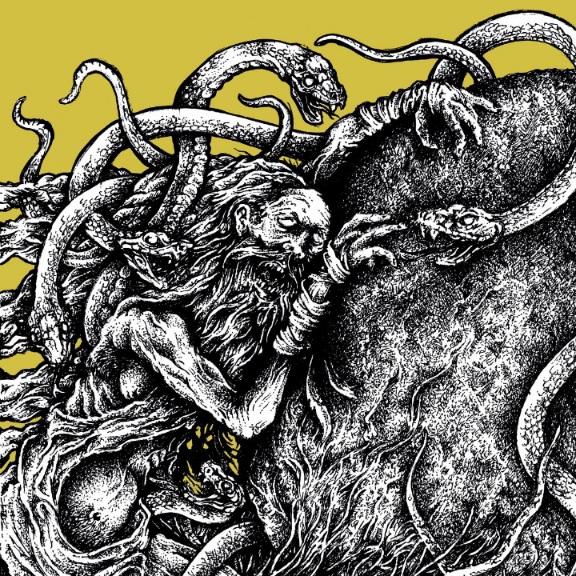
Twelve songs, and ten of them are finished before the two minute mark. The longest, "Slope", runs two minutes and eighteen seconds. The whole of Sisyphean Life is over inside twenty minutes, which is a tea break with the kettle still warm, and that running time is most of the argument before a single blast beat has landed.
The four men from Groningen who have spent fifteen years turning the working week into a percussion instrument, Suffering Quota, put their fourth full-length out on 18 September 2026 through 7 Degrees Records and Tartarus Records at the same time, three years on from Collide, twelve tracks deep and named after the one figure in Greek myth who never got to go home.
Nothing in the line-up has moved and nothing needed to. Gerald Timmermans has been shouting for this band since 2015 and works almost entirely at the top of his range, a shriek with a bellow underneath it for ballast. René Beukers, who also plays in a band genuinely called Grinding Halt, spends the record taking an angle grinder to his own chords. Martin Kah keeps a concussive blast going with the air of a machine that has one setting and no off switch.
"Strain" opens the shift and sets the terms. Seventy nine seconds, blasting from the first bar, then a crawl at the end heavy enough to crack a paving slab. "Overpowering Weight" carries the whole idea, the only song here with room to move around in. Kah described it to No Clean Singing on 7 July 2026: "After the grindcore start, the powerviolence takes over to end with a heavy groove that slows down to a grinding halt." What he leaves out is that the closing riff, in seven eight, gets slower every time it comes round, so the album writes its own subject into the arrangement instead of leaving it to the lyric sheet.
"Slope" does the dirty work at walking pace: dissonant, circular, a riff with the patience of a job nobody wins an argument with. Relief arrives in seconds and is taken straight back. "Again" takes fifty eight seconds. Kah told Decibel on 26 August 2026 that it is "a 59-second outburst of total madness. This is the soundtrack of a train derailing." He undersold it.
Here is what the record does with its myth. It takes the rock off the mountain and brings it indoors. There is an asset number stencilled on the side of it now, and a rota, and a time clock by the door, and the job is to push the thing from one end of the floor to the other until the whistle goes so the night shift can push it back where it started. The riffs do not develop. They clock on. That is why the repetition is a design rather than a shortage of ideas, and why the album gets harder to shake on the third run rather than easier.
This is where the album divides a room. Heard one way it is twelve songs. Heard the other it is one unbroken run sheared into twelve pieces, twelve detonations and a door closing. It is twelve songs. A band that runs grindcore into powerviolence into a doom crawl inside one track, then parks "Slope" at walking pace in the middle of the blasting, is not making one block of noise. The variation is in there. It arrives at speed and leaves before it can introduce itself.
The flaw is small and specific. Twice the record stops shouting and finds a melody. "Dust" does it for forty nine seconds. "Strain Once More" does it again a track later. Both are the best evidence here that these four can write something other than an assault, and both are gone before they have done anything with it. The concept covers for them, because nothing may develop when the man pushing the rock never develops either. Good excuse. It is still two moments that should have been songs.
Nothing here is underwritten except the two moments that should have been songs.
It will not convert anybody, and nobody in the band asked it to. The production is raw and deliberately airless, density and volume between them pulling the last of the oxygen out of the room, and a listener with forty grind records on the shelf can still bounce straight off the dissonance and the pacing. That is the price of the thing working at all. Sand it down for comfort and the concept collapses into twelve fast songs about nothing.
Three years of work, under twenty minutes of product, four hundred copies pressed, and a band that has got better at the single thing it does without once pretending to do something else. Play it twice. The second pass is where the craft under the noise turns up, which is the record making its own argument. Getting to the top of the hill was never the job.