
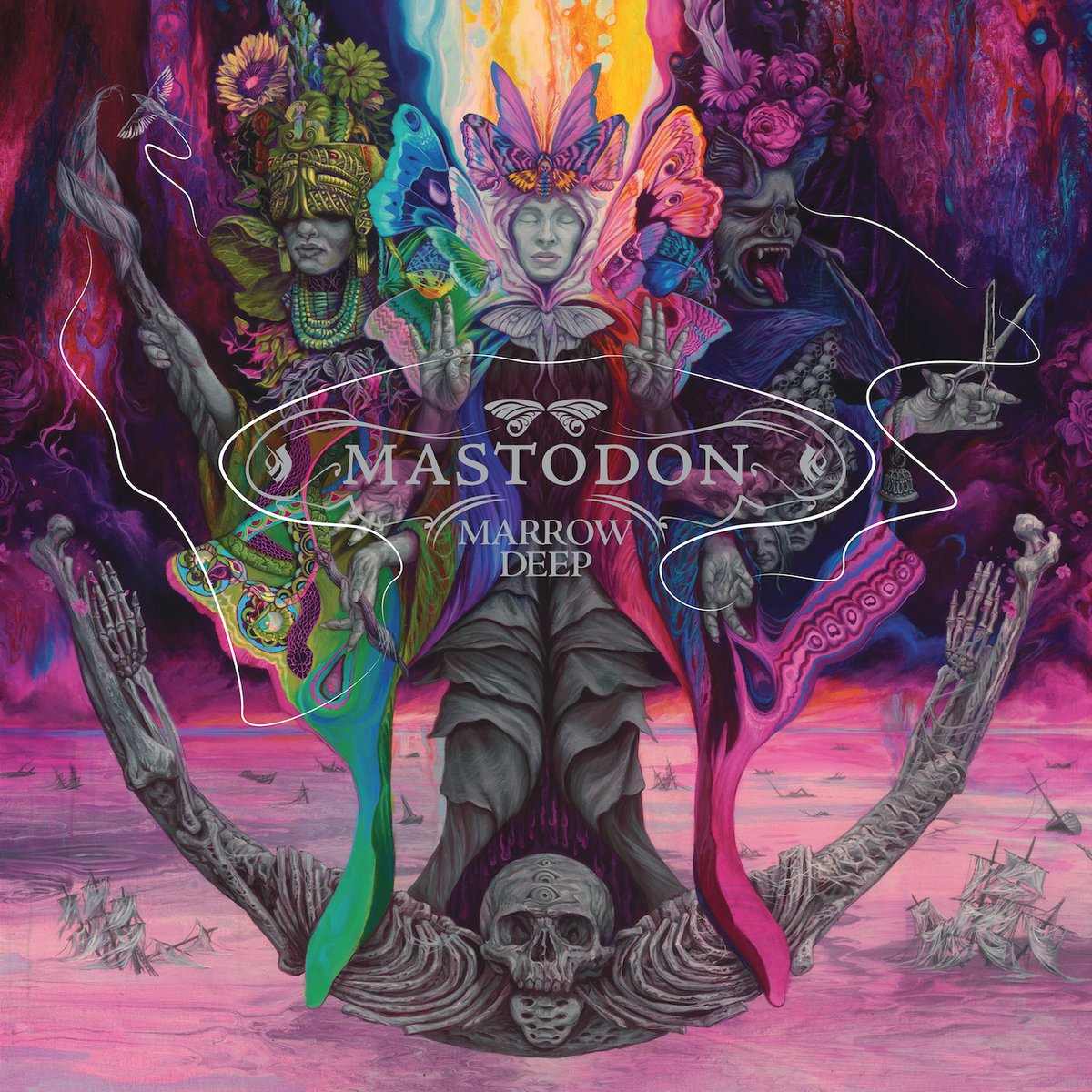
The question put to Marrow Deep was never whether Mastodon could still play. It was whether the band could write a Mastodon record without Brent Hinds, the founding guitarist, singer and songwriter who is not on it.
The band dismissed Hinds in early 2025, and he died later that year. This album was recorded in September 2025, after his death and after the death of Brann Dailor's mother, and it is a record about grief.
The surviving founding trio, Dailor on drums, Sanders on bass and Bill Kelliher on guitar, took on two new full members, Nick Johnston on guitar and João Nogueira on keyboards, handed production to Patrik Berger and Kurt Ballou of Converge, and delivered the ninth studio album on 28 August 2026, their first for Loma Vista Recordings and the first ever made by Mastodon as a five-piece. It entered the American Billboard 200 at forty. The four-piece is finished.
The sombre double-LP sprawl of Hushed and Grim, the 2021 predecessor, has been traded for something leaner and harder, and the whole of the band's past is audible in the trade. The record works like a core drill. The bit tears straight down through the band's own geological record, the sediment of Leviathan, the hard crust of Blood Mountain, the dark seam of Crack the Skye, and hauls up one column of rock in which every layer is present, every grain visible, and not one of them as thick as it lay in the ground. It does not reach the height of those albums. Two thirds of it could be mistaken for any Mastodon record made since The Hunter, and that is the fairest complaint the album invites. It is still too severe. A core cut from familiar ground is still a new core.
Five players and one absence
Johnston is not the problem, and he is not the answer either. He fills the space admirably and without imitating the man who left it, a hugely competent guitarist arriving in a band that had never before needed to recruit one, and that is also the limit of what this record can do about its central loss, because a capable player in the second position restores the parts and not the man who wrote them. Competence is not the same thing.
Where the five-piece earns its keep is in the places that were never Hinds's to begin with. Nogueira's keyboards are the largest single change to the band's sound, a permanent voice in the arrangement rather than colour applied by a guest, and the gain is real: the keyboard freakout that runs through the second single, "Snakes for Dinner", does more for that song than the guest vocal laid over it. Dailor's drumming is beyond argument, and the two voices, Sanders rough and Dailor clean, are the other constant, the soaring chorus of "Golden Spires" balancing the melodic and the heavy halves of the album because the two answer each other rather than take turns. The foundation stone under all of it is the drum kit, and there is not a crack in it.
The column, layer by layer
"Your Ghost Again", the first single, is the centre of the record and the piece that needs no defending, a tribute to Hinds carried on urgent driving verses that open out into melody. It moves without reaching for it.
"Moth and Bone" is where the drill strikes something that was never in the band's ground at all. A keyboard figure opens it and layers over itself in cascading lines, closer to jazz than to metal in its bearing, and a listener dropped into the first minute of it would not name the band; this is the track that breaks the mould, the place where Johnston's soloing sounds least like a man sitting in somebody else's chair, and the strongest argument the new line-up makes for its future.
The weight sits at the end. "The Vanishing" is a psychedelic odyssey with Geezer Butler of Black Sabbath on the bass introduction and Joe Duplantier of Gojira on vocals, and "The Three Fates" is a monolithic jam of a closer, with Neil Fallon of Clutch preaching over the top of it, the most experimental thing the band has ever put at the end of a record. The guests are where this album divides its audience. Butler's introduction can be heard as a passage pasted on to the front of a song that did not need it and Fallon's sermon as a distraction laid across a finale already built, or both can be heard as the reason those two songs open as far as they do. The first reading is the honest one. The cameos are the most disposable material here and both songs would survive losing them, but the writing underneath is the most ambitious on the album, and those two are better than the record that holds them.
A good Mastodon record without Brent Hinds turns out to be possible. A great one has not arrived.
Where the rock is soft
The trouble sits in the middle of the column. The back half drags, consecutive slow acoustic passages sag through it, and an hour of music that would have been improved by shrewder editing goes out instead at full length; Sanders's repeated cry on "They're Coming for You" grates by its third return, and a hook a listener starts counting has been sung once too often. A band nine albums into its career should not let the middle of a record about loss go slack. That part is not good enough.
The mix is the second fault. The production is crunchy and too clean at once, and a compressed master saps power from a band whose whole appeal is weight: riffs disappear whenever drums, vocals and synths arrive together, and the crash cymbals ride over and flatten the instruments beneath them. The warmth in it is real and it has been paid for by squeezing the range out of the loud parts. The faults pull in different directions and they cost the same thing, the guitars, and on an album whose whole argument turns on what the guitars can still do without Hinds, a mix that buries them works against the case the songs are making.
Split this record like a bone and the marrow is there, dark and dense, in "Your Ghost Again", in "Moth and Bone" and in the two long songs that close it; the rest is bone, well made, heavy in the hand, and there is too much of it packed around the good parts. Marrow Deep is for the listener who has followed this band since Leviathan and needs to know whether it survived, and it gives that listener a qualified yes. Anyone who passes on it gives up four songs on which the new five-piece sounds like a band with a future, and very little else.