
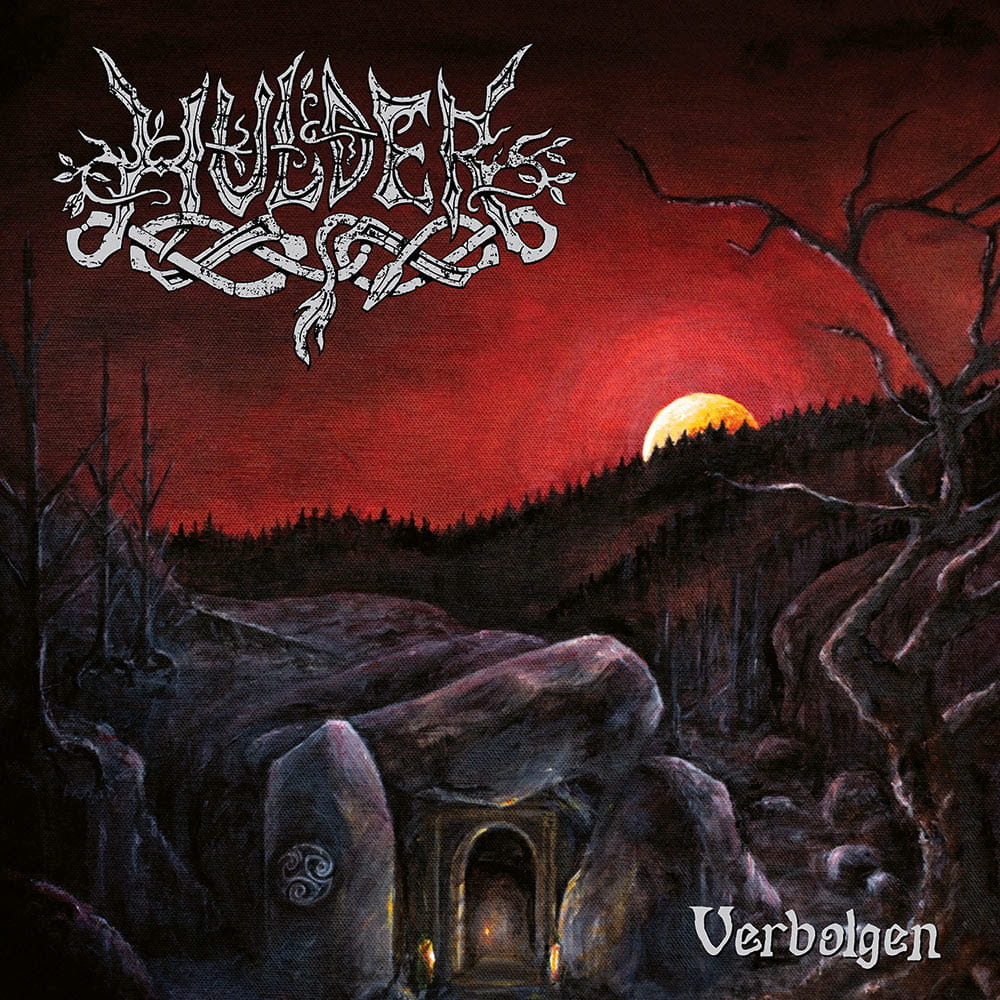
On 7 August 2026, 20 Buck Spin in North America and Season of Mist across the rest of the world released Verbolgen, the third full-length from Hulder, nine tracks and just under forty-nine minutes gathered under an old Dutch word for incensed, and the first record in this project's short, furious life on which the anger has been ruled, measured and set down by more than one hand. The title is wrath. The book is patience.
The Belgian-born scribe who founded this project alone, Marliese, no longer holds the pen by herself. Promoted from session bassist to full and equal writing partner, Necreon, who is Sam Osborne of Funebrarum and her husband, now shares the bass, the voices and the songs. The corpse paint that fronted Godslastering: Hymns of a Forlorn Peasantry in 2021 and Verses in Oath in 2024 has been scraped off the frontispiece and replaced by an emblem drawn from the forest, the old face cut out of the book with a penknife and the page left clean for something older. Two scribes. One desk.
That is the shape of the whole record. Verbolgen is not a pamphlet run off a hand press in a hurry, it is an illuminated manuscript: tremolo lines in the old second-wave hand ruled across the vellum in iron-gall ink, which goes on pale, darkens as it dries and keeps eating into the skin for centuries, and round the margins the hurdy-gurdy, the flute and the acoustic guitar coiled like the vines and beasts a monk painted round a psalm. The lyrics move between English, Flemish and old Germanic like three scripts sharing a single page. It is a record built to darken on the page rather than scald on contact. It is slow craft. It shows.
The pages that burn
"Drie raven (Intro)" rules the margins and lays out the colours before a word is written, and then "The Crowning" arrives as the one page set down in the hand of the earlier records: the most immediate thing here, a tremolo assault in the early second-wave manner that goes for the throat and does not stop to decorate itself. "Thy Binding Oath" follows it through the same breach, and together the opening salvo settles the first question anyone will ask, which is whether a second author blunted the knife. He did not. Marliese's rasp is the quill cut to a point, scratching hard enough to tear the grain of the skin, and against it Necreon's voice and the new chanted and clean passages open a second column down the leaf, two voices answering each other in a way no earlier Hulder record could manage, because no earlier Hulder record had two authors. The production keeps the ink clear without bleaching the underground out of it.
At the hinge of the nine stands "...and We Shall Sing", six minutes under a title that reads like a rubric in red at the head of the page, the partnership announcing before a note is struck that this book is sung by more than one voice. "In Blood and in Earth", at seven minutes and nine seconds the longest piece on the album, is the centrepiece, the song where the partnership shows the full reach of its writing, folk instruments and black metal worked into one long composition. Then comes the leaf the whole book was made to carry. "Den nacht zijn lied", the night's song, is the strongest thing on Verbolgen: the page an illuminator keeps back for the great initial, gold leaf laid on gesso and burnished until it flares off the vellum like a struck match, every melodic idea on the record gathered into one lit letter and set burning at the head of the text.
Where the ink runs thin
The fault is in none of those songs, which is exactly what makes it hard to cut out. Godslastering is Dutch for blasphemy, and the record that carried the word was heresy nailed to the church door, unchecked venom struck off in one pass and left to stain the wood; Verbolgen trades that venom for composure, and somewhere in its back half the trade comes due. Through "View from Nemeton" and on towards the close the pieces keep the same measured stride, handsomely made and lit in every margin, and the momentum slackens precisely where the book should strike hardest. Rich pages. No blow.
The riff that snaps the neck, the hook that the earlier records drove through the skull and left there, is the one page this manuscript never writes.
"The Glow of Dawn" is where that argument is settled or lost, and the closer splits clean down the middle: a hypnotic, patient ending that lets the book shut itself, or an ending that never quite arrives. It is a colophon, the scribe's quiet line at the foot of the last leaf, and a colophon is honest work. It is also not a final blow, and this record needed one before the colophon, not instead of it.
So the book is the best thing Hulder has made, and it is still not quite the book it could have been. Verbolgen is for anyone who wants black metal written slowly and by two hands, pre-Christian memory under every line and folk instruments crawling through the margins, in ink that keeps darkening long after the page is turned. What it costs to ignore is "Den nacht zijn lied" and the opening salvo, the clearest proof yet that this project grew by taking a partner rather than by losing its teeth. What it withholds is the single page that bleeds. Nine tracks. One missing wound.