
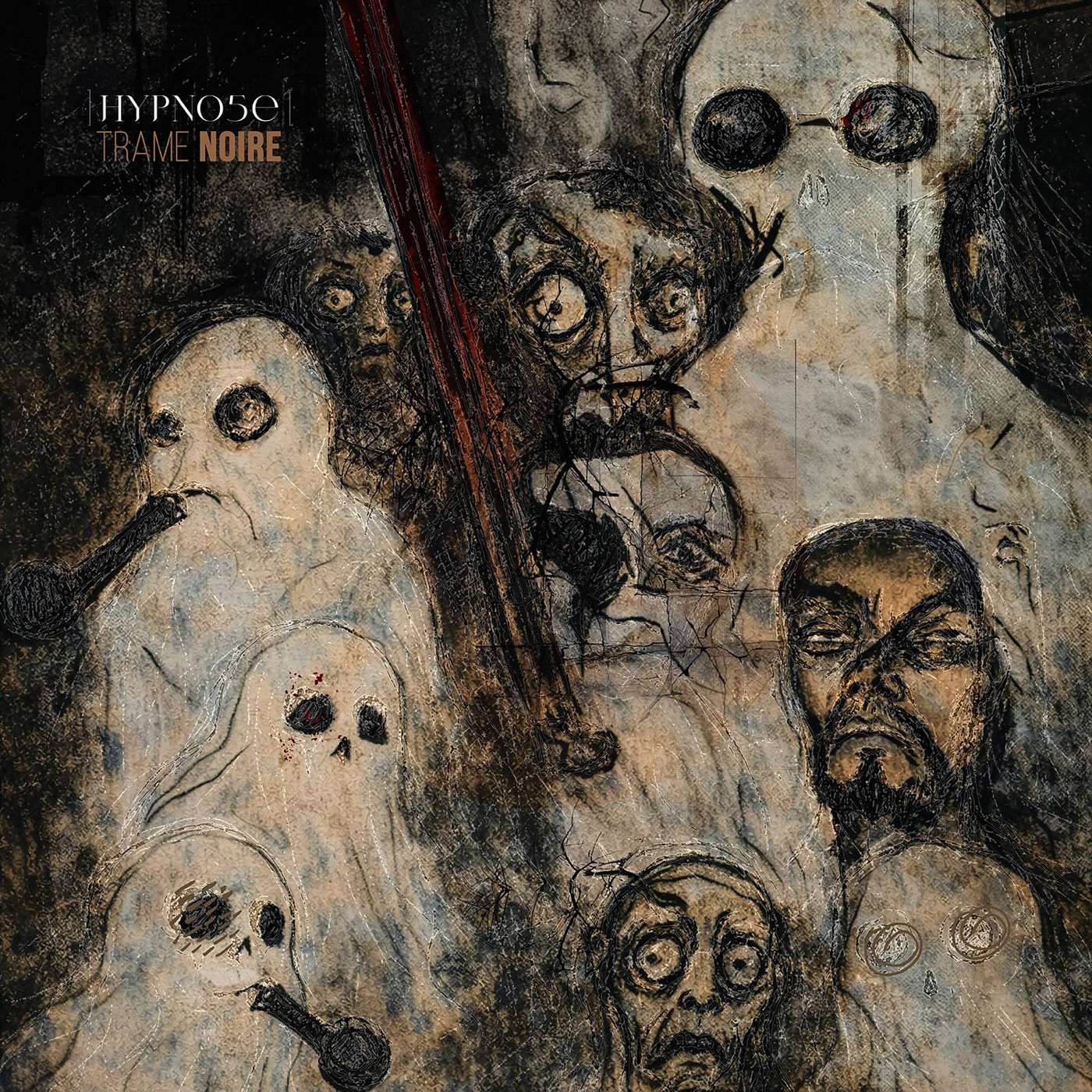
Thirty-nine minutes and eighteen seconds. For a band whose recent albums ran past the hour mark, that number is the whole argument of Trame Noire, the shortest record Hypno5e have ever made and, by a clear distance, the most tightly woven.
Released by Pelagic Records on 6 November 2026, more than three and a half years after Sheol and seven years after A Distant (Dark) Source, the seventh studio album from the French quartet of Emmanuel Jessua on voice and guitar, Jonathan Maurois on guitar, Charles Villanueva on bass and Pierre Rettien on drums is the first record this line-up made as a four, though the four only began playing together in September and most of the writing was done in pairs, with a sleeve painted by Jessua's father, Thierry, who by his son's account wrote the lyrics. "They were written by my father," Jessua told Verdammnis in an interview published on 15 October 2026, translated from the French. Five tracks. No guests. Nothing loose.
Start with the title, because it does two jobs. In French, a trame is the weft, the thread that runs across a loom and binds the warp into cloth. A trame noire is also a term from conservation, a corridor of darkness left unlit so that nocturnal animals can move through it, and Jessua found it on La Réunion, at an observatory, talking to a scientist who studied it. One protagonist, one night, a trauma faced in the dark. The story, he has said, is almost a detail. The weave is the point.
And the weave is dense. Picture a loom at full tension: the warp of the rhythm section strung tight from end to end, and across it the shuttle flying, heavy blackened passages one pass, airy synth-led ones the next, the direction turning hard at the edge of every row, each pass beaten down against the last by the reed until not a single loose end is left hanging off the selvedge. That is how these songs are built. Structures shift constantly, the turns are abrupt, and conventional hooks are scarce. Predictable is the one thing this pattern never becomes.
What changed is the yarn. The sound is warmer and looser than anything the band has put on record, more organic, lighter on samples, with a seventies psychedelic and progressive grain running through it that pulls the whole cloth toward Pink Floyd territory. Now the gear part. Jessua told Verdammnis the guitars were reamped this time, a first for the band: the recorded guitar signal is sent back out through an amplifier and miked up again in a room, which is how you trade the sterile precision of a direct signal for air and grit. The drums were recorded last.
"Lost Fires" opens the loom and sets the pattern every other track will follow. "Falmer" is the piece that travels farthest, from a calm, drifting opening to a forceful outburst, the shuttle slamming home row after row until the cloth itself seems to tighten. Jessua and Villanueva went from instrument to instrument on songs like this one, piano and harmonium among them, two weavers trading places at the beam. "Molecular Angel" is the short one, under five minutes, the tightest weave on the album and the best way in for anyone new to the band.
A cloth this dense is not worn on the first day; it is broken in.
"Bare Bones" carries a title the whole record could have worn, and then the title track closes it. "Trame Noire" runs close to ten minutes and ends on a harmonium that, by Jessua's account, was recorded in a rush, the band unsure where to put the microphones, and then left that way, the last pass of the shuttle kept as it fell rather than tidied into the pattern. It is the right ending. You can see the hand that made the cloth.
The vocals carry the same double thread. Clean singing, high and clear, sits against harsh screams, the same contrast this band has always run on, and the new warmth of the sound gives the clean thread more room to show its colour. That is the house style, and it is intact.
What holds it back is what holds every Hypno5e record back, only tighter. This album asks you for work. There is no chorus waiting at the end of the row to reward you, and a first listen leaves you holding a handful of beautiful threads rather than a finished piece. Three or four listens in, the pattern appears all at once. Some will not give it that long, and nothing in the record tries to persuade them.
So here is the verdict. Trame Noire is the most focused record this band has woven, the warmest and the most human, forty minutes of cloth with no wasted yard in it, and it sits a single step below essential only because it refuses to meet you halfway. If you like your progressive metal sprawling, the band's longer records are still there. If you have ever wished Hypno5e would cut the bolt shorter and pull every thread tight, this is the one you were waiting for, and leaving it on the shelf means missing the tightest piece of work ever to come off their loom.