
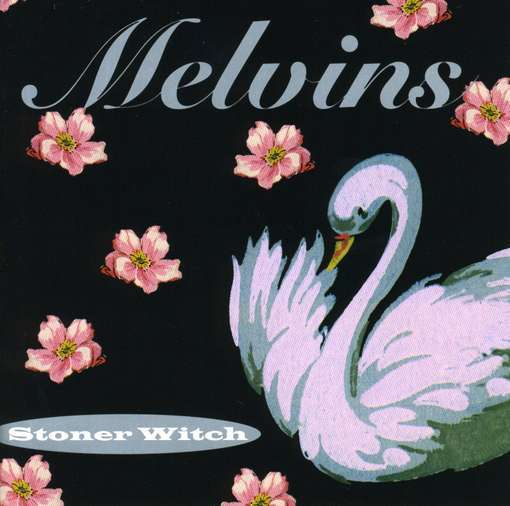
Nineteen days. That is all the time the trio from Montesano spent at A&M Studios in Hollywood on Stoner Witch, most of the songs captured in a single take, GGGarth Richardson producing beside the band, Joe Barresi recording and mixing, and the tracking and the mastering done in one continuous session, the way a foundry pours a whole bell in one go because a second pour would leave a seam you could hear for a century. It shows. Nothing on this record sounds assembled. Everything sounds cast.
Released through Atlantic on 18 October 1994, the second of the three albums the major label paid for, between Houdini in 1993 and Stag in 1996, Stoner Witch is the record on which the Northwest's slowest and heaviest institution, signed with Kurt Cobain's backing after he had co-produced part of Houdini, took a grunge-era cheque and used it to pave over every sales projection on the Atlantic desk with a single detuned chord. King Buzzo sang and played guitar, Dale Crover drummed, Mark Deutrom played bass. The title is what Crover and his friends called the stoner girls at their high school. It sold around fifty thousand copies on its first release and then spent the better part of two decades out of print, until Third Man Records cut it again from the original analogue tapes in 2016.
Two things about the sound are settled. It is the most approachable album Melvins had made to that point, built from songs that keep a verse and come back to it instead of grinding a single riff into the floor. And it is loud in a way that stops being a matter of taste and becomes a matter of physics: the drums arrive like a pile driver working a building site at dawn, and the guitar comes down after them like hot tar poured from the top floor of the same building, slow, black and impossible to scrape off.
The first side behaves like a record that knows who is paying for it. "Skweetis" is over in a minute and twelve seconds, a throat-clearing rather than a song. "Queen", out as the first single on 26 September 1994, is three minutes long and the clearest statement of the bargain: a proper song, built for a label to push, with the weight left in.
"Sweet Willy Rollbar" opens on the snorting of a pig and is finished inside a minute and a half, a punk sprint that ends before anyone has decided whether it was a joke. "Revolve", the one chosen for radio, is as close as the record comes to something a major label could sell, and it is still a Melvins song long before it is a single.
The first side was made for the label. The second side was made to find out how much the label would put up with.
The answer begins with "Roadbull", whose whistling floats over the riff like a man walking home past a slaughterhouse, and it arrives in full with "At the Stake". Eight minutes less four seconds, slow, menacing and patient, it is the centre of the record and the best thing on it, a funereal procession that builds its own pyre one log at a time and never lets the flame hurry. Every quality the band would be remembered for, the lethargy turned into threat, the weight that refuses to apologise, is in those eight minutes.
Then the album starts testing its own audience. "Magic Pig Detective" spends most of its five and a half minutes on noise and feedback before snapping into a fast, almost thrash section, and the snap is worth the wait, just. "June Bug" is two minutes of bass and drums alone, a short breath before the end. And "Lividity" closes the record with nine minutes and fifteen seconds of bass and feedback, which is where the bargain finally breaks. As a statement against the label it is magnificent. As music it is four minutes of idea stretched over nine, and it costs the album the ending it had earned with "At the Stake".
That is the limit, and it is the whole limit. Stoner Witch is not the band's most extreme record and not its most consistent one. It is the one on which a sound built for basements was given a major label's room and a major label's budget, and refused to become any smaller or any friendlier in return. For anyone who has only heard the band as a footnote to Seattle, this is the door in. For anyone who already knows the early records, it is the proof that the weight survived the money. Skip "Lividity" the first time. Come back to it later, when the album has earned the patience it asks for.