
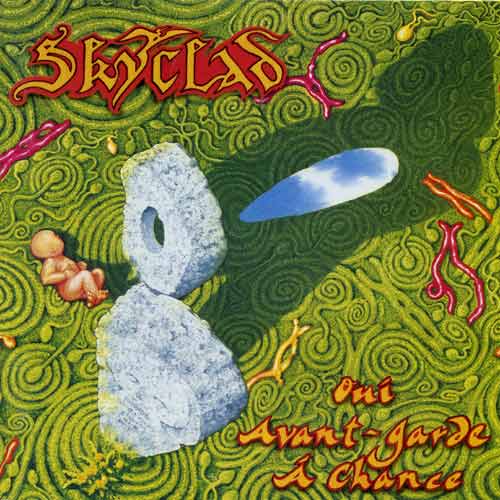
On 4 November 1996, not quite nine months after Irrational Anthems had opened the band's account with Massacre Records, the label's Swanlake imprint released a second Skyclad album inside a single calendar year, and the opening bars leave no doubt about the appetite behind it. A drum roll, a fiddle line at full gallop, and George Biddle's bow saws the hymn sheet clean in half while the former Sabbat singer, Martin Walkyier, hurls an anathema at heaven over a dance tune built for a barn floor rather than a pew. "If I Die Laughing, It'll Be an Act of God" is a country dance in open heresy against the Sunday service. It is also the strongest argument the record makes.
Recorded at Parr Street Studios in Liverpool and at Jacobs Studios in Surrey, produced by Kevin Ridley together with the band, mastered at the Townhouse in London by Bunt Stafford-Clark and played by four credited members plus two drummers who split the kit between them, Paul A.T. Kinson on five tracks and Paul Smith on the other seven, Oui Avant-garde Á Chance is a pasticcio. The eighteenth century knew the form well: a stage work stitched together for a single season out of arias already written, some by the house composer, some lifted from rivals, a few old favourites dressed in fresh ornaments. The borrowings here are printed in the credits. Seven new songs, one instrumental shadow of one of them, two reworkings of songs from Irrational Anthems and two covers, fifty-three minutes and forty-six seconds in all. Even the title shrugs, French words picked to sound like "We haven't got a chance" and to mean nothing whatever in French.
Seven songs of genuine invention and five of padding add up to a record whose first half would hold its place on any of the band's albums with Walkyier and whose second half is a sleeve note set to music.
The four musicians the sleeve lists as Skyclad divide the composing with unusual fairness, Steve Ramsey writing the music to five tracks, Graeme English to three, Biddle to two, Walkyier every word that is not a cover, and the guests supply the ornaments. Three members of the German folk rock band Subway to Sally come in from outside, Eric Hecht on bagpipes and penny whistle, Frau Schmitt on a second violin and Bodenski on backing vocals, and Les Smith adds accordion to three tracks. English's "Great Blow for a Day Job" puts the visitors to work: an entirely acoustic Irish dance tune, pipes and whistle over the accordion, taken at the tempo of a fiddler who has heard the devil tuning up behind him. The lyric is a Faustian bargain struck to escape the day job. Not one electric guitar answers the call.
Then the record drops its tempo three times running. "Constance Eternal", "Postcard from Planet Earth" and "Jumping My Shadow", all three with music by Ramsey, form a slow movement of real weight, and the first of them is the finest thing here after the opener: an elegy, dedicated in the handwritten booklet to a woman born in 1903 who died in the year the record was made, carried by fiddle and acoustic guitars. "Postcard from Planet Earth" drifts toward psychedelia and hangs its chorus on a hook the band would have been glad of in any year, and "Jumping My Shadow" tells a failed love affair without self-pity. Walkyier, the scold of every earlier record, writes here like a balladeer singing to an empty chair. The protest song waits.
It comes back with "Bombjour!", Biddle's tune against the French nuclear tests of 1995, its lyric bending a nursery round into a wake-up call for President Chirac, and with English's "A Badtime Story", the darkest of the new songs, slow and morose, a dirge in all but name. Seven new songs. Not one of them weak.
From the seventh track on, the pasticcio runs out of new arias. "History Lessens (The Final Examination)" and "Penny Dreadful (Full Shilling Mix)" rework two songs that had come out on Irrational Anthems in February, and "Bombed-Out (Instru-Mental)" is "Bombjour!" with the voice taken away. The two covers, "Come On Eileen" from Dexys Midnight Runners and "Master Race" from New Model Army, are played with good manners and no reason; the Subway to Sally trio called in to sing and play on the first of them cannot supply one. A reprise is a device for the end of a long work, a theme returning transformed once the listener has earned it. Five reprises and borrowings among the last six tracks, two of them taken from a record still in the shops, turn the back half into a string of encores for a concert that had barely begun. Only the "Full Shilling Mix" justifies its seat, and it has the best pedigree of the lot: a new arrangement and Les Smith's accordion brighten the February original, and its sneer at a music business that buys and sells singers bites harder in the new costume.
Seven songs of genuine invention and five of padding add up to a record whose first half would hold its place on any of the band's albums with Walkyier and whose second half is a sleeve note set to music. The booklet that came with it on 4 November 1996 thanks the buyer for "our little musical experiment", and the description fits to the bar: a metal band writing its folkiest music yet to see how far from the amplifier it could travel and still sound like itself. Play it as far as "A Badtime Story" and stop, and you hold thirty-eight minutes of rarely generous folk metal; let the disc run on and the experiment turns into its own rehearsal tape.