
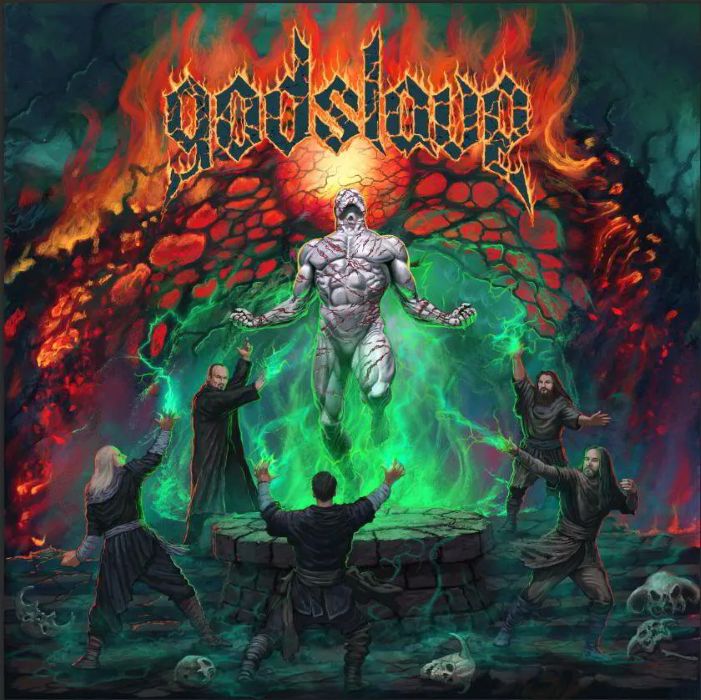
Eight albums in, and the one with the band's own name on the sleeve turns up five years after the last set of songs they wrote themselves. Godslave filled that gap in 2025 with Champions, a covers record made to mark fifteen years of the band, its tracklist running from Twisted Sister to Limp Bizkit to a David Hasselhoff song played with a straight face. That was a lap of honour. This is the record: ten songs, out on Metalville on 11 September 2026, and it is a very strong German thrash album, machined to a drawing and tested to it, whose finest moment is the one where somebody puts the drawing down and makes a part by hand.
The five men who spent an anniversary year living inside other people's songs had something to prove about their own, and the title is the proof they picked. Guitarist Bernie told the metal.de podcast on 6 September 2026 that the album was nearly named after its opening track and that the band put its own name on it instead because this one needed it, and in the same conversation he gave the subjects as mobbing, depression, self-hatred, belonging and forgiveness, under the standing description of what this band does: German thrash metal with a positive attitude. Ten songs later that motto has calluses on it.
"Reset, Rebuild, Reclaim" opens the album by putting an angle grinder to the seam between the Teutonic template and everything these five have been listening to since, and the sparks come off both sides. The build is Kreator, no ornament anywhere on it, and as a statement of intent it leaves nothing to argue about. What follows is more varied than a band eight albums deep usually gets credit for: punkier than the last one, more melodic than the last one, both at the same time, which by rights should not work. The rhythm guitars lose not a kilo to the tunes. Accessible is normally the word for something that has been softened. Not here.
Underneath all of it sits the thing the German scene has been admired for since the early records of Sodom, Destruction and Tankard: rhythm guitar as engineering. The two guitars deal in thick, repeatable parts cut to a tolerance, and there are enough different ones across the ten songs that nothing in the second half sounds like an offcut from the first. Overkill is the other name in the room. It stands beside the German three rather than in front of them, and a record that carries two lineages without disappearing into either is doing something an eighth album is under no obligation to do.
The songs and the jobs they do
"And Yet I Stand" is the straight thrash song and the one where the lineage shows plainest: it starts in the Bay Area and walks to Germany without changing its shoes, a Slayer downbeat handed over to a Kreator chorus. "Square One" goes past in three minutes and thirty-nine seconds and is the leanest thing here, proof that a band with this much machinery available can still decide not to use it.
"Let the Fire Come" is where the record breaks its own mould, and it divides a room. Heard one way it is the most adventurous song on the album, wandering off the thrash grid into passages that belong to a different kind of band altogether. Heard the other way it falls out of the frame, harder and more rhythm-bound than anything on either side of it, a good song in the wrong house. Both hearings describe the same song correctly. Only one of them is right about the album, and it is the first: a record built this squarely can afford one room with a different floor, and that is the room people will keep walking back into.
"The Fire That Calls Me" closes the album and is barely a thrash song at all. It steps out of the genre and into power metal, sets Laura Guldemond of Burning Witches against Thommy's shout, and builds the kind of chorus that comes back at you off the floor instead of out of the speakers. It is the best thing on the record by a margin that ought to worry the rest of it. Picture the works at the end of the shift: spanners down, the drawing folded over the bench, and one part made freehand that sits better than anything bolted up to specification all day.
Ten songs machined to the drawing, and the part that matters most was made freehand.
Where the drawing runs out
So here is the limit, and it is not a fault in any single song. The centre of this album is dependable in the exact way a well made thing is dependable, and dependable is where it stops. The straight thrash songs are built to a specification, run at full load and handed back in working order; not one of them fails, and not one of them surprises. Nothing here is broken. Nothing here is dangerous either. The two songs that ignore the specification are the two you go back to, and an album whose departures outrank its core is telling you what it thinks of its core, however clean the welding is everywhere else.
Against that, the subjects do more work than they are usually given credit for. A thrash record that goes at mobbing, depression and self-hatred and comes out the far side arguing for belonging and forgiveness is a harder thing to write than another forty minutes of nuclear war, and it is the reason the melodies were let in at all. The positive attitude is not a slogan stuck on the front. It is the writing brief, and it holds for all ten songs.
Bands at this point in a career normally book the anniversary tour, keep the covers set and quietly stop writing. I have watched it happen often enough to be glad it did not happen here. Godslave is ten songs of German thrash made by people who still care whether a riff is any good, with a closing track that says the next record could be a stranger and better one if the hand-made parts are let off the leash. Buy it for the riffs. Keep it for the ending. Ignore it and you miss the point at which a hard-working band found out what else it can do.