
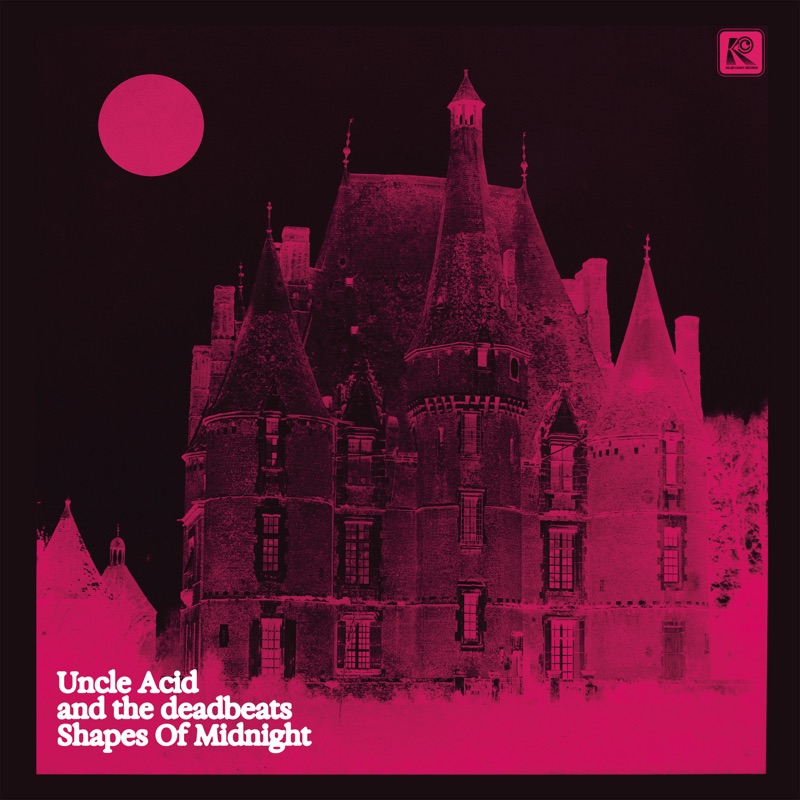
The argument against Uncle Acid and the Deadbeats has always been that the murk was doing the work, that a layer of tape saturation and second-hand reverb sat between the listener and a set of songs that would look ordinary in daylight. Shapes of Midnight is that argument answered, and it is answered in the least forgiving room the band could have booked.
The English outfit that built its name on a home-made gloom took its seventh studio album to Abbey Road, tracked it live to analogue tape across a three-day session with the engineer Chris Bolster and a set of vintage Neumann microphones from the EMI era, had Noel Summerville master it, and released it on 18 September 2026 through Killer Candy Records, the band's own imprint and the label that first issued Blood Lust in 2011. Three days. Eight songs, forty-five minutes, and no chance to overdub the nerve back in afterwards. The session stripped the reverb off the guitars and left the room standing in its place.
Nell' Ora Blu, the 2024 predecessor, was a mostly instrumental soundtrack to a Giallo film that does not exist, keyboards and atmosphere carrying an hour of music with barely a riff left standing in it. This record brings the guitars back to the front and keeps the keyboard confidence that detour bought. It is a concept album built on Edgar Allan Poe's "The Masque of the Red Death", the rich sealing themselves in while the plague works through everyone outside, and Kevin Starrs has pushed the parallel past the story, so that the wealth gap and a ruined environment stand where the plague stood. "Our albums exist in an alternate universe to our own," Starrs told Premier Guitar on 25 July 2026. "They're all stories that could happen here, but everything's just a bit off."
What the room did to the songs
This is where the album divides a room. The Abbey Road session can be heard as a scrubbing, the one distinctive thing about this band sanded off in a studio built for other people's records, or it can be heard as the first time these songs have been shown without cover. Both readings are reacting to the same method, and the method belongs to an older machine: eight songs played into one horn, cut whole, with the creak of the kit and the air between the amplifiers kept in the groove because taking them out would have cost more than they were worth.
The second reading is the correct one. A clean capture of a dirty performance is not a clean record, and the tar drained out of the guitar tone has gone into the timing instead: nothing here is nudged, quantised or flown in, and the small drags and rushes of a band playing at once carry more menace than any amount of reverb ever did. The grain did not go anywhere. It belongs to the room now rather than to the desk, and the distance between those two is the whole record.
The songs that make the case
"House by the Grave" opens the door and takes the long way through it, six minutes and forty-nine seconds of the riff writing the band was doing in 2011, thickened by a gallop lifted from the New Wave of British Heavy Metal and a second guitar line running in harmony above it in the manner Thin Lizzy made standard. It is the most direct statement of intent the band has made in a decade. The title track then stops the record being a horror album and starts it being a strange one, moving into a boogie played in the present tense, opening in the middle into a passage of psychedelic prog that takes its bearing from the space rock Hawkwind was making in the early seventies, and walking back into the song as though nothing had happened. It is the least predictable five minutes here.
"Psycho on the Loose" does the dirty work without a riff. The keyboard figure at its centre is struck rather than played, one cold interval at a time, a needle set down in the same groove until the repetition itself becomes the threat, and the effect is worse than anything the heavier tracks manage. A song that never raises its voice turns out to be the most frightening thing on the album.
"I Won't Sleep ('Til You're Gone)" is the one that will outlive the record. It swaggers where the rest of the album stalks, six minutes of sleaze built on a hook that cannot be shaken off, with a saxophone arriving where no song by this band has ever needed one. Set against it, "Don't Let It Control You" is the shortest thing here at three minutes and forty-five seconds, the lead single, and the clearest demonstration of what Starrs actually writes: a pop song with the wiring crossed, catchy enough to be whistled and unpleasant enough that whistling it feels like a mistake.
Take the murk away and the songs are still standing. Take the last eleven minutes away and almost nothing is lost.
The last eleven minutes
The record does not know how to finish. "The Other Side of the Sky" and "Sleep No More" carry eleven of the album's forty-five minutes between them, and they are where an album that has been tightening for half an hour turns leaden in the wrong way, a dirge pace arriving after the songs have stopped supplying reasons for it. "Sleep No More" is the bleakest and most furious thing here and it is still not an apex, because fury at the end of a record is not the same as a record arriving somewhere. Forty-five minutes of accumulated dread should close on a bell. This one lets go of the rope before the bell sounds. Seven albums in, that is not a problem that should still be open.
What Shapes of Midnight proves is the thing this band most needed proving. Fifteen years on from Blood Lust, the records made in the dark turn out to have had songs underneath them the whole time, and the proof cost three days, a borrowed room and a set of microphones older than anyone who played into them. It is the best-made record the band has, and it is still not quite the best one, because an album that spends thirty-three minutes sealing the doors should know what to do when they come open. Anyone who wrote this band off as an effect will have to do it again, on new evidence and without the excuse. Anyone who has waited since 2011 to hear these songs recorded as well as they were written now has the record, and ignoring it means missing the one album in the catalogue that does not need the dark to work.