
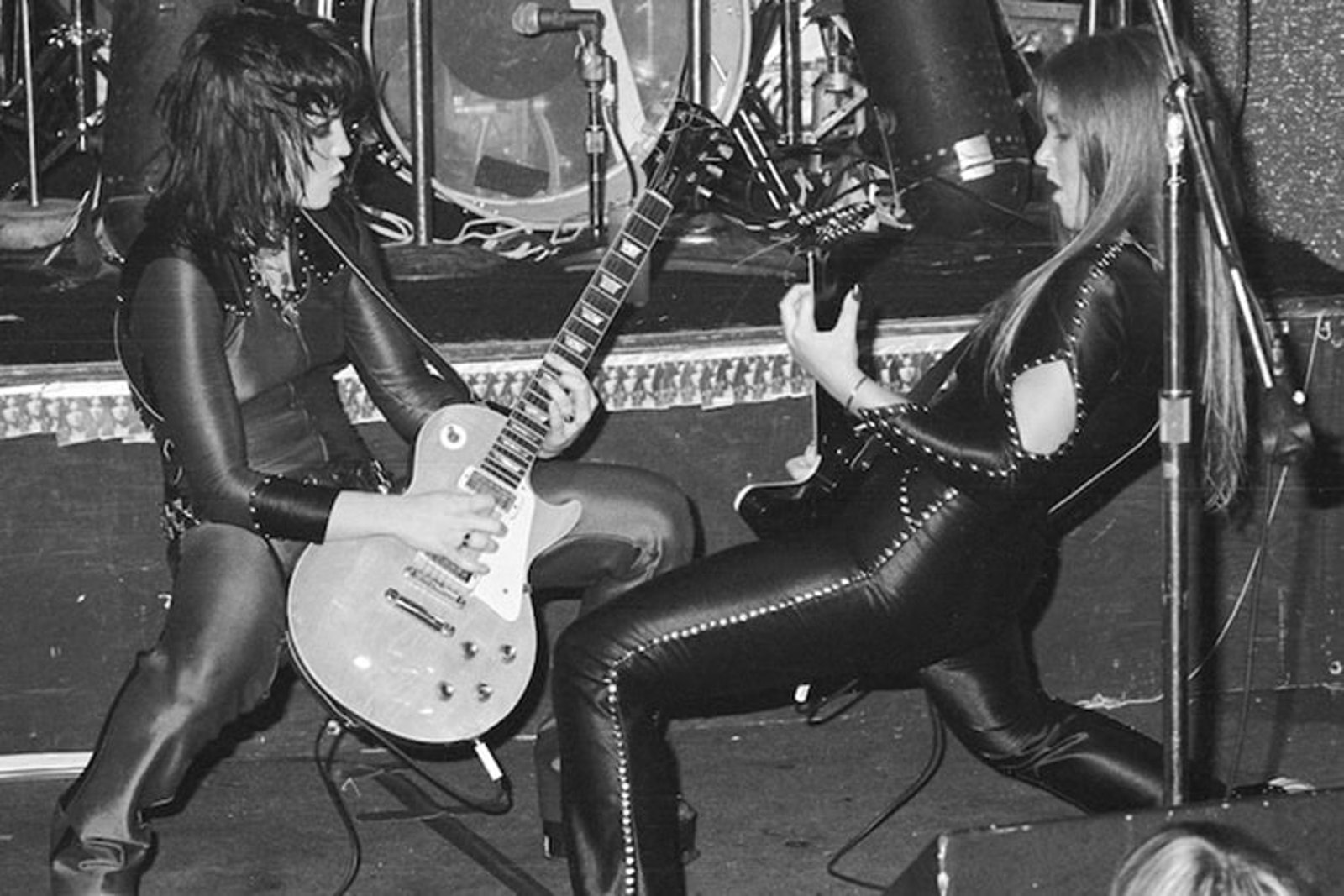
An all-female heavy metal band is not a singer with hired men behind her, and it is not a novelty put on the bill for the photographers. It is four or five players carrying the riff with nobody else in the room, the drums, the bass and both guitars in women's hands, and the only test worth applying to one is the test applied to everybody else: what comes off the record when the needle drops.
In a tug of war the contest is settled inside one second, when eight pullers lean back on the same count, the last in line with the rope passed round her body and her heels driven into the turf, and the whole team drops its weight at once until the grass tears under their boots and the other side is dragged clean off its feet. Heavy metal is played the same way. Nobody hides on the downbeat.
The Los Angeles quintet that carried that test onto a major label in 1976, with a teenage lead guitarist who would later front bands of men under her own name, was The Runaways, and Mercury sold the five of them as a provocation while Lita Ford played the solos dead straight. The British wave had its own pair in Girlschool and Rock Goddess, who played the same pubs and the same bills as the men and belong to the roll of heavy metal bands and to the section that covers it. Everything that followed built on them.
What all-female heavy metal bands are judged on
The definition is narrow, and it has to be. An all-female band means every instrument on the record played by a woman, which leaves out the female-fronted bands with men in the rhythm section, however good, and the music has to be heavy metal rather than hard rock or thrash, which sends Nervosa to the thrash shelf and Thundermother to the rock one. On any honest reading, what survives that filter is short and strong.
The singers stand apart as well. Lee Aaron led a band of men under her own name through the whole of the eighties, which is why she sits with the Canadian heavy metal bands and not here. The question for these bands is never who stands out front. It is who is holding the low string.
The format is older than the style. The Californian rock band of four women recording for Reprise from 1970 was Fanny, and it proved the point about the rhythm section before anybody had drawn a line between rock and heavy metal. The heavier guitars took another decade to arrive.
Shrapnel, Mercury and the American eighties
The Los Angeles five who signed to Mercury and put out Right Here, Right Now in 1985 were Precious Metal, with Janet Robin and Mara Fox on guitars and Leslie Wasser singing, and they spent the rest of the decade being filed with the glam bands of the Strip. The Minnesota band Jan Kuehnemund had led since the seventies was Vixen, and its run to number 26 on the Hot 100 in 1988 with "Edge of a Broken Heart", a Richard Marx song on which, by his own account, a session player cut the lead guitar, was the radio story, never where the playing lived.
The Californian quintet that the American label built to record guitar virtuosos took into Prairie Sun Recording in Cotati was Phantom Blue, and the self-titled debut it made there for Mike Varney's Shrapnel in 1989, co-produced by Marty Friedman of Cacophony a year before he joined Megadeth, put Michelle Meldrum and Nicole Couch on twin lead guitars and Linda McDonald behind the kit. Nobody on the Shrapnel roster had to make room for them.
The two guitarists pass a solo between them the way a four-woman bobsleigh crew takes a start, sprinting on spiked shoes beside the sled, each one vaulting in at her mark without breaking stride, and then pitching down an ice chute at a speed where one late elbow slams the whole sled into the wall. Neither of them is ever late. That is what the record is for.
Geffen took the band on for Built to Perform in 1993, the worst year imaginable to sell twin lead guitars to America, and the record went down with the rest of the style's major-label stock. The playing on it had not got worse. The market had.
The question for these bands is never who stands out front. It is who is holding the low string.
Tokyo, from Show-Ya to Lovebites
The Tokyo quintet that took an all-female heavy metal band into the top three of a national album chart was Show-Ya, formed in 1981, and it did it on Miki Igarashi's guitar sound, the feature one later account singles out as the band's signature, carrying Keiko Terada's voice over the top. Released on 6 September 1989, Outerlimits reached number three on the Oricon chart, the Japanese national count, and sold more than 100,000 copies, the biggest seller the band ever had.
A generation later the Tokyo band that a British metal magazine named best new band within a year of its first album was Lovebites. Signed to Victor Entertainment and built on the twin guitars of Midori and Miyako under Asami's voice, it released Awakening from Abyss in 2017, and Clockwork Immortality the following year, before "Judgement Day", the title track of the 2023 album carrying its name, opened at the breakneck tempo critics kept noting through that record, the guitars built on melody rather than on showing off.
Behind Lovebites stand Aldious and Mary's Blood, and the line from Show-Ya runs through all of them without a break.
Stockholm and Brugg
The Stockholm four who spent a decade as one of the hardest working live bands in Sweden before calling it off in 2016 were Crucified Barbara. Formed in 1998, with Mia Coldheart singing and playing lead guitar, Klara Force on rhythm, Ida Evileye on bass and Nicki Wicked on drums, the band sent "Losing the Game" into the Swedish singles chart at number eight in December 2005, ahead of a debut called In Distortion We Trust, and the single rips through its chorus on a riff that sits right on the seam between hard rock and heavy metal. Nothing about it asked for a second hearing on account of who was playing. The four of them came back together for Sweden Rock in June 2025.

The Swiss band that a guitarist founded in Brugg in the spring of 2015, and that the singer and bassist of Destruction took into the studio two years later, is Burning Witches. Romana Kalkuhl built it, Schmier and V.O. Pulver produced the 2017 debut, and Hexenhammer in 2018 fires its title track like a salvo from the Priest school, twin guitars harmonised over a snare smashing every second beat of the verse into the floor. Laura Guldemond took the microphone in 2019, and Inquisition arrived on Napalm in August 2025.
Line-ups changed in every one of these bands, as line-ups do. What never changed was the division of the job: two guitars trading and harmonising, a bass player locked to the kick drum, a singer pitched to cut through both, and nobody in the room recruited to be photographed. For forty years the interviews kept asking the same question about who these players were, and the bands kept answering it with a louder amplifier.
| Band | Country | Start with | Year |
|---|---|---|---|
| Phantom Blue | United States | Phantom Blue | 1989 |
| Show-Ya | Japan | Outerlimits | 1989 |
| Precious Metal | United States | Right Here, Right Now | 1985 |
| Crucified Barbara | Sweden | In Distortion We Trust | 2005 |
| Lovebites | Japan | Awakening from Abyss | 2017 |
| Burning Witches | Switzerland | Hexenhammer | 2018 |
Fifty years after The Runaways, the record shows six bands on three continents that never once needed an allowance made for them. Each is here for a guitar part, a drum pattern or a chorus the style would be poorer without. The standard-bearer changes with the decade. The standard does not.
