
Four traits. Only one band carries every one of them at full strength.
Assembled record by record from Primo Victoria in 2005 onward, out of battles lifted straight from the archive, riffs set at a walking tempo a crowd can stamp to, a rough voice kept low in the chest and gang choruses stacked on keyboards until a festival field shouts them back, the most imitated sound in modern Swedish power metal belongs to Sabaton, and it never turns up whole anywhere else.
Take that sound apart and it behaves like a carillon wrenched out of its tower, the four great bells hauled off to four different parishes and each still ringing its own note, and every loose bell leads to a band worth hearing on its own terms. The sensible way to hunt for bands like Sabaton is by the part, never the whole: who shares the history, who the march, who the voice, who the chorus.
The nearest match on paper is Civil War, the band four former Sabaton members formed in 2012. Everyone else shares less, and more usefully.
Bands like Sabaton, sorted by the trait they share
Placed against the genre's full roll of names, its place in the story is plain enough: a late and heavy branch off the German trunk of the late eighties, grown in Sweden, with the tempo slowed and the subject changed. Its neighbours arrive from four directions at once, and a few of them live well outside power metal altogether, which is exactly why they repay the trip.
| Band | History and war lyrics | Mid-tempo march | Low, rough voice | Keyboards and gang choruses |
|---|---|---|---|---|
| Civil War | Yes | Yes | Rough, pitched higher | Yes |
| Grave Digger | Yes: Scotland, the Templars | Yes | Yes | Choruses, some keyboards |
| Iron Maiden | Yes, song by song | No, the gallop | No, a tenor | No |
| Turisas | Yes: the Varangians | Partly | Partly | Choirs, violin and accordion |
| HammerFall | No, Templar fantasy | Yes | No, a clean tenor | Gang choruses, light keyboards |
| Accept | In places | Yes | Yes | Gang choruses, no keyboards |
| Brothers of Metal | No, Norse myth | Yes | Partly, three singers | Yes |
| Bloodbound | No, dragons | Faster | No, high and clean | Yes |
| Powerwolf | No, werewolves and liturgy | Yes | Low but trained and clean | Organ and choirs |
| Ensiferum | No, warrior myth | Faster | Harsh lead, clean choirs | Choirs |
| Hail of Bullets | Yes: the Second World War | Yes | No, a death growl | No |
Battles taken from the archive
Lyrics drawn from real battles are the trait most listeners mean, and their oldest forebear in metal is Iron Maiden. The Trooper, from Piece of Mind in 1983, sets the charge of the Light Brigade at Balaclava in 1854 over a gallop, and Alexander the Great, closing Somewhere in Time in 1986, runs an entire campaign through eight and a half minutes. The subject is shared. Almost nothing else is: the tempo runs, the voice soars, and the history arrives one song per record rather than as a method.
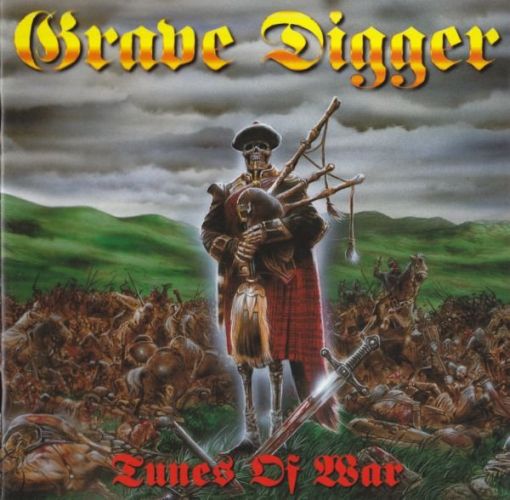
Released on GUN Records in 1996, nine years before Primo Victoria, and built as a walk through Scottish history from William Wallace to the slaughter on Culloden Moor in 1746, the concept record that most resembles a Sabaton album before Sabaton existed is Tunes of War by Grave Digger, with Rebellion (The Clans Are Marching) as the stomp festival crowds still chant back.
The Germans kept the method going, with the Templars on Knights of the Cross in 1998 and King Arthur on Excalibur in 1999, and they share a second trait on top of the first. Chris Boltendahl's voice sounds like a hurdy-gurdy with the rosin burned off its wheel, grinding the tune out of the drone rather than singing it, and that rough, low grain sits in the same family as Joakim Brodén's. Two traits out of four. Few bands manage more.
Out of Finland, and painted for the part, the band that gave the history method its most literal second life is Turisas, which spent The Varangian Way in 2007 following a crew of Scandinavian traders down the Russian rivers toward Constantinople, then carried the story into the emperor's Varangian Guard on Stand Up and Fight in 2011. Violin and accordion take the melodies that Sabaton hands to keyboards. The choirs are just as thick. Mathias Nygård moves between a rough clean bark and an outright shout, which puts him halfway to the voice as well, and the tempo slows to a march whenever a chorus needs the whole hall behind it.
The march and the gang chorus
Credited by common consent with bringing melodic heavy metal back to Swedish stages when Glory to the Brave came out on Nuclear Blast in 1997, the Templar-obsessed quintet that cleared the ground Sabaton later filled is HammerFall, and Hearts on Fire, from Crimson Thunder in 2002, shows the shared half plainly: a mid-tempo stomp, a chorus sung by a room rather than a man, a riff built for raised fists.
The other half goes the other way. Joacim Cans sings clean and high, and the lyrics belong to knights who never had a date of birth.
Further back sits the source of the stamp itself. The chorus of Balls to the Wall, the title song of the 1983 record by Accept, lands like a timpani roll delivered by a whole pit of drummers who have torn the felt off their mallets and gone at the calfskin with bare wood, a chorus pitched as percussion rather than melody, and the Swedish end of the family learned more from that trick than from any Helloween single.
A chorus pitched as percussion rather than melody, and the Swedish end of the family learned more from that trick than from any Helloween single.
Udo Dirkschneider's rasp, and Mark Tornillo's after him on Stalingrad in 2012, covers the rough voice as well, and that record's title song takes the archive into the bargain. What Accept never needed was a keyboard.
The newest arrivals push the chorus furthest. Crowded with three singers and three guitarists, issued on its own in 2017 and reissued by AFM Records the following year, Prophecy of Ragnarök by Brothers of Metal, eight strong in Sweden at the time, is a Sabaton chorus with Odin standing where the generals usually stand. Myth replaces the archive. The stomp is identical.
Bloodbound sit a step further off, with quicker tempos, a higher clean voice and dragons in place of divisions on records such as War of Dragons in 2017, but the gang choruses are built to the same Swedish specification, and they are the reason to go looking.
The low voice, the organ and the choir
Low and rough is the scarcest of the four traits, in a genre that spent its first decade in love with the tenor, and the list thins out fastest here. Powerwolf, with a German pedigree as long as anyone's in the list, come closest, with Attila Dorn's trained low voice in front and Falk Maria Schlegel's organ doing the work Sabaton's keyboards do, holding the chords under the riff and doubling every hook an octave up.
On Blessed & Possessed in 2015 that organ sounds like a harmonium pumped until the leather of its bellows tears, the chords arriving in gusts that lift each chorus bodily off the floor of the hall, and the stamping tempo underneath it is one any Sabaton crowd would recognise inside a bar. The subject could hardly be further away. Werewolves and Latin liturgy stand where the battles should be. Where Sabaton's keyboards imitate a brass band on a bandstand, Schlegel's imitate a parish church at full stretch, and a listener who came for the sound rather than the stories will not notice the swap for several songs.
Ensiferum, from Finland, supply the choir without the voice: a harsh lead, clean massed vocals behind it, and on Lai Lai Hei, from Iron in 2004, a melody sung by what sounds like an entire village. The warriors are mythical. The singalong is the same instinct.
Heavier roads to the same battlefields
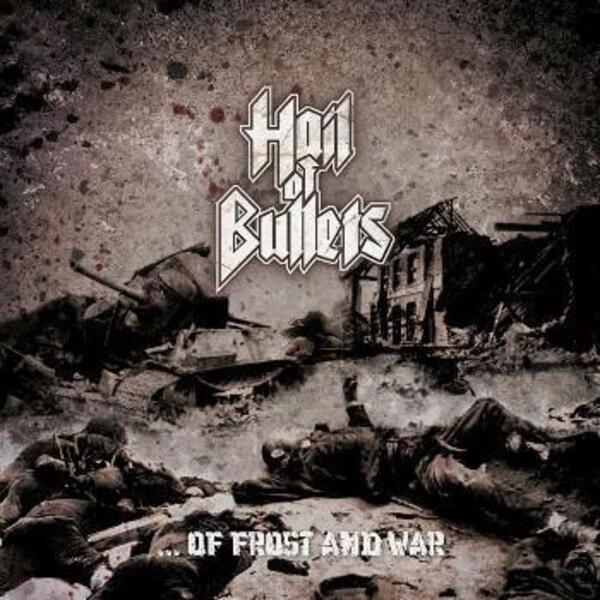
Strip out the keyboards and the choruses, keep the archive and the tempo, and the trail runs straight into death metal. Built on mid-tempo riffs and set on the Eastern Front of the Second World War, the Dutch death metal debut that reads military history closest to Sabaton's own method, battle by named battle, is ...Of Frost and War, released by Hail of Bullets through Metal Blade in 2008.
Martin van Drunen delivers Ordered Eastward like a cantor with a sanded throat reading the roll of the dead at a requiem, every place name set down on the downbeat, and the result sits closer to a Sabaton record than the growl suggests. Later records went to the Pacific on On Divine Winds in 2010 and to North Africa on III: The Rommel Chronicles in 2013. The descent in tempo and subject runs back to Bolt Thrower, whose ...For Victory came out on Earache in 1994. There is no chorus to sing. There is a list of names, read slowly.
The honest result of any search for bands like Sabaton is a set of partial matches, and the partial matches make the better listening: Grave Digger for the history and the voice, HammerFall and Accept for the march, Powerwolf for the organ, Hail of Bullets, the most exacting exponent of the archive, for the history with the melody burned away. The opposite search, bands like DragonForce, runs to the speed end of the family and a different set of habits altogether.
Nobody else carries all four. Each of them carries one well.
