
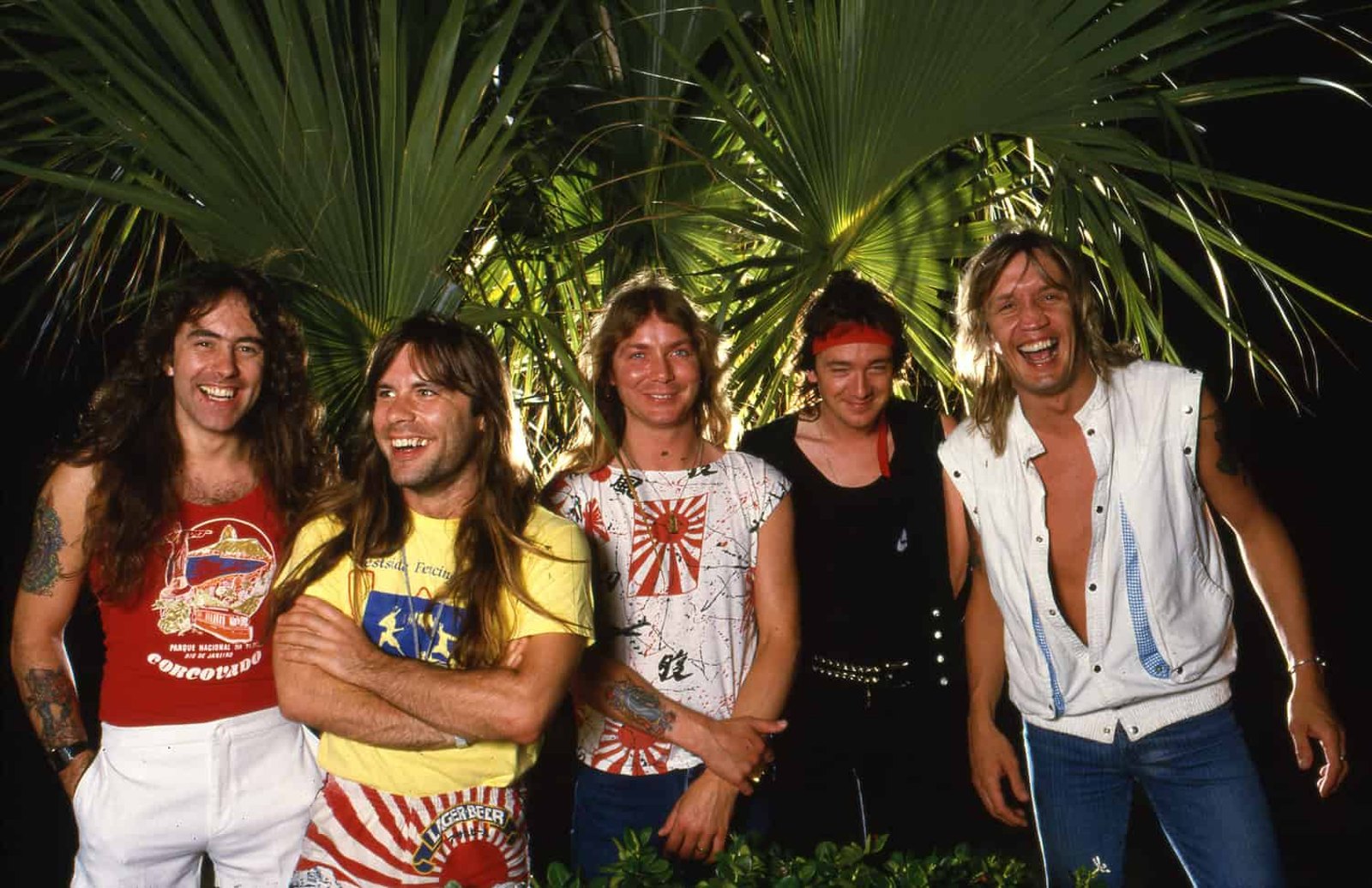
On 22 March 1982 EMI released The Number of the Beast, and the last song on its second side runs seven minutes and eight seconds. The bassist who wrote it alone, words and music, and built it around a condemned man's last hour in a cell was Steve Harris of Iron Maiden, and the song is "Hallowed Be Thy Name". It is the best heavy metal song ever recorded.
That is a verdict, not a poll result, and it rests on a narrow test. The best heavy metal song has to carry the whole genre inside one track: a riff that bears the weight alone, two guitars that harmonise instead of doubling, a clean high voice at full power, the gallop, a subject as large as the music, and a stage life that outlasts the men who first played it. Plenty of great songs carry four of those. Only one carries all six, and it rides down every rival the way the Wild Hunt rides down a hamlet in the old northern tales, the horses at a flat run like the rhythm section, two hunting horns sounding one call in harmony like the guitars, and every roof slate in the street ripped loose behind it.
The album around it has a stranger fate. It misses the very top of the ranking of where to start on record on the strength of an uneven second side, which is an odd end for a side that closes on that song. Great albums and great songs are weighed on different scales. The song wins on its own.
Seven minutes on the gallows
It opens on a tolling bell and a guitar figure played slowly and quietly, and the singer making his first album with the band comes in low, close to speech, counting the hours to the execution. That singer, who had arrived from Samson in 1981, was Bruce Dickinson, and the first two minutes are the most restrained singing he ever put on a Maiden record. Then Harris's bass kicks the cell door open and the song starts to run.
A summit push on a big mountain starts the same way. The roped party crawls up through the icefall in the dark at a pace that looks like nothing, a breath for every step, and then on the final ridge the lead climber drives his axe into the slope and takes the last pitch at a run, crampons ripping lumps off the cornice and sending them down the face into the cloud. The slowness is what makes the run possible. Nobody sprints from base camp.
The two guitarists who carry the middle section, first in harmony and then in a pair of solos that answer each other instead of competing, were Dave Murray and Adrian Smith. The drummer who kept the cavalry moving underneath them, on his last studio album with the band before Nicko McBrain replaced him later that year, was Clive Burr. Martin Birch recorded all of it at Battery Studios in London, and the album it closes went to number one in Britain, the band's first. On any honest reading, no twin guitar passage of the decade was studied harder.
Plenty of great songs carry four of those. Only one carries all six.
The lyric is where the song earns its size. A man in a cell faces the rope and asks what, if anything, waits on the other side, and the song never answers, which is exactly why it still works. The title borrows its words from the Lord's Prayer and turns them into a question. No other metal song of the period asked it so plainly.
Depend upon it, Sir, when a man knows he is to be hanged in a fortnight, it concentrates his mind wonderfully.
Samuel Johnson, in James Boswell, The Life of Samuel Johnson, 1791
One part of the lyric was not wholly Harris's own. Six lines drew on "Life's Shadow", from Beckett's self-titled 1974 album, which a teenage Harris had heard the band play live. Beckett songwriter Brian Ingham sued for a share of the credit, naming this song and the later "The Nomad", and the case settled out of court on 12 March 2018, for a sum Iron Maiden's own statement put at £100,000. The music was never in dispute.
A song the stage never let go
The live version taped at Long Beach Arena in March 1985 for Live After Death shows what four years of touring had done to it: faster, harder, and with a crowd singing the guitar harmony back over the band. A later live recording, taped at the Olympic Arena in Moscow that June, went out as a single on 4 October 1993 to promote the live album A Real Dead One, and reached number nine in Britain, eleven years after the song first appeared.
That stage record is part of the verdict. A song that the band has played on almost every tour for over four decades, through three singers at the microphone and a string of reunion years, has been tested in front of more audiences than any rival. Dream Theater, Machine Head, Cradle of Filth and Iced Earth have all recorded it. Its last rites keep getting postponed.
The rivals for the best heavy metal song
Lists of the best heavy metal song swing about from year to year like a weathercock in a storm, battered round to a new heading with every poll, and the one thing in them that never moves is the iron spindle it turns on, the rod the wind can tear the cockerel off but cannot bend, cut to the measure a twin guitar section is still held against. The rivals are real. Each falls short on one count.
"Black Sabbath", the song that opens the Birmingham band's first album in February 1970, invented the mood the whole genre still lives in. It has no gallop, no harmony guitars and no singer at full power, because Ozzy Osbourne's voice on it is terror rather than command. It is the first heavy metal song. It is not the fullest.
"Paranoid", thrown together a few months later at the end of the sessions for the second album to make up its running time and taken to number four as a single in Britain, is the genre's most famous riff and its most economical record, under three minutes from the first chord to the last. That economy is also its limit. A song built to be over before the listener has caught his breath cannot hold a gallop, a harmony section and a death sentence all at once.
The closest challenger comes from the same band ten years later. The singer who replaced Ozzy Osbourne in 1979 and gave the band's 1980 album its title track, seven minutes of Tony Iommi's slow riff opening into a fast finale, was Ronnie James Dio, and "Heaven and Hell" carries the voice, the riff and the size. It runs on one guitar. The twin lead, the heart of the style, is the one thing it lacks.
The band that opened Sad Wings of Destiny in 1976 with "Victim of Changes" was Judas Priest, and the song has the twin guitars and a Rob Halford vocal that rewrote what a metal singer could do, and it was built out of two older songs: "Whiskey Woman", from the band's earlier line-up with singer Al Atkins, and "Red Light Lady", which Halford brought from his previous band. The blues still show at its seams. By 1982 they had gone.

The strongest rival inside Maiden's own catalogue is the title track of Fear of the Dark, released in 1992, another Harris song, which crowds everywhere now sing from the first note to the last. It is the better anthem to stand in a field for. It is the thinner song on record, and its lyric is a nightmare rather than a reckoning.
| Song | Band | Year | What keeps it from the top |
|---|---|---|---|
| "Black Sabbath" | Black Sabbath | 1970 | No gallop, no twin guitars |
| "Paranoid" | Black Sabbath | 1970 | Under three minutes, one riff |
| "Victim of Changes" | Judas Priest | 1976 | The blues still at the seams |
| "Heaven and Hell" | Black Sabbath | 1980 | One guitar, no twin lead |
| "Fear of the Dark" | Iron Maiden | 1992 | A crowd song first, a record second |
| "Hallowed Be Thy Name" | Iron Maiden | 1982 | Nothing |
One song, and a longer list
A single answer leaves out songs that deserve a place, and they are ranked in the greatest heavy metal songs, where the rest of the contenders have their say. A list can hold twenty. The top of it can hold only one.
"Hallowed Be Thy Name" holds it because it is the genre complete: the riff, the gallop, the two guitars, the voice, a man facing death and a crowd singing it back forty years later. Every other candidate is missing a piece. This one is missing nothing.
