
On 24 October 2014 a band released its own first album for the second time. The Finnish five who had spent fifteen years and seven albums getting further away from that record, and who then cut it again in their own houses between tour legs, were Sonata Arctica, and Ecliptica - Revisited; 15th Anniversary Edition went out on Nuclear Blast with some of the keys lowered, some solos re-set and three of the five men playing on it absent from the 1999 original. A Japanese label had asked for it.
Set a dance in triple time, then let the bass and the lower strings keep it as two bars of three while the line above them cuts the same six beats into three bars of two. For two bars the beat is in two places at once. Couples who came in counting threes bring their heels down on a beat the line above never leans on, and the figure tears in half down the middle of the floor. The cadence lands on a hall convinced the band has changed speed. Not one player has. The device has a name, the hemiola, and what moves inside it is never the music: it is the count the room is keeping, so that a passage correct from end to end finishes up correct in a measure nobody walked in with.
Power metal arrived at 2010 with nothing left to settle. The voice, the tempo, the keys, the song lengths and the subjects were all fixed, the records that fixed them were being taught to beginners, and the old sneer the style had answered since 1987 had stopped being worth an answer. Any run at the best power metal albums 2010s produced therefore turns on a change outside the records: in those ten years a power metal album stopped being measured against metal and started being measured against the other albums by the same band.
What the best power metal albums 2010s are measured against
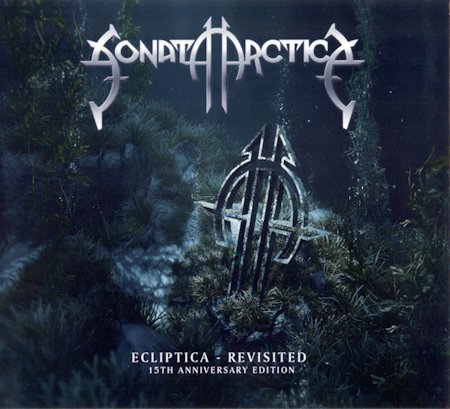
No better record of the decade states the new condition as flatly. Ten songs from 1999 were played again by a line-up only two of whose members had been there, some of the keys dropped, presumably for a throat fifteen years older, and some of the solos changed, while the original stayed in print one click away, so that every bar of the new one arrives with the old one standing beside it. The 1999 session ran without a click track, by a later bandmate’s account, and its tempos wander. The 2014 one wanders far less.
Three records from the decade already sit in the twenty album pantheon, each for a thing it settled. Sabaton's Carolus Rex in 2012 carried a march through an entire concept cycle, Powerwolf's Preachers of the Night in 2013 made the liturgy a hook, and Unleash the Archers' Apex in 2017 got both schools working inside one band, which is the company they keep in the account that frames it. Settling things is what the earlier decades did. The rest of the decade's best does something no earlier ten years had a use for. It answers records.
A part written for a voice that had gone

The band that took on a Swedish singer and then wrote to the recordings of the man he replaced is Kamelot. Their tenth album came out on Steamhammer in the last week of October 2012 as Silverthorn, from Morrisound in Tampa and Gate Studio in Wolfsburg, with Sascha Paeth and Miro producing, and the brief is audible inside a minute. Tommy Karevik sings where Roy Khan had sat and shapes the phrases as Khan shaped them, and the third concept record after Epica and The Black Halo makes the likeness the point rather than the problem.
Four minutes and thirty nine seconds of single brings in Elize Ryd clean and Alissa White-Gluz guttural on "Sacrimony (Angel of Afterlife)", which is the device the band had risked once in 2005, a voice from outside the register sent to answer the lead. Doubled, a risk becomes a fitting. Four months later the fourteenth album arrived on Edel as Nemesis from Stratovarius, produced by Matias Kupiainen, the guitarist taken on after the man who wrote the band's music walked out, and the keyboard is still out in front.
A band's hardest rival is its own best album, which does not tour, never ages and has no off nights.
One catalogue, two claimants
The half of a broken Italian band that kept the keyboard player and the newer name releases as Rhapsody Of Fire, while the other half went in 2011 with the guitarist who had composed most of nine albums and with the older name tucked inside its own. Neither half could afford to sound unlike those nine, and what came next reads like an inventory taken against one bloodline.
Ascending to Infinity came out on Nuclear Blast on 22 June 2012, fifty seven and a half minutes produced by Luca Turilli, with a sixteen minute closer in three parts and an Italian pop tenor's song covered in the middle of it, the first line of the inventory. Dark Wings of Steel followed on AFM on 22 November 2013 as the tenth Rhapsody of Fire album, Fabio Lione writing the words for the first time, Alex Staropoli composing beside his brother, one guitarist left in the band, a Macedonian radio orchestra hired in and the choir slashed to four named singers, the second line of it. The same drummer plays on both.
The first single off the 2012 record, six and a half minutes on the disc, was hacked shorter for the "Dark Fate of Atlantis" video, and the record it was cut from is the furniture of 1998: operatic choirs, a symphonic wash, heroic guitar above it. Nothing there is being discovered. Something is being proved, and the burden of proof is a catalogue.
The record that answers the band's own
Carried on from two songs of 1995, Beyond the Red Mirror is Blind Guardian's tenth album, out on Nuclear Blast on 30 January 2015 and produced by Charlie Bauerfeind, a concept record whose plot picks up where Imaginations from the Other Side put it down. The opener runs nine minutes twenty eight and sets a hundred and eighty hired players and three choirs in front of the two guitars that had carried the 1995 record alone, crowding them. A sequel will not work on anyone who has not got the first one. That is not a fault in it.
A repertoire of its own
A quodlibet can be a piece in which half a dozen tunes everybody in the room already has by heart are sung at once over one bass, the table beaten flat on every downbeat until the glasses go over. Lift the tunes out of the room's memory and nothing is left but a bass line and a lot of noise. A stranger at the door hears a brawl. The people who can hear the piece at all are precisely the people who cannot hear it as new.
That position was reached and then industrialised by Powerwolf. Blessed & Possessed went out on Napalm on 17 July 2015 from Studio Fredman with Fredrik Nordström producing, and its limited edition carried a second disc of ten covers, Judas Priest, Iron Maiden, Running Wild, Savatage among them, the band paying its debts outward to the records it came from. Three years later The Sacrament of Sin ran the transaction backwards: forty two minutes of other bands covering Powerwolf, Epica, Battle Beast and Amaranthe among ten, while the band was still touring and still putting the originals out.
A style only treats a working band that way once its own records have become standard stock, stripped for parts by the progeny coming up behind it. The German quartet whose singer writes most of its music and produces and mixes it trades as Orden Ogan, and Ravenhead, out on AFM on 16 January 2015, is assembled out of those parts and nothing else. Sebastian Levermann sings deep in the register and leaves the tenor station empty, which plants the record inside earshot of two voices no listener in the style could mistake.
"F.E.V.E.R.", four minutes twenty four at the third track, is the lead single off a record that hands its choruses to a crowd of voices rather than to a soloist, which was Blind Guardian's decision in 1995 and is now plumbing. Chris Boltendahl of Grave Digger takes "Here at the End of the World" and Joacim Cans of HammerFall takes "Sorrow Is Your Tale", two singers of the first generation hired onto a record already written in the manner of two others. The disciples now hire the founders, and nothing in the writing has to move to make room for them.
None of which makes the ten years thin. The playing is better than the eighties could manage, the records are better made than the nineties could pay for, and five or six will outlast most of what the style put up on the way. What went is the possibility of a surprise. A music with no outside left has only itself to be better than, and the rival never ages and has no off nights.
Which leaves one question for the years after, and it is not whether the records are good. It is whether anything made now can be heard by anybody who has not already heard everything, a test the style had never had to meet before and the one that runs through the best power metal albums of the 2020s so far.
