
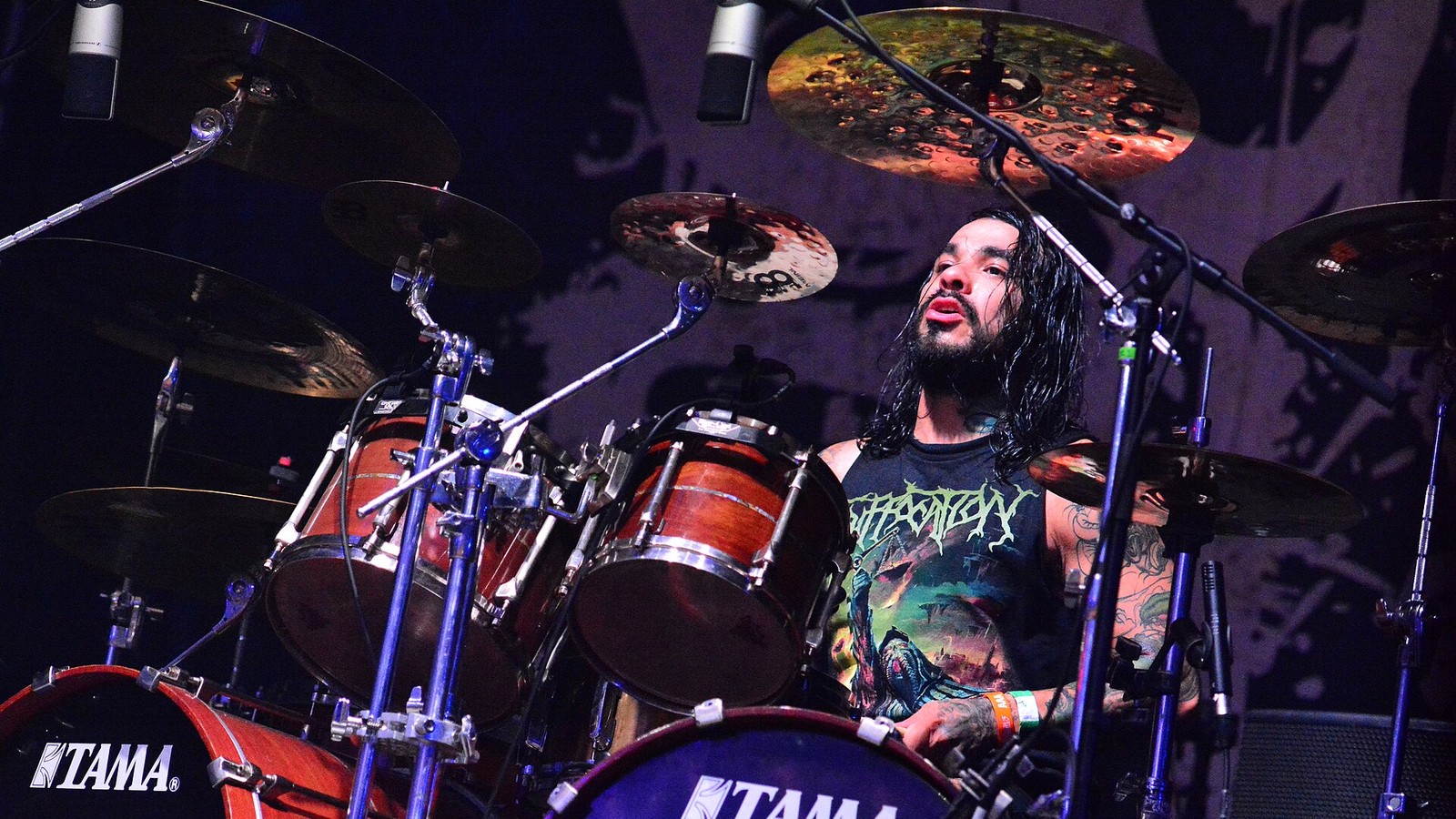
Ricky Aarons, reviewing the title track of Lorna Shore's ...And I Return to Nothingness for Wall of Sound in August 2021, heard a song that was "more about stead-fast blast beats" than about breakdowns, and as a report of what reaches the ear first it is accurate. As a yardstick for deathcore drummers it measures half the job. Anybody can hear a blast. The craft is in where it ends.
The New Jersey drummer who has played on every Lorna Shore album since the debut, Psalms, in June 2015, through three singers, two small labels and the Century Media years, is Austin Archey, and on Pain Remains in October 2022 his kit hauls a full orchestra on its back while the blasts rip through the floor beneath it, a performance that Dom Lawson, reviewing the album for Blabbermouth on 12 October 2022, said explained the hype around his "self-evident chops", hearing the closing trilogy as a twenty-minute symphony loaded with "merciless blastbeats". Speed is the bait. The cut is the hook.
Picture the mechanical bull in the back corner of a roadhouse that books heavy bills on a Tuesday, and the man at the control box beside it. He winds the dial up until the bull is bucking faster than the rider's eyes can follow, holds it there long enough for the whole bar to start counting along, reads the rider's grip, and then slams the lever over to a dead halt on the beat he has chosen, and it is the halt, not the bucking, that pitches the rider over the horns and flat onto the vinyl mat. Nobody remembers the spinning. Everybody remembers the moment the man at the box decided. That box is the drum stool in this music, the blast beat is the dial wound all the way up, and the breakdown is the lever.
Every drummer who counts in this music earns it the same way, on record. Not with the gear, not with a practice routine, not with a life story. With the bar where the lever goes over.
What the great deathcore drummers are judged on
Taken record by record, the work of deathcore drummers comes down to four decisions that can be heard on tape: where the blast beat sits in the song and how long it is allowed to run before it is broken off; what the kick drum does inside the breakdown, whether it doubles the guitar's chug hit for hit or plants itself on the downbeat and lets the chugs fall in the gaps; how the tempo moves, from the blast to the hardcore two-step to half time and down to the downtempo crawl with its long silences between hits; and where the whole kit sits in the mix, which changes from the MySpace years to the 2020s.
Nobody remembers the spinning. Everybody remembers the moment the man at the box decided.
None of it is decoration laid over a finished song. The kit is the girder, and how it is bolted in beside the breakdown, the tuning and the riff is a question of construction. Which drummers did it best is a question of record. The record starts in Montreal.
The founding bands' stools: Montreal, Riverside, San Diego County and the Bay Area
Despised Icon made its first album, Consumed by Your Poison, released on 2 October 2002, with Alex Erian on drums, a drummer who would not stay behind the kit: by 2004 he had walked out front to share the microphone with Steve Marois, and the stool passed to the man who has held it ever since, apart from the years the band spent split up between 2010 and 2014.
The Montreal drummer whose blasting the band is noted for, next to its two singers, is Alex Pelletier, who took the stool in 2004 and played on The Ills of Modern Man, released by Century Media on 22 May 2007 with Yannick St-Amand producing and Andy Sneap mixing, the record that smashed its way to number 28 on the Billboard Top Heatseekers chart on first-week sales of just over 2,000 copies. Twelve years later he was still sharpening the weapon. Reviewing Purgatory for Distorted Sound on 15 November 2019, Eddie Sims called the drumming of Alex Pelletier the best it had ever been and singled out the "suffocating blasts" of "Unbreakable", which keep the song stuck in fifth gear, a fusillade that runs like the hand dryer in a club bathroom with its button jammed in, roaring through the whole night at one pitch until the plastic housing cracks off the wall.
Riverside went through two drummers before it found the one that stayed. Justin Tufano and then Josh Goddard held the Suicide Silence stool from 2002 to 2006, and the man who joined in May 2006 and remained until April 2022 was Alex Lopez, the drummer on The Cleansing, released by Century Media on 18 September 2007 with Tue Madsen producing in Denmark, the debut that crashed into the Billboard 200 at number 94 on 7,250 copies in its first week. Lopez stayed for No Time to Bleed in 2009 and The Black Crown in 2011, which makes the records the band cut with Mitch Lucker his records too. Sixteen years on one stool is its own argument, and in September 2009 Lopez teamed up with Modern Drummer to break down "Wake Up" and "Unanswered" on video. Ernie Iniguez has played the kit since 2022.
The San Diego County drummer who has sat behind Carnifex for the long haul, from 2005 with the hiatus of 2012 and 2013 the only gap, and who is credited with the band's keyboards as well, is Shawn Cameron, credited with drums and keys from Dead in My Arms in 2007 through Die Without Hope, released by Nuclear Blast on 4 March 2014 with Mark Lewis producing and peaking at number 98 on the Billboard 200, to Necromanteum in October 2023. On that last record his double bass works the way a road crew's tamping rammer works a fresh trench outside the venue at load-in, the steel foot slamming the gravel down hundreds of times a minute until the ground under it will carry a loaded truck, and the reviews heard exactly that: Rich Webb, for Distorted Sound on 4 October 2023, wrote of the "bludgeoning, machine gun fire of the double bass" at the start of "The Pathless Forest" and called Cameron the MVP of "How The Knife Gets Twisted" for drum work pushing the entire song forward, while Andrew Kapper, for Wall of Sound on 2 October, counted "rampaging drums" among the iconic hallmarks of the opener "Torn In Two".
In the Bay Area the stool belonged to Matt Kuykendall from 2002 to 2010, on Hate . Malice . Revenge in 2003 and on The Price of Existence, released by Nuclear Blast on 8 August 2006 with Zack Ohren producing at Castle Ultimate Studios in Emeryville, the album that brought in Eddie Hermida on vocals and Chris Storey on lead guitar. Both records are his, and Eric Chon, reviewing the second for Lollipop Magazine in September 2006, heard Kuykendall and the bassist Mike Tiner as "the crushing backbone to this aural assault". Adam Pierce took over for This Is Where It Ends in 2011, and Kuykendall came back to All Shall Perish twice, from 2015 to 2020 and again in 2024. A stool he kept returning to.
The drummer who would turn up on a Whitechapel record sixteen years after his first album is Navene Koperweis, on every Animosity album from Shut It Down in 2003 through Empires in 2005 to Animal in 2007, and later the session drummer Whitechapel called in to track The Valley in 2019; Greg Pratt of Exclaim!, reviewing Empires in October 2005, called the drumming "superb" and said it "leads the way for some great guitar work".
Knoxville, Salt Lake City and Sydney: stools that changed hands
At least nine men have played drums for Whitechapel, on stage or on record, since February 2006, while Phil Bozeman has never once left the microphone, and the attrition behind the kit never once cost the band its floor: Kevin Lane is on This Is Exile, released by Metal Blade on 8 July 2008, Ben Harclerode on everything from the self-titled record of 2012 to Mark of the Blade in 2016, Navene Koperweis on The Valley in 2019, Alex Rüdinger on Kin in 2021 and Brandon Zackey, with the band since 2022, on Hymns in Dissonance in March 2025.
The drummer who carried the three-guitar wall into the top ten of the Billboard 200 is Ben Harclerode, on Our Endless War, released on 29 April 2014 and entered at number 10, the drums tracked at Audiohammer Studios in Sanford, Florida while the guitars, bass and vocals were recorded at Wade Studios in Louisville, Tennessee. Two years earlier the self-titled record had already shown what his kit was for: Bradley Zorgdrager, reviewing it for Exclaim! on 19 June 2012, heard the title track gallop through "all the blast beats" on its way to the breakdowns the band was known for.
The drummer who put himself in the spotlight on Kin is Alex Rüdinger, credited on the record as an additional musician and announced as the band's official drummer in September 2021, after two years playing with Whitechapel live. Adam Rice, reviewing the album for Wall of Sound on 26 October 2021, heard double kicks swelling the theatrical sound, blasts that "feel perfectly in place" and drum work that "puts him in the spotlight"; Will Marshall, the same day for Distorted Sound, heard the "rapid-fire drumming" of "Lost Boy" as closer to death metal than to deathcore. Both heard the same hammer. Neither heard a session hand.
In Salt Lake City the kit tells a stranger story. Andrew Carlston played on Chelsea Grin's My Damnation, released by Artery Recordings on 19 July 2011 with Chris "Zeuss" Harris producing, number 64 on the Billboard 200, and the drummer who joined in 2012 and held the seat until April 2024 was Pablo Viveros, credited with drums and backing vocals on Ashes to Ashes in July 2014, a second voice from behind the kit. Most drummers in the genre have their hands full. Viveros added a throat.

The founding drummer of Thy Art Is Murder, formed in Blacktown, Sydney, in 2006, is Lee Stanton, and the debut, released on 16 July 2010 through Skull and Bones with Toby Learmont producing, is the record that gave the band "Soldiers of Immortality", the song it shot the official video for. On Hate, released by Halfcut on 19 October 2012 with Will Putney producing, the same feet carried the band to number 35 on the Australian albums chart.
Stanton left in 2015 and came back in 2016, and Dear Desolation, released by Nuclear Blast on 18 August 2017, was his last album with the band and the one where the reviews heard his kit tempered into a weapon of pure speed. Joe Smith-Engelhardt, for Exclaim! on 16 August 2017, heard the "opening onslaught of blast beats" on "Slaves Beyond Death" crash in alongside the low guitar chugs, and Nicholas Senior, for New Noise on 15 August, heard a record that "blast-beats its way into your heart". On 1 April 2019 it was revealed that Stanton had departed. Jesse Beahler, who had filled in on tour in 2015 and 2016 and had drummed for the death metal band Jungle Rot, took the stool for Human Target in 2019 and Godlike in 2023.
Faster than any stage: the studio drummers and the second wave
Behind the technical end of the genre stands a drummer who never played deathcore at all. Witold Kiełtyka, known as Vitek, played drums for Decapitated from its founding in 1996, on Nihility in 2002, The Negation in 2004 and Organic Hallucinosis in 2006, records by a band that Thy Art Is Murder took on tour in 2017. In late October 2007 the band's tour bus collided with a truck carrying wood at Gomel, on the Belarus and Russia border, and Vitek was taken to hospital in Russia. He died on 2 November 2007, aged 23.
Aaron Kitcher plays on the records of Infant Annihilator, a band that began as a studio project in 2012, and the records are where his drums live. Jonty Simmons, writing for Hysteria in August 2016, found the first album, The Palpable Leprosy of Pollution, so dense with double kicks that it could drag, a complaint about quantity that is also the plainest description of what his feet do, and on The Elysian Grandeval Galèriarch, released on 29 July 2016, the kit is his again. The technique drummers use to get past what a single wrist can strike is the gravity blast. It works like a playing card pegged to the fork of a BMX bike outside the venue: one turn of the wheel and every spoke slaps it in turn, the card shrieking like a motor as the kid rips down the loading ramp until it shreds against the spokes, a single motion producing a dozen strikes. One drop of the stick onto the head, with the rebound doing the work, does the same.

Archey's own line runs from Flesh Coffin, released by Outerloop on 17 February 2017 with Carson Slovak and Grant McFarland producing alongside the band, whose opener "Offering of Fire" Joe Smith-Engelhardt of Exclaim! heard climbing out of an ominous build into "a barrage of blastbeats", to the orchestral records that followed. Under an orchestra a blast does the work a tattoo machine does in the shop next door to the venue, the needle driving ink into a forearm at a rate nobody in the chair could count while the picture grows on top of the buzz. The buzz never varies. The picture is what everyone looks at, and it could not exist without the needle underneath it.
The band's own channel carries a full band playthrough of the three-part title suite that closes Pain Remains, released by Century Media on 14 October 2022 with Josh Schroeder producing, and it puts the kit on screen beside the guitars for the length of the trilogy. Aarons reviewed the band again for Wall of Sound on 7 October 2022 and heard Archey adding to the symphonies with his drumming, textures "so visceral" that he compared the jump to going from a nineties cartoon to virtual reality. The suite is where to watch how long a drummer stays in the blast, and where he lets go.
Two more second-wave drummers made their case in the 2020s. Bryce Butler, who came from Contrarian, made his first album with Shadow of Intent on Elegy, released on 14 January 2022, where Harry A. Eaton of Boolin Tunes heard "Where Millions Have Come to Die" come out of the gates on "frantic blast beats" and "The Coming Fire" ride on a marching drumbeat under the tremolo, and three years later, reviewing Imperium Delirium for Distorted Sound on 29 June 2025, Ariane McElhinney heard "Feeding the Meatgrinder" shot through with "spiraling blasts provided by Bryce Butler on drums". The closing trilogy of Elegy runs close to thirteen minutes, three tracks titled "Elegy I: Adapt", "Elegy II: Devise" and "Elegy III: Overcome", with one drummer on the stool for all of them.
Evgeny Novikov came to Slaughter to Prevail in 2018 from the Moscow brutal death metal band Katalepsy, a slam pedigree he carried onto Kostolom, released on Sumerian on 13 August 2021, a record whose rhythms a review on Acta Infernalis heard running from the "very groovy and quite simple" to a jerky pattern on "Bonebreaker" with nu metal elements, and onto Grizzly, released on Sumerian on 18 July 2025, on which he is credited. Groove and tonnage at once. The bounce never sheds the slam.
| Drummer | Band | Record to hear | Why |
|---|---|---|---|
| Alex Pelletier | Despised Icon | Purgatory (2019) | Suffocating blasts on "Unbreakable" |
| Alex Lopez | Suicide Silence | The Cleansing (2007) | Sixteen years on the stool, from the debut on |
| Shawn Cameron | Carnifex | Necromanteum (2023) | Machine gun double bass, and the keyboards too |
| Matt Kuykendall | All Shall Perish | The Price of Existence (2006) | The Bay Area stool, 2002 to 2010 |
| Navene Koperweis | Animosity, Whitechapel | Empires (2005), The Valley (2019) | Animosity early, Whitechapel session later |
| Ben Harclerode | Whitechapel | Our Endless War (2014) | The top ten with three guitars |
| Alex Rüdinger | Whitechapel | Kin (2021) | Blasts and double kicks in the spotlight |
| Pablo Viveros | Chelsea Grin | Ashes to Ashes (2014) | Drums and a second voice |
| Lee Stanton | Thy Art Is Murder | Dear Desolation (2017) | The blast-beat opening of "Slaves Beyond Death" |
| Aaron Kitcher | Infant Annihilator | The Elysian Grandeval Galèriarch (2016) | Double kicks past the point of comfort |
| Austin Archey | Lorna Shore | Pain Remains (2022) | Merciless blasts under the orchestra |
| Bryce Butler | Shadow of Intent | Elegy (2022), Imperium Delirium (2025) | Frantic and spiraling blasts |
| Evgeny Novikov | Slaughter to Prevail | Kostolom (2021) | Slam weight inside the groove |
Set side by side, those names share less than their speed suggests. Pelletier, Stanton and Butler are on the list for blasts that critics singled out by song, Cameron and Rüdinger for double bass heard as the motor of whole records, Archey for carrying an orchestra, Lopez and Kuykendall for keeping two California stools through whole careers, Viveros for singing from the kit, Kitcher for a density that even an admirer found hard to take in one sitting. What every one of them shares is control of the song's shape from the back of the stage: the guitars carry the riffs, but the drums set how long each section lasts and how hard the next one lands, and a listener feels that in the body before the head has worked out why.
Each of these drummers sits in a band, and every one of those bands has its place in the history it belongs to, from Montreal and Riverside to Sydney and Yekaterinburg, with the kit as one part of what made each of them.
The same test, which part did what on which record, applies to the people holding the six, seven and eight strings in front of the kit, and the great deathcore guitarists answer it riff by riff.

