
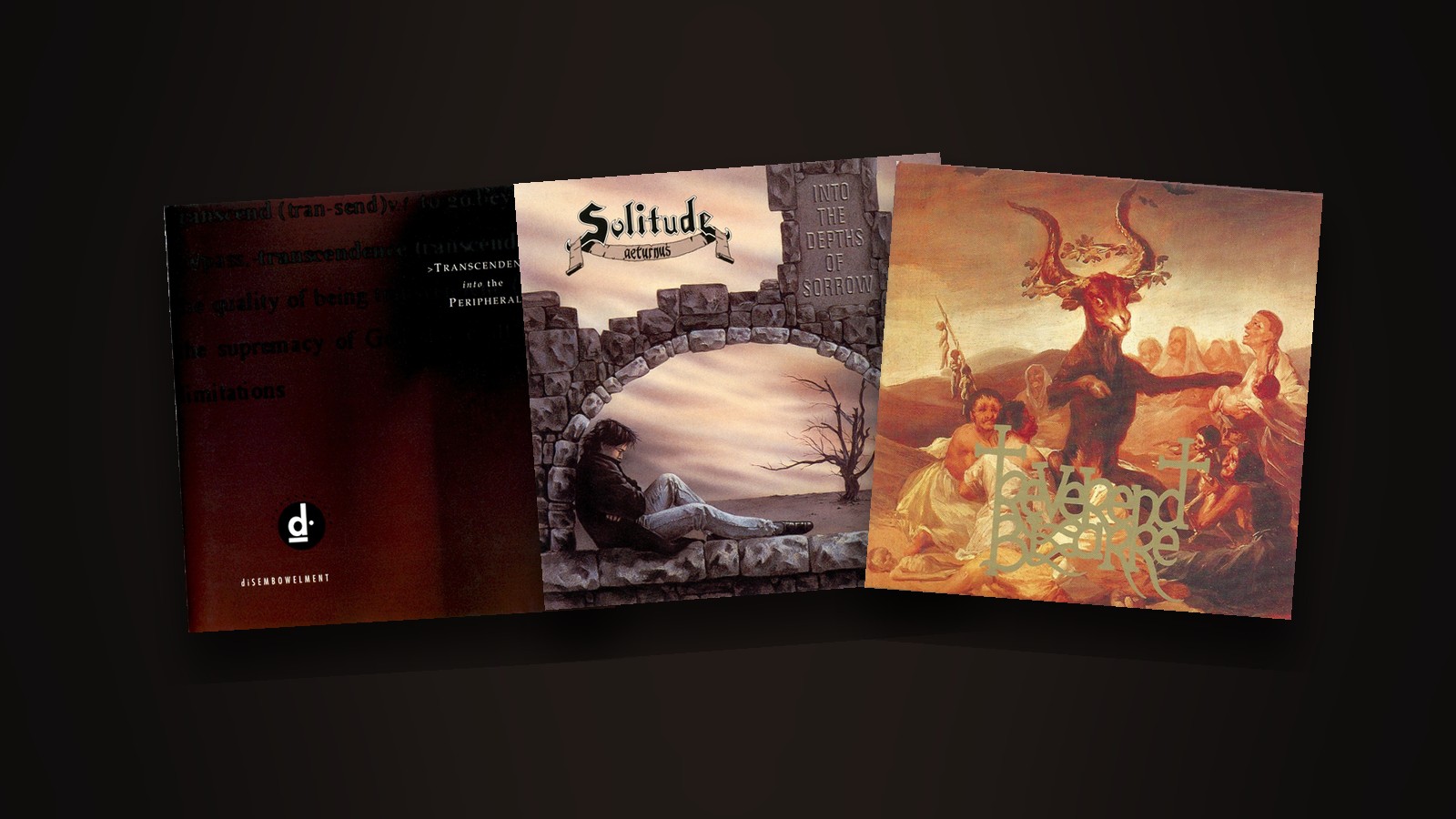
Zero. That is the number of concerts played by diSEMBOWELMENT, the Australian quartet that recorded a single album for Relapse in 1992, saw it released the following year and dissolved without once carrying an amplifier onto a stage, and thirty-three years later that album is still among the first a listener is told to find once the obvious doom records have been heard. No tour sold it. No single carried it.
Every old common has a footpath that nobody planned: a strip of bare, packed earth cut on the diagonal from the stile to the far gate, while the gravel walk the parish laid around the edge goes green from disuse, because the turf was crushed away one boot at a time by people who never consulted one another and all went the same way. Record collections are crossed by the same kind of path. In doom it runs through records no label promoted, bands that split before anyone heard them and one album a major label heard in full and refused to release.
We set out the canon in the records that matter, and not one of the twelve below is among its twenty. This is the reference for the path beyond that shelf, in order of release: the date, the label, the producer, the line-up, two songs, and a sourced reason why the ground under each record is worn bare.
The magazines draw the map, the feet wear the line.
1982 to 1991: the first boots across the grass
Recorded on 10 and 11 April 1982 with Peter Hinton credited as producer and released by Heavy Metal Records that September, Death Penalty by the English trio Witchfinder General set Zeeb Parkes's voice over Phil Cope, who played guitar and, under the name Woolfy Trope, the bass, and Graham Ditchfield on drums, and hauled the slow riff of early Black Sabbath into the new British heavy metal of its year. "Witchfinder General" and "Burning a Sinner" are the two to hear. Martin Popoff's Collector's Guide to Heavy Metal gave it ten out of ten, and the sleeve, photographed in a Staffordshire churchyard without the vicar's permission, drew criticism of its own.

Signed as the first band on David Constable's British label Axis after Black Dragon dropped it, the Swedish quintet Candlemass recorded Nightfall at Thunderload Studios between July and September 1987, produced it itself with Ragne Wahlqvist engineering, and released it on 9 November 1987 with Messiah Marcolin singing, Lars Johansson and Mats Björkman on guitars, Leif Edling on bass and Jan Lindh on drums. "At the Gallows End" and "Samarithan" were its singles, and they toll like a bell rope hauled by a man who means to wake the whole parish before the burial. Bernard Doe of Metal Forces called it "an essential buy for any true metal fan".
The Maryland trio that had recorded a whole album for Metal Blade in 1985 and watched the label never release it, The Obsessed, finally put those songs out in 1990 on the German label Hellhound, produced by Scott "Wino" Weinrich, who sang and played guitar, with Mark Laue on bass and Ed Gulli on drums. "Freedom" and "River of Soul" are the heart of its thirty-two minutes. Within a year its singer had crossed the field back to it: in 1991 Wino left Saint Vitus, and in April that year a new Obsessed, with Scott Reeder on bass and Greg Rogers on drums, was in a Berlin studio recording its second album.
The Texas quintet that would later hand its singer to Candlemass, Solitude Aeturnus, recorded its debut at Dallas Sound Lab with Danny Brown producing alongside the band, and Roadrunner released Into the Depths of Sorrow in 1991, with Robert Lowe singing over the guitars of John Perez and Edgar Rivera, Lyle Steadham on bass and John Covington on drums. "Opaque Divinity" and "Mirror of Sorrow" are the two to walk to. AllMusic gave it four and a half stars, and Lowe fronted Candlemass itself from 2007 to 2012.
1993 to 1996: where the turf gave way first
Formed in November 1989 out of a two-piece grindcore band, the quartet with no concert to its name recorded Transcendence into the Peripheral at Toybox Studios in 1992, produced it itself and saw Relapse release it in 1993, with Renato Gallina on vocals and guitar, Jason Kells on guitar, Matthew Skarajew on bass and Paul Mazziotta on drums. "The Tree of Life and Death" and the fourteen and a half minutes of "A Burial at Ornans" are its landmarks. The band split up soon after the album came out, and Eduardo Rivadavia of AllMusic describes it as still revered underground among the "doom-grind pioneers".
When its bassist left in 1992, the Finnish quartet Skepticism let Eero Pöyry move from guitar to an organ that took over the low end, while the drummer Lasse Pelkonen began playing with felt mallets instead of sticks. Recorded in 1994, produced by the band and released by the American label Red Stream in 1995, Stormcrowfleet sets Matti's voice over Jani Kekarainen's guitar, the organ and the muffled drums across fifty-seven minutes, "Sign of a Storm" and the twelve minutes of "The Everdarkgreen" among them, a cortege moving so slowly that the mourners seem to age between the church door and the grave. Inducting it as number 110 of Decibel's Hall of Fame in 2014, Scott Koerber wrote that it ended up "necessitating the new genre tag 'funeral doom'".
The Swedish band whose own singer could no longer scream after health problems that followed its debut, Katatonia, borrowed a voice for its second album: Mikael Åkerfeldt of Opeth sang lead on Brave Murder Day, recorded at Unisound in July 1996 with Dan Swanö engineering, produced by the band and released by the Italian label Avantgarde Music in 1996, with Jonas Renkse on drums, Fredrik Norrman on guitar and, by the booklet's credits, Anders Nyström on bass. "Brave" runs past ten minutes and "Murder" answers in under five. Inducting it as number 33 of the Hall of Fame in November 2007, Chris Dick of Decibel called Katatonia "the first to marry metal and shoegaze".
2002 to 2006: the path the label refused
The Finnish trio that took the names of an inquisitor, a vicar and a nobleman of the void, Reverend Bizarre, worked at Red House studio in Turku from 18 March to 25 June 2001, produced the record itself and released In the Rectory of the Bizarre Reverend through Sinister Figure in 2002: Sami Hynninen as Albert Witchfinder on bass and vocals, Kimi Kärki as Peter Vicar on guitar and Jari Pohjonen as Earl of Void on drums and guitar, seventy-four minutes under a Goya painting of a witches' sabbath. "Burn in Hell!" opens it and "Doomsower" is the short one, at five and a half minutes. Nick Green, inducting it as number 130 of Decibel's Hall of Fame in 2015, wrote that it "transcends pastiche from its opening notes".
Signed to London Records on a promise of artistic freedom, the San Jose trio Sleep, Al Cisneros on bass and voice, Matt Pike on guitar and Chris Hakius on drums, recorded one composition of about an hour live to tape at Record Two Studio in 1994 with Billy Anderson, in sections, because a reel held only twenty-two minutes, and the label refused to release it as delivered. The band broke up over it. An unauthorised edit of fifty-two minutes appeared in 1999 as Jerusalem; the version closest to what the band had delivered, Dopesmoker, came out through Tee Pee Records on 22 April 2003. There are no two songs to name. There is one riff cycle, turned for an hour like a millstone grinding the same grain and never running empty. Rivadavia called it "an instant doom metal classic", and Mojo gave it five stars.
The German quartet that went to Herman Melville for its words, Ahab, released The Call of the Wretched Sea through Napalm Records on 10 October 2006, produced, engineered, mixed and mastered by its bassist Stephan Adolph, with Daniel Droste on vocals and guitar, Christian Hector on guitar and Cornelius Althammer, recruited for the sessions, on drums: sixty-six minutes built on Moby-Dick, with lyrics adapted from the novel. "Below the Sun" opens the voyage at almost twelve minutes and "The Hunt" gives chase at the pace of a whaleboat rowed through tar. AllMusic gave it four stars and Blabbermouth eight out of ten.
2009 and 2016: the line still being worn
Disbanded by its founder in January 2006 and reformed two years later, the Oregon trio YOB came back with The Great Cessation, recorded in March and April 2009 with Sanford Parker, who produced it with Mike Scheidt and mixed it, and released by the Canadian label Profound Lore on 14 July 2009, with Scheidt on vocals and guitar and Aaron Rieseberg on bass. "Burning the Altar" opens at twelve and a half minutes and the title track closes at twenty and a half. Pitchfork gave it 7.0, no coronation, and the listeners went there regardless: the band crossed to the Netherlands for Roadburn in 2010.
The Denver quartet formed in 2012 after the guitarist Ben Hutcherson moved to Colorado for a doctorate, Khemmis, made its second album with Dave Otero, who produced, mixed and mastered it at Flatline Audio, and 20 Buck Spin released Hunted on 21 October 2016, with Phil Pendergast and Hutcherson on guitars and vocals, Dan Beiers on bass and Zach Coleman on drums. "Above the Water" opens it and the thirteen and a half minutes of the title track close it, leaden twin harmonies laid down like paving over a path already walked for thirty years. Decibel put it first in its Top 40 albums of 2016, ahead of Nails and Blood Incantation, and Rolling Stone placed it eleventh among the year's metal albums.
Twelve records on twelve labels, and a path that runs from a churchyard photographed for a sleeve in 1982 to a studio in Denver in 2016 without once following the gravel. The records of this decade are weighed in the Best Doom Metal Albums of the 2020s. The map will be redrawn. The feet will decide again.
