
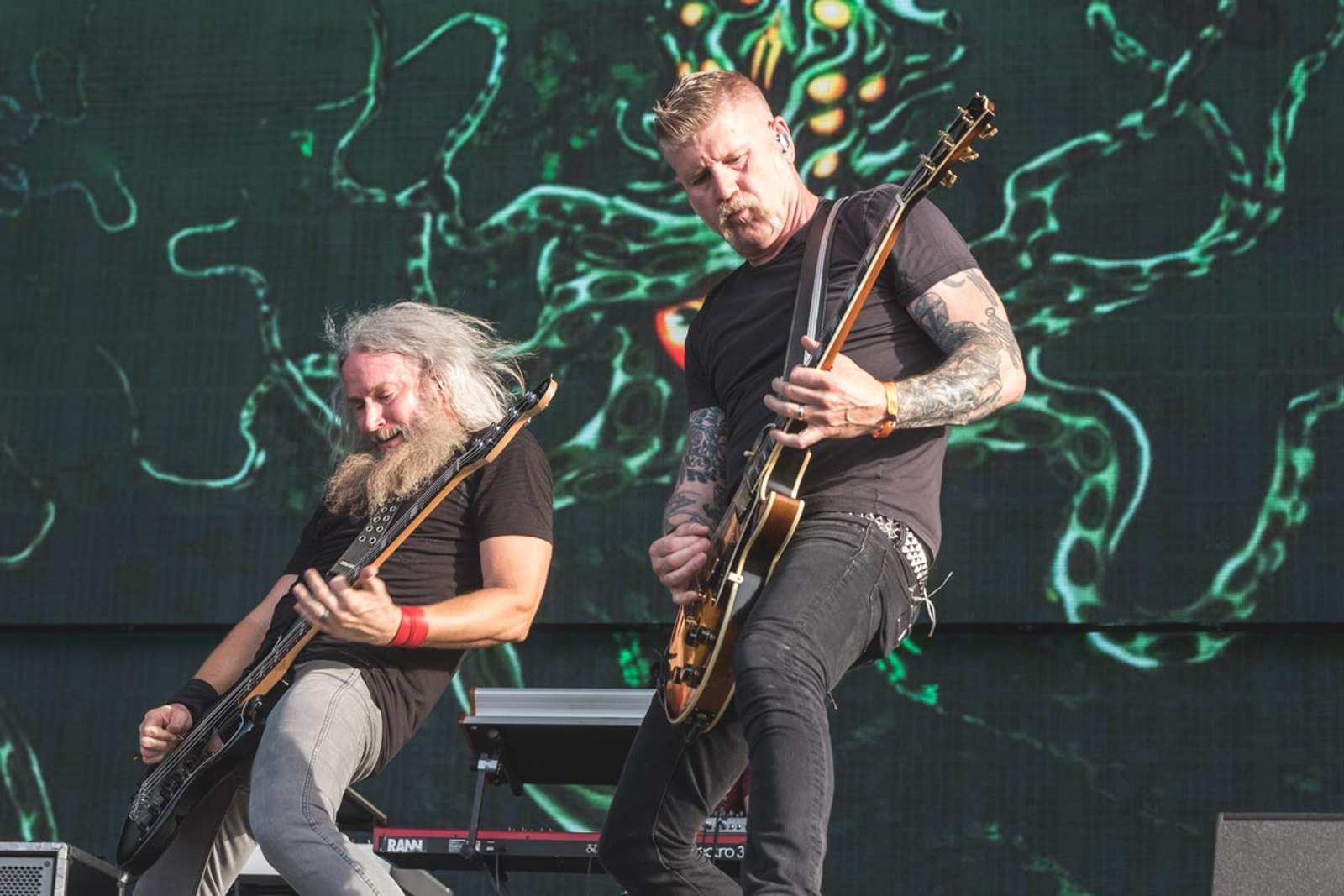
On 29 May 2000 EMI released Brave New World, and it went to number seven in Britain. The East London sextet that made it, three guitarists standing abreast on a record for the first time and Bruce Dickinson and Adrian Smith back in the ranks after most of a decade away, was Iron Maiden. The long quiet was over.
For most of the nineties the style had lain on the seabed like a submarine rigged for silent running, the galley serving cold food so no pan would ring against the steel and the crew padding the passages in socks while destroyers swept overhead, and in the first year of the new decade it blew its tanks with a roar of compressed air and came up bow first, tearing the swell apart along its casing. Nobody on the surface expected it. Everybody heard it.
The 2000 heavy metal bands did two jobs at once. The veterans came back to prove the old engines still turned over, and a generation born after The Number of the Beast learned the drill from its parents' records and kicked the drum machines and samplers of the nu metal years off the riser, leaving twin guitars, a clean high voice and a chorus standing in the wreckage. It was not nostalgia. Nostalgia does not sell out a hall.
Who built the style in the first place, and which single record proves each band's case, belongs to that part of the history. The decade from 2000 onwards asks a simpler question: who came back whole, and who came back with something the old records never had.
The veterans come back whole
"The Wicker Man" opened Brave New World and reached number nine as a single, a riff Adrian Smith brought to the reunion, and it tears the opening bars off the album before the drums have landed, the sound of a band that knew exactly what it had mislaid in the nineties and wanted it back by the weekend. Kevin Shirley recorded the six of them playing together in one room at Guillaume Tell in Paris. The songs only grew longer from there.
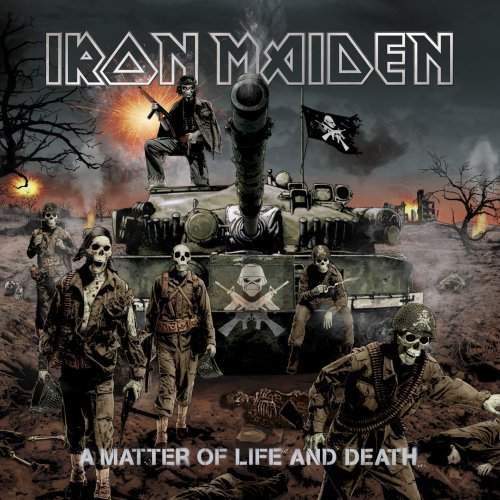
Released at the end of August 2006 and played in its entirety every night of the tour that followed, A Matter of Life and Death went to number four in Britain and number nine on the Billboard 200, the American album chart, the first time Maiden had reached the American top ten in a recording career of twenty-six years, and only its opening track runs under five minutes. A band with nothing left to prove had chosen to prove it anyway.
The singer who had walked out of the Birmingham band in 1992 and walked back into it in July 2003 was Rob Halford, and Angel of Retribution, released at the start of March 2005 with Roy Z producing, took Judas Priest to number thirteen on the Billboard 200. "Judas Rising" opens it on a scream that climbs clear of the guitars and stays up there. After that the band reads aloud from its own old manual. Not every page deserved a second reading. The first one did.
Stranger still was a band that renamed itself after its own best record. The line-up that had made Mob Rules for Black Sabbath in 1981 regrouped in 2006, and the quartet of Tony Iommi, Geezer Butler, Vinny Appice and Ronnie James Dio that recorded The Devil You Know for Rhino in 2009 went out as Heaven & Hell. "Bible Black" opens on an acoustic guitar and Dio almost whispering, and then Iommi's riff drops on it at the pace of 1980, which was always the right one. The album reached number eight in America.
Dio died of stomach cancer on 16 May 2010, aged sixty-seven. It was his last studio album.
2000 heavy metal bands in the European halls
The Gothenburg five that had lit the revival in 1997 and opened the new century by taking Renegade to number one on the Swedish album chart was HammerFall, and on Crimson Thunder in 2002 the band wrote choruses as drill commands, the hall stamping in step on "Hearts on Fire" while Oscar Dronjak and Stefan Elmgren laid harmony leads over the top like a descant over a hymn. Nobody in the room had come for irony. Nobody got any.
The London six who played power metal at the speed of an arcade machine, Herman Li and Sam Totman chasing each other up the neck in harmony until the solos turned into a race with no finish line, were DragonForce, and a plastic guitar controller carried them into more teenage bedrooms than any radio station of the decade. The purists sneered. The teenagers bought the records.
The American cellar
America's best heavy metal of the decade came out on small labels, in pressings of a few thousand. The San Francisco band that Mike Scalzi had led since the late eighties, playing Thin Lizzy harmonies over riffs with a Celtic lilt and taking a science fiction role-playing game as the libretto for Traveller in 2003, called itself The Lord Weird Slough Feg. Scalzi barks rather than sings. It suits the songs perfectly.
From Pennsylvania came the heaviest singer of the underground decade. The quartet with Tim Aymar's gravel-edged voice out front, Matt Johnsen's riffs underneath and Chris Black behind the kit went by the name Pharaoh, and The Longest Night, released by Cruz del Sur in 2006, is US power metal as Jag Panzer and Omen had drawn it twenty years before, played with the precision of men who had studied the drawings. It sold to believers. They are still buying it.
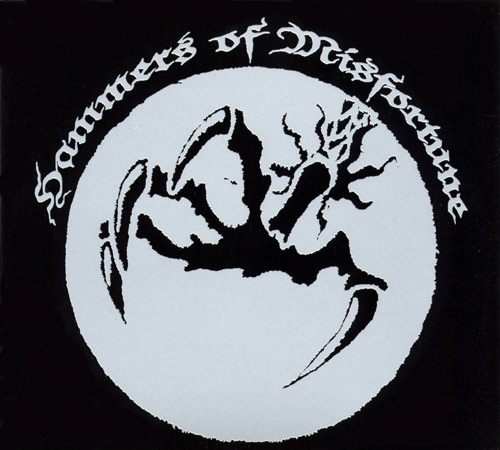
The strangest record of the American cellar came from the guitarist John Cobbett's San Francisco project Hammers of Misfortune, whose The August Engine, issued in 2003, set a Hammond organ, a male and a female voice and progressive structures against riffs out of 1976, so that a listener hears Rainbow and early Queensrÿche arguing across the same table. Nothing else from that year sounds like it. Few records from any year do.
The decade's biggest-selling heavy metal record in America came from the wrong side of the fence. The Huntington Beach five who had started out screaming over metalcore and then, on City of Evil for Warner Bros. in June 2005, put the screams away and wrote twin leads straight out of the Maiden songbook were Avenged Sevenfold, and "Bat Country" took the harmonised guitar back onto MTV for the first time in years. The old guard frowned. Its grandchildren did not.
A generation born after The Number of the Beast learned the drill from its parents' records and kicked the drum machines off the riser.
Sons and daughters of the vinyl
The young bands at the end of the decade worked like a mine-clearing sweep across open ground, one steady pulse sent out and the echo slamming back off every ridge and canyon of 1983 with its range and bearing written on it, so that a band of twenty-year-olds could chart a whole buried seabed of seven-inch singles they had never once seen come up. Then the kids built their own.
The Los Angeles band that the bassist Jon Leon assembled in 2007 to play the style exactly as it sounded in 1984, spandex included, was White Wizzard, and "High Speed GTO", the title track of a 2009 EP, fires a gleaming, chrome-plated riff and a chorus about a fast car with not one note of apology. Earache, a label built on grindcore, released the debut album Over the Top in 2010. That tells you how far the tide had turned.
Around it grew a whole new wave with a clumsy name, the new wave of traditional heavy metal. Toronto answered with Skull Fist, whose guitarist and singer Jackie Slaughter hammered the Heavier Than Metal EP of 2010 into a debut a year later, and Pasadena with Holy Grail, formed in 2008 by musicians who had passed through White Wizzard and pushed the tempo toward speed metal on Crisis in Utopia in 2010. Each is a scion of records older than its own members.
Sweden supplied the purest salvo of all. Bullet, fronted by Hell Hofer's shredded rasp, put out Heading for the Top in 2006 and played it like AC/DC tuned for a fight with Accept, and they stood at the head of a column that continues through the heavy metal bands from Sweden, the one country that turned the revival into an export.
| Band | Start with | Year | Verdict |
|---|---|---|---|
| Iron Maiden | A Matter of Life and Death | 2006 | Longer, darker, still first |
| Heaven & Hell | The Devil You Know | 2009 | Iommi and Dio, one last time |
| Judas Priest | Angel of Retribution | 2005 | The voice back where it belongs |
| HammerFall | Crimson Thunder | 2002 | Choruses as drill commands |
| The Lord Weird Slough Feg | Traveller | 2003 | Thin Lizzy in deep space |
| Pharaoh | The Longest Night | 2006 | US power metal, studied and exact |
| Hammers of Misfortune | The August Engine | 2003 | The strangest of the lot |
| Avenged Sevenfold | City of Evil | 2005 | Maiden harmonies for a new audience |
| White Wizzard | Over the Top | 2010 | 1984, without a wink |
Ten years that began with three guitarists in one room in Paris ended with teenagers in Toronto and Pasadena playing records their parents had sold for rent money. By any fair count it was the best decade the style had enjoyed since the eighties. The pedigree held, and nobody had to pretend otherwise.
