
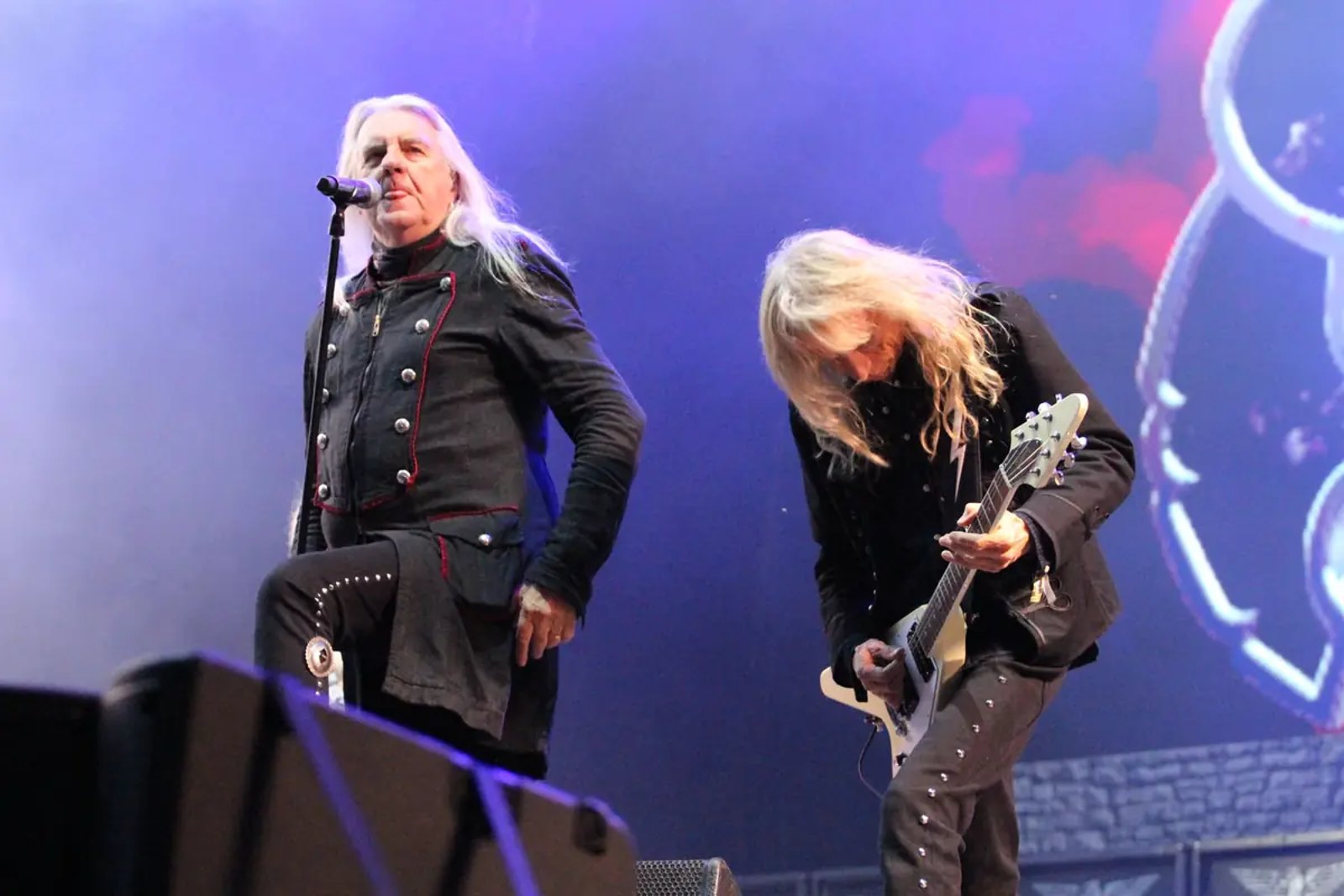
One and a half million dollars for a single night's work. The quartet from Pasadena that took that fee home from the second day of the US Festival, on Sunday 29 May 1983, was Van Halen, and the figure is still the loudest thing ever said about what heavy metal festivals could be worth.
Staged in Glen Helen Regional Park outside San Bernardino and bankrolled by the Apple co-founder Steve Wozniak, Heavy Metal Day marched Quiet Riot, Mötley Crüe, Ozzy Osbourne, Judas Priest, Triumph and the Scorpions across one stage ahead of the headliner, in front of a crowd estimated at 375,000, the single biggest day the festival drew across its four dates. That Sunday a hillside in California tore the playlist off the studio wall at every rock station in America. The festival still lost money, around twelve million dollars. The field did not care.
Heavy metal festivals begin in a racing circuit's infield
Three years earlier the English version had been built almost by accident. Conceived by the promoter Paul Loasby as the closing date of a Rainbow tour, the first Monsters of Rock put 35,000 people onto the infield of the Donington Park racing circuit in Leicestershire on 16 August 1980, one day, one stage and a bill climbing from the afternoon into the dark, and that shape became the template for every open air muster of the decade.
The Yorkshire five who turned that first afternoon into a hit single were Saxon. "And the Bands Played On", issued in 1981 and carried to number 12 on the British singles chart, the highest any Saxon single has reached, is a song about the Donington festival itself, and a group that scores its biggest hit by writing about its own audience has said plainly who the day belonged to.
The formula travelled. From 1983 the Monsters of Rock name was exported to West Germany, then to Sweden in 1984 and on across the Netherlands, Spain, Italy and France, while the English original kept growing. By 20 August 1988 the crowd at Donington had tripled to about 107,000, with Iron Maiden at the top of the bill. Two young men died that afternoon in a crush near the stage. The festival left Donington after 1996.
| Festival | First held | Where | Format |
|---|---|---|---|
| Monsters of Rock | 1980 | Donington Park, England | One day, one stage, open air |
| US Festival, Heavy Metal Day | 1983 | Glen Helen Regional Park, California | One day inside a four-day festival |
| Wacken Open Air | 1990 | Wacken, Schleswig-Holstein | Open air on farmland, several days |
| Headbangers Open Air | 1998 | Brande-Hörnerkirchen, Germany | Open air, in the founder's garden |
| Keep It True | 2003 | Lauda-Königshofen, Germany | Indoors, in a sports and events hall |
When the radio let go, the fields held on
A post mill stands on its ridge with the whole timber body, sails, gears and stones balanced on one oak post, and when the wind swings the miller sets his shoulder to the long tail pole and heaves the entire building round until the sails face into it again, because a mill turned the wrong way is only a shed with arms. Through the nineties the music did exactly that.
Stripped of American radio play and pushed to the margins of music television once grunge had swept the spandex off the racks, the bands that had filled arenas in 1985 heaved their whole operation round to face the one wind still blowing, which came off the summer fields of Germany, the Netherlands and Scandinavia, where the faithful had never stopped buying tickets. The touring year bent to the festival season. It has stayed bent.
A mill turned the wrong way is only a shed with arms.
Wacken and the German summer
The gathering that Thomas Jensen and Holger Hübner started in 1990 in a gravel pit on the edge of a village in Schleswig-Holstein, with around 800 people in front of the stage, is Wacken Open Air. It drew 1,300 the next summer and 10,000 by 1997, and it now fills a site of some 240 hectares, campsites included, with about 85,000 people, most of them in black, most of them there for the old guard as much as for anything new.
The veterans treat the field as a garrison they return to every summer. Judas Priest filmed its live release Battle Cry there on 1 August 2015, in front of a capacity crowd, and Saxon has recorded there more than once. The weather has its say as well. Heavy rain in 2023 forced the organisers to stop motor vehicles entering the site, and those who could not get in were offered refunds.
Keep It True and the bands that came back
The other half of the story happens indoors, in April, in a municipal events hall. Founded in 2003 by Tarek Maghary, the singer of the German band Majesty, and Oliver Weinsheimer, an editor at the magazine Rock Hard, and staged since its first edition in the Tauberfrankenhalle in Lauda-Königshofen, Keep It True books almost nothing but traditional heavy metal and treats a band that stopped in 1986 as a headliner nobody has booked yet.
The hall works like a seed bank. A packet of grain from a variety nobody has farmed in forty years comes out of the cold drawer, goes into the ground in spring, and the whole point of the exercise is to see whether it still comes up true to type, which is exactly what the festival's name demands of every band walked onto its stage. The American band that came back there in 2005 for its first show in seventeen years was Deadly Blessing. Fans came from abroad for shows like that one.
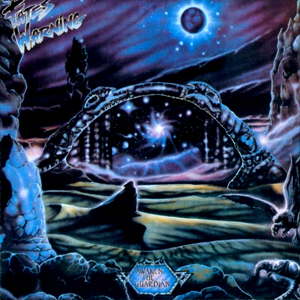
The reunion that put the festival on record came on 30 April 2016, at Keep It True XIX. The Connecticut five who walked out that night with John Arch singing, his first concert with the band since he left in 1987, were Fates Warning, and they played the whole of Awaken the Guardian, their Metal Blade album of 1986, with the line-up that had recorded it: Arch, Jim Matheos, Frank Aresti, Joe DiBiase and Steve Zimmerman.
Metal Blade filmed the night and issued it in 2017 as Awaken the Guardian Live, with "Fata Morgana" sent out first as the preview. Arch had not sung a Fates Warning set on a stage since 1987. The festival that brought him back was a hall in a small town in the Tauber valley that seats about 3,500 people, and no arena promoter had come close.
The circuit has since filled in around it. The festival Thomas Tegelhütter began in 1998 in the garden of his family's farm in Brande-Hörnerkirchen, and still calls the biggest garden party in the world, is Headbangers Open Air. The band that ended a silence begun with its break-up in 1991 by headlining the second Frost and Fire festival at the Majestic Ventura Theater on 8 October 2016, in the California town it came from, was Cirith Ungol.
What the field keeps
The festival does two jobs the record shop never could. It puts the veterans and the young bands on the same bill on the same afternoon, so that a sixteen year old who came for one group leaves with six more written on the back of a hand, and it turns a crowd into a choir, the second job belonging to the vocals chapter, where the chorus sung back at the stage gets its own account.
It also runs the merchandise tent, the one stall where the banners of a hundred bands hang from the same scaffolding. The black cotton sold under that canvas, dated and bought on the spot, is the subject of heavy metal band shirts, and more of what gets carried home from a field than any record.
The rest of the culture, the sleeves, the patches and the ink, grew in the same soil and is laid out in the chapter above. The field is the one place all of it is worn at once. Forty summers after Donington, Wacken has in several recent years sold every ticket within hours of going on sale, before a single headliner was named.
