
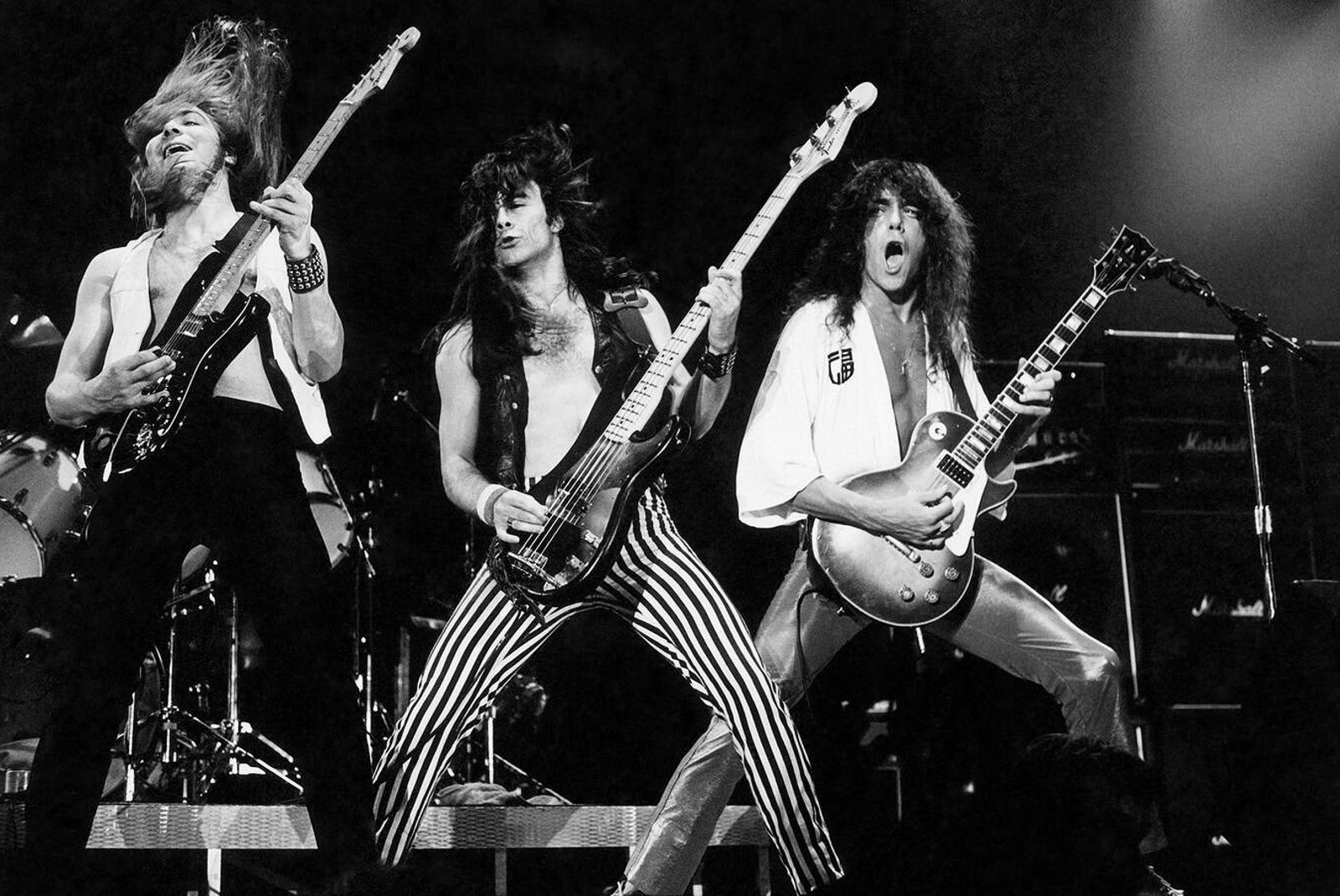
A London Weekend Television crew came to film Iron Maiden in 1980, for 20th Century Box, a regional series about what young Londoners were doing with their evenings, and caught the band on the stage of the Marquee with Paul Di'Anno at the microphone and the front row close enough to touch the guitars. The presenter, a former record shop assistant who had written for Sniffin' Glue and was barely into his twenties, was Danny Baker. Very little of the wave was ever filmed from inside it.
On the gable end of an old terrace, when the billboard that covered it for half a century is finally unscrewed and lowered to the pavement, a hand-painted advertisement comes back into the light, the letters for a mill or a tonic or a boot polish flaking off the brick in patches, the colours burned down to a ghost of what the signwriter mixed in 1925. Conservation officers have a firm rule about ghost signs. Nobody repaints one, because fresh enamel over the faded original makes it legible and destroys it in the same afternoon.
Every nwobhm documentary made since has had to choose between those two things, reading the faded wall or painting over it. The history itself, from a Sounds headline in May 1979 to a number one album in 1982, is in the chapter that covers it. What followed on film is how it has been shown since, and only some of it left the brick alone.
The footage that was there at the time
The camera found the new wave of British heavy metal late and rarely. Top of the Pops put the chart bands on BBC One for three minutes a time, regional television dipped in now and then, and the rest of the wave, the hundreds of bands who pressed a single and played the Soundhouse circuit, was barely filmed at all. What exists is a handful of reels. Every one of the chroniclers since has cut from the same few.
The band that kept its own reels, and knew what they were worth, was Iron Maiden. Released on 8 November 2004, The History of Iron Maiden, Part 1: The Early Days put a ninety minute documentary directed by Matthew Amos beside the 20th Century Box programme, forty five minutes of the band at the Ruskin Arms and its concert at the Rainbow in December 1980, and it went to number three on the British music video chart. The Rainbow footage is the best attested night the Di'Anno band ever played. It looks like a riot that learned to count.
What makes The Early Days better than a band portrait has any right to be is who was let back in. Paul Di'Anno, Clive Burr, Dennis Stratton, Doug Sampson and a line of guitarists and drummers who passed through the band before 1980 all sit in front of the camera and say why they left or were shown the door, and the film lets them say it. The authorised version, for once, included the people it had sacked.
The authorised portraits
The series that took one album at a time and put the tape machine on the table went out as Classic Albums, and two of its episodes of 2001 belong to this story. The Number of the Beast, released on 26 November 2001 and directed by Tim Kirkby, has Martin Birch and Clive Burr beside the band, pulling the old multitrack apart channel by channel. British Steel, released on 10 December 2001, does the same with Tom Allom and Judas Priest, a band that fed the wave without ever belonging to it.
The Barnsley band that waited longest and went furthest was Saxon. Heavy Metal Thunder: The Movie, a feature length history sold first to the band's fan club and released to the shops through UDR on 7 December 2012, brings Graham Oliver and Steve Dawson back in front of the camera and calls Lars Ulrich and Lemmy as witnesses from among the faithful. It is a repaint, but a careful one.
Fresh enamel over the faded original makes it legible and destroys it in the same afternoon.
The unauthorised NWOBHM documentary, and the television histories
The film that read the wall without asking permission came out in 2008, ran to two and a half hours, and carried a disclaimer that the current Iron Maiden had not authorised it. Iron Maiden and the New Wave of British Heavy Metal is built from the people the official story used as scenery: Di'Anno and Stratton again, Brian Tatler of Diamond Head, Rob Weir of Tygers of Pan Tang, Barry Graham, the Samson drummer known as Thunderstick, Neal Kay from the Soundhouse and Geoff Barton from Sounds. Its interviews with Kay and Barton are the nearest thing on film to the two men who hosted and named the wave talking about it as their own. It is too long. It is also the only one that remembers how many bands there were.
A BBC Four overview packs a whole national history into one evening's programme the way a removal crew loads a house into a van, the wardrobe and the double bed heaved up the ramp first and wedged against the bulkhead, and the box of small things that made the house a home left on the doorstep when the doors slam shut. The director who made Heavy Metal Britannia, first shown in March 2010, was Chris Rodley, and the film runs from the Midlands of the late sixties to Iron Maiden's arenas with Tony Iommi, Rob Halford, Ian Gillan, Biff Byford, Bruce Dickinson and Lemmy all talking, and it left Girlschool on the doorstep.
The North American version came a year later. The Canadian who gave the wave a whole episode of Metal Evolution, his VH1 Classic series, "New Wave of British Heavy Metal", first broadcast on 10 December 2011, was Sam Dunn, and the episode puts Motörhead, Iron Maiden, Saxon and Diamond Head at its centre. It explains more than it shows. On any honest reading, for viewers meeting the wave for the first time, that was the right choice.
The American format that did most to fix how the wave's biggest export is remembered was VH1's Behind the Music, and its Def Leppard episode, first broadcast on 21 June 1998, tells the Sheffield story as rise, loss and return: the teenage band, Rick Allen's arm lost in a car crash on the last day of 1984, the death of Steve Clark in January 1991, and the stadiums. The pub years sit at the front of a story built to end in arenas. The format had no slot for the Soundhouse.
Late portraits and the new cinema
The one portrait from the wave's orbit made while its subject was still working came from America. Directed by Greg Olliver and Wes Orshoski and released in 2010, Lemmy follows Motörhead's leader between the Rainbow Bar and Grill in Los Angeles and a small flat stacked with war memorabilia, with Dave Grohl and members of Metallica queueing to pay tribute. Motörhead fed the wave without ever joining it. The film knows the difference and does not care.
The singer on the Rainbow footage died in October 2024, and the film about him arrived after he had gone. The co-director of Lemmy, who spent 2017 to 2023 following Paul Di'Anno through illness and a return to the stage, is Wes Orshoski, and Di'Anno: Iron Maiden's Lost Singer was announced by Cleopatra Entertainment for a summer 2026 release, with Steve Harris among the faces on screen. It is the portrait of a man, not a movement. The movement is in every frame anyway.
The band he left is in the cinema too. Announced by Universal in February 2026 for release that May and directed by Malcolm Venville, Iron Maiden: Burning Ambition covers fifty years with the band and Rod Smallwood taking part, and it is the band's own account from first frame to last, told by the people who won.
| Year | Film | Made by | Authorised | What it has |
|---|---|---|---|---|
| 1980 | 20th Century Box (Iron Maiden) | London Weekend Television | Filmed at the time | Maiden at the Marquee, 1980 |
| 1998 | Behind the Music: Def Leppard | VH1 | Yes | The Sheffield arc, told for America |
| 2001 | Classic Albums: The Number of the Beast | Tim Kirkby | Yes | Martin Birch at the desk |
| 2001 | Classic Albums: British Steel | Tim Kirkby | Yes | Tom Allom and the tapes |
| 2004 | The History of Iron Maiden, Part 1: The Early Days | Matthew Amos | Yes | The sacked members, on camera |
| 2008 | Iron Maiden and the New Wave of British Heavy Metal | Independent | No | The bands the others left out |
| 2010 | Heavy Metal Britannia | Chris Rodley, BBC Four | Not a band film | The whole British story in one programme |
| 2010 | Lemmy | Greg Olliver, Wes Orshoski | Yes | The wave's elder, still at work |
| 2011 | Metal Evolution: New Wave of British Heavy Metal | Sam Dunn, VH1 Classic | Not a band film | The wave explained for America |
| 2012 | Heavy Metal Thunder: The Movie | Saxon, UDR | Yes | Oliver and Dawson on camera |
The films end where the wave ended, around 1983, and none of them follows the music into the hands of the bands born long after it who now play its rules as if they had written them. That story is the new wave of traditional heavy metal, and so far nobody has pointed a camera at it with any patience.
