
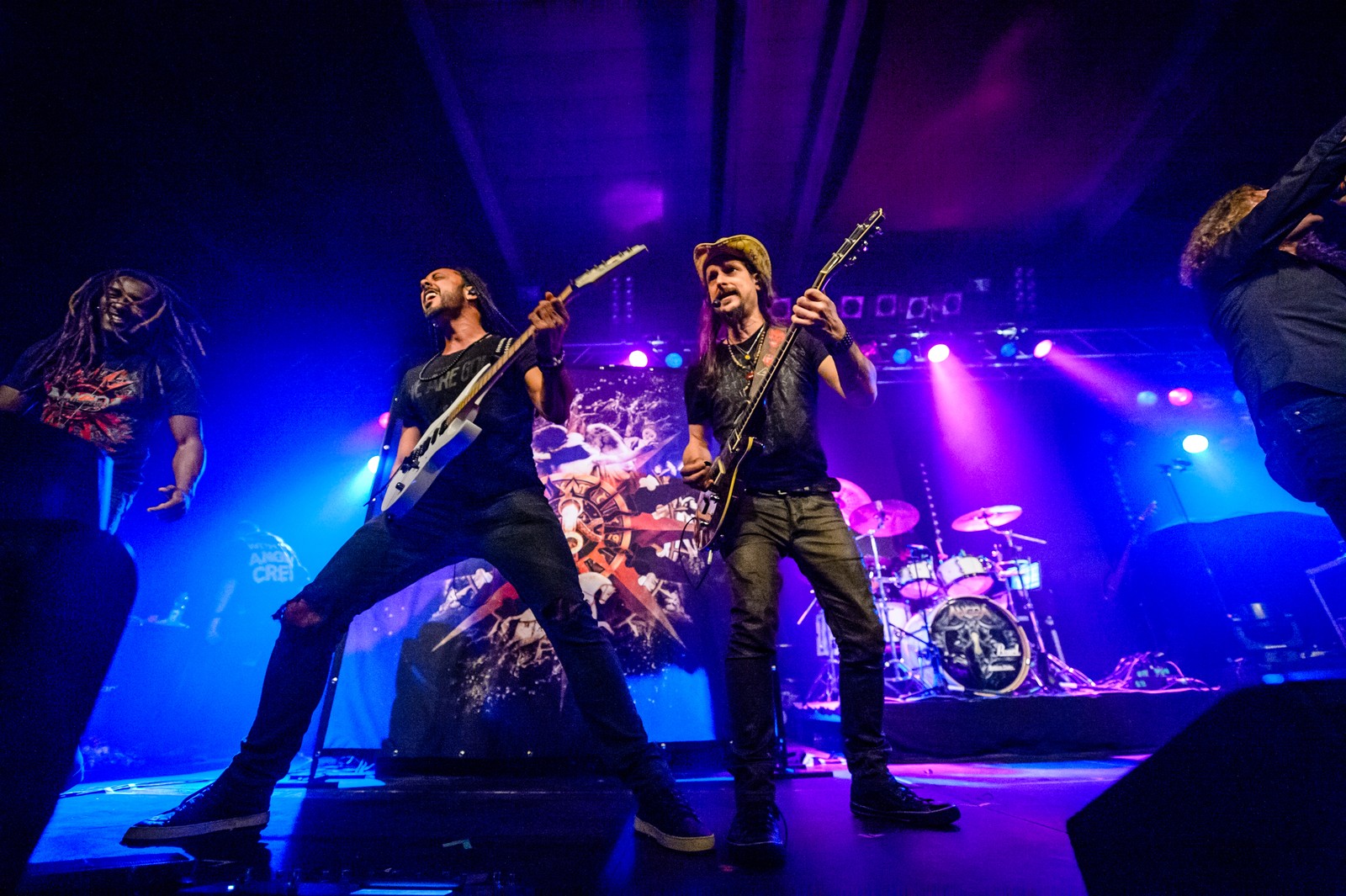
The band that had spent the previous decade setting Tolkien to double kick drums, and that put a 1954 barbershop novelty out as a single on 7 February 1996 with a video made for it, was Blind Guardian. Power metal covers of pop songs are the only arrangements in this music that can be marked against a fixed answer, because the thing being argued with is still in print.
A pop record is built out of changes too small to name. A tambourine walks in for the last chorus and the floor tilts, and it registers only because the field around it is thin enough to let a small thing count. Hand the same job to two distorted guitars, a kick drum that never stops and a chorus stacked eight deep, and the smallest increment on offer is a layer: another guitar track, another octave, another throat. A tambourine battered against a palm right through a chorus like that, until the steel discs buckle in their slots, moves next to nothing, and the man holding it can stop and hardly a soul in the room will find out.
Which leaves one component of the original with nothing in it to break. A sequence of pitches has no loudness, no timbre and no size written into it, and it is the only part of a pop single's sound that arrives in this genre whole. Everything else gets built again from nothing, at a resolution the original never used, its hundred small decisions hammered flat into three or four big ones.
So the shelf sorts itself in two, and one question does the sorting: did the band write the accompaniment or inherit it. A cover that works keeps the tune and throws the record away. A cover that fails keeps the record and swaps the timbres, playing somebody else's arrangement with guitars where the synthesisers were, and it argues nothing, because every decision in it was taken in another studio, for other instruments, by people who are not in the band. Such a record can still be well made and well liked. It just cannot be a claim about the song.
Why power metal covers go looking in the pop charts
A pop single is written to a specification almost nothing else in music has to meet: a stranger who was not paying attention has to be able to hand the tune back after one pass. It is also a hard thing to write, and it is the exact article this genre's choruses are built to deliver. The borrowing is mechanical, then, and not ironic.
Two records were built on borrowed songs. Metal Jukebox, twelve tracks on Victor in Japan in September 1999 and eleven on Castle in Europe, is covers end to end, and so is nearly half of The Forgotten Tales, which Virgin released in April 1996. Neither belongs with the essential power metal records, which are original work to the last sleeve.
Two covers that keep the tune, and only one that lets the record go
Written in a single evening by an eighteen year old, released on 20 January 1978 and installed at number one in Britain for four weeks that March, "Wuthering Heights" was Kate Bush's first single and the first British number one by a woman who had written all of it herself. The band from Sao Paulo that put it seventh on its 1993 debut, and that brought in a different drummer for that one track while another man sat behind the other nine, was Angra.
Angra's reading lands among the covers that keep the record. Angels Cry, produced by Sascha Paeth and Charlie Bauerfeind and out on 3 November 1993, carries the song at 4:41 against the original's 4:29, leaves the melody in the register it was written for instead of hauling it down to where a man's chest voice sits, and hands the back half to guitar solos. So does the original, whose solo is Ian Bairnson's and whose piano is Bush's own, and the Angra track credits a piano as well. One published reading calls the result surprisingly faithful, and about the arrangement it is right: the accompaniment was inherited, which settles it. What no arrangement could hand over was the voice. The singer Andre Matos takes the line in falsetto in a woman's register, the one thing reviews agree on, and that substitution is the one every covering band has to make, so it separates nothing: Helloween, covering ABBA, had no choice about replacing a vocoder either. What the Angra track argues about the song is nothing at all. Almost every other decision on a record can be inherited, and the singer never can.

The clean case sits on the Blind Guardian compilation, on the track nobody expected it on. "To France" was Mike Oldfield's, written by him, sung by Maggie Reilly and issued in June 1984 by the label that would put the covers record out twelve years later, and at 4:33 it is layered studio pop. Blind Guardian's version runs 4:43 and is made of chords, leads and Hansi Kürsch, which is to say the layering went out and four men playing new parts came in. One review calls that the full lavish treatment and another hears a song the band might have written itself.
What a swap of timbres leaves behind

Benny Andersson and Björn Ulvaeus wrote "Lay All Your Love on Me" and produced it, Agnetha Fältskog sang the lead. Two sounds make that record what it is, and neither is a part a musician can play. The vocal that walks downward into the refrain was got by feeding a harmoniser's output back into its own input until the pitch kept falling. Parts of the chorus went through a vocoder because the two writers heard a hymn in it and wanted a congregation singing a little out of tune.
The band that took the song at 4:37 against the original's 4:35, kept its shape and put guitars where the machinery had been, was Helloween, and the parts arrived from five men recording separately in different countries before being assembled at Andi Deris's studio on Tenerife. A record copied as a set of parts, by a band working as a set of parts. One published reading hears an outtake from the sessions for The Time of the Oath and wishes by its close for a more highly arranged adaptation; another grants the catchiness and says flatly that it does not come off; a third finds a song that was fine before the guitar leads were layered over it.
The oldies on the other record stay close to their originals' shape and make no secret of it. "Mr. Sandman" runs 2:10 against the Chordettes' 2:22 and keeps the opening vocal arpeggios, the figure later genres lifted wholesale; "Surfin' U.S.A." comes in at 2:25 against 2:29, with a session pianist on it; the "Barbara Ann" medley is over in 1:45. Published verdicts on all three run from a curiosity worth one listen to a band making the songs its own. Blasphemy is the wrong charge against any of the three. A cover that keeps the record keeps the record's good manners too.
One industry performs this division on purpose. A karaoke disc is a record with the song cut out of it and the setting kept whole: session players re-cut every fill and every pad of a hit, and the one component everybody came for is left out for a stranger to supply. That line, between a composition and its recording, sits where the law puts it, drawn by people with no aesthetic interest in either side. A band that reproduces an arrangement faithfully and stands its own tenor where the original singer stood has built the same object with gain on it. The Angra track is that object too, and the readings that admire it break nothing: an inherited arrangement can be a pleasure and make no claim.
What the running times can and cannot prove
The arithmetic is free and it points one way. "Mr. Sandman" comes in twelve seconds under the Chordettes, "Surfin' U.S.A." four seconds under the Beach Boys, the ABBA cover a few seconds over ABBA, which is where a band lands when it keeps another band's bar count. The British band that cut Celine Dion's "My Heart Will Go On" down to 3:24, the shortest of ten tracks on a 2019 record whose others run from 4:29 to 6:47, was DragonForce, and the song it took was composed by James Horner with words by Will Jennings, for a film, not written by the woman whose record sold it. Seventy six seconds came off a 4:40 album version, and the published accounts describe a track that opens in 8-bit tones and runs at the band's top speed, which is demolition and not decoration. Whether that went to speed or to cuts, a ballad at that pace has been rebuilt from the floor up, which puts it where "To France" is.
Then the stopwatch gives up, because "To France" is 4:43 against 4:33 and was rebuilt rather than copied. Running time reports a bar count and a tempo and nothing else. The test is never whether the timbres match. It is whether the band wrote the accompaniment or inherited it.
The test is never whether the timbres match. It is whether the band wrote the accompaniment or inherited it.
What the transfer reports about the song it borrowed
Power metal covers are measurements of their originals before they are anything else, and the measurement is the interesting half. A melody that survives being played twice as loud by a band with no quiet setting at all was holding the song up by itself. Volume galvanises nothing.
Three of these cases report that from three directions. The ABBA chorus stands up under a metal band's guitars because its writers had already heard a congregation in it and faked one with a vocoder, and a real voice is cruder and still does the job. The Bush melody stands up under a man's falsetto with the rest of the arrangement left where it was, which makes it the cleanest measurement of the three, because only one thing changed. The Horner theme stands up at the band's top speed. In each the tune was the asset and the record was the setting, and a finished master hands the two over as one object, which is why a band that tries to lift the setting out ends up building a replica of it instead.
No apostle of the original is wrong about the notes. The notes are not the question. The one performance that cannot cross is the singer's, and it belongs to the person who gave it.
So the question usually asked first is the wrong one. Anybody can set the two recordings side by side, and the comparison answers one thing: did somebody in the band decide something, or copy a sheet of decisions taken by strangers. The genre's own standing work was made the first way, the best power metal albums of the 80s included, and that is the standard a borrowed song has to meet.
