
Progressive deathcore changes where the blows land, not how fast they come. The blast beats stay, the gutturals stay, and the breakdown sits exactly where the genre has always kept it, but everything around that drop gets kicked off the grid: riffs that start on the wrong sixteenth note, songs that run on past the place where a chorus would come home, keyboard pads and clean interludes wedged between the hits. The test is mechanical. A band moves the accents and the song form, or it is some other kind of deathcore.
Picture the washer in the corner of a house-show basement, thrown off balance by a load of soaked tour hoodies, its drum slamming the cabinet on a count of its own while the drummer's hi-hat ticks a dead straight four a yard away; the two drift apart, cross, drift again, and on the bar where they finally land together the machine rips its drain hose out of the wall, walks off its spot and caves in the side of the water heater. That landing is the breakdown. The lopsided slam before it is the riff.
Built under other names in the Chicago suburbs from 2003, recorded instrument by instrument by a drummer who played every part himself, produced in North Hollywood by Michael Keene of The Faceless and released by Sumerian Records on 2 October 2007 as an eight-track EP called The New Reign, the band that opens any honest roll of progressive deathcore bands is Born of Osiris. Every band in the branch earns its place with something you can hear in the bar lines.
Progressive deathcore, measured by the bar
The branch sits on the wider map drawn in the account that frames it, right beside technical deathcore, and the two get confused for a simple reason: both ask a lot of the guitarist. They spend it differently. Technical deathcore is counted in notes per second. The progressive kind is counted in where the downbeat went missing, how far a song travels before it is allowed to stop, and how much air it lets in between the drops.
The riff at the centre comes from one lineage. Meshuggah, formed in Umeå in 1987, built the low, palm-muted, syncopated chug that the scene later named djent, and the progressive deathcore bands took that chug and nailed it to the breakdown. What matters inside deathcore is the collision. The syncopated riff pulls against the count, the breakdown snaps everything back onto it, and the second hit feels heavier for the first.
Then you get the furniture that never fit in a MySpace-era song: seven- and eight-string guitars, keyboard players in the line-up rather than on a backing track, ambient interludes, instrumental passages long enough to make a crowd stand still. None of it is decoration. It is the reason these bands wrote breakdowns that hit like they had been waiting a whole song to arrive.
The Sumerian class of 2007 to 2010
Ash Avildsen founded Sumerian Records in 2006, and inside four years the label had signed the three bands that defined the branch. All three came out of the same corner of the Midwest, and in early 2009 After the Burial and Veil of Maya co-headlined a tour of the United States together.
The Palatine band is on the roll for the keyboard and for the way it treats a record as one piece. Joe Buras plays keyboards in the band itself, a full member rather than a backing track, and his synth lines run through the songs as atmosphere and fills instead of bolted-on intros while the guitars keep chugging underneath. A Higher Place, released by Sumerian on 7 July 2009 and produced by Zeuss, fits thirteen tracks into thirty-four minutes, opens on a track that picks up where the last song of the EP left off, and entered the Billboard 200 at number 73. The songs are short. The record is long. That is the progressive move, made across a whole album instead of inside one song.
"Now Arise", the single from A Higher Place, got its video in September 2009, and it is where to start. Listen for the keyboard fills and the guitar melodies sharing the track with the blast beats, and for how little room the song leaves between them. Born of Osiris then hired Jason Richardson from All Shall Perish on lead guitar for The Discovery, released on 22 March 2011, and the record entered the chart at 87.
Formed in Chicago in 2004 around Marc Okubo, credited with every note of music on its third album, signed to Sumerian in January 2008 and produced on two records running by Michael Keene, the quartet that crams the whole progressive method into three-minute songs is Veil of Maya, on the roll for the opposite reason. [id], out on Sumerian on 6 April 2010, fits eleven tracks into twenty-nine minutes, three of them instrumental, and still reached number 1 on Billboard's Heatseekers chart. The longest song stops at three minutes forty-five, and the precision of that timing is the method: a branch that sells restlessness cannot afford a song that outstays it.
Here is the best party trick in the branch. "Namaste" runs three and a half minutes and carries a choked, staccato riff that punches the bar full of holes the way a ticket taker's punch chews a strip of tickets at the door, each hole clean and deliberate. Later records took Veil of Maya into progressive metalcore. On Matriarch in 2015, with Lukas Magyar singing, clean vocals arrived for the first time.
The songs are short. The record is long. That is the progressive move, made across a whole album instead of inside one song.

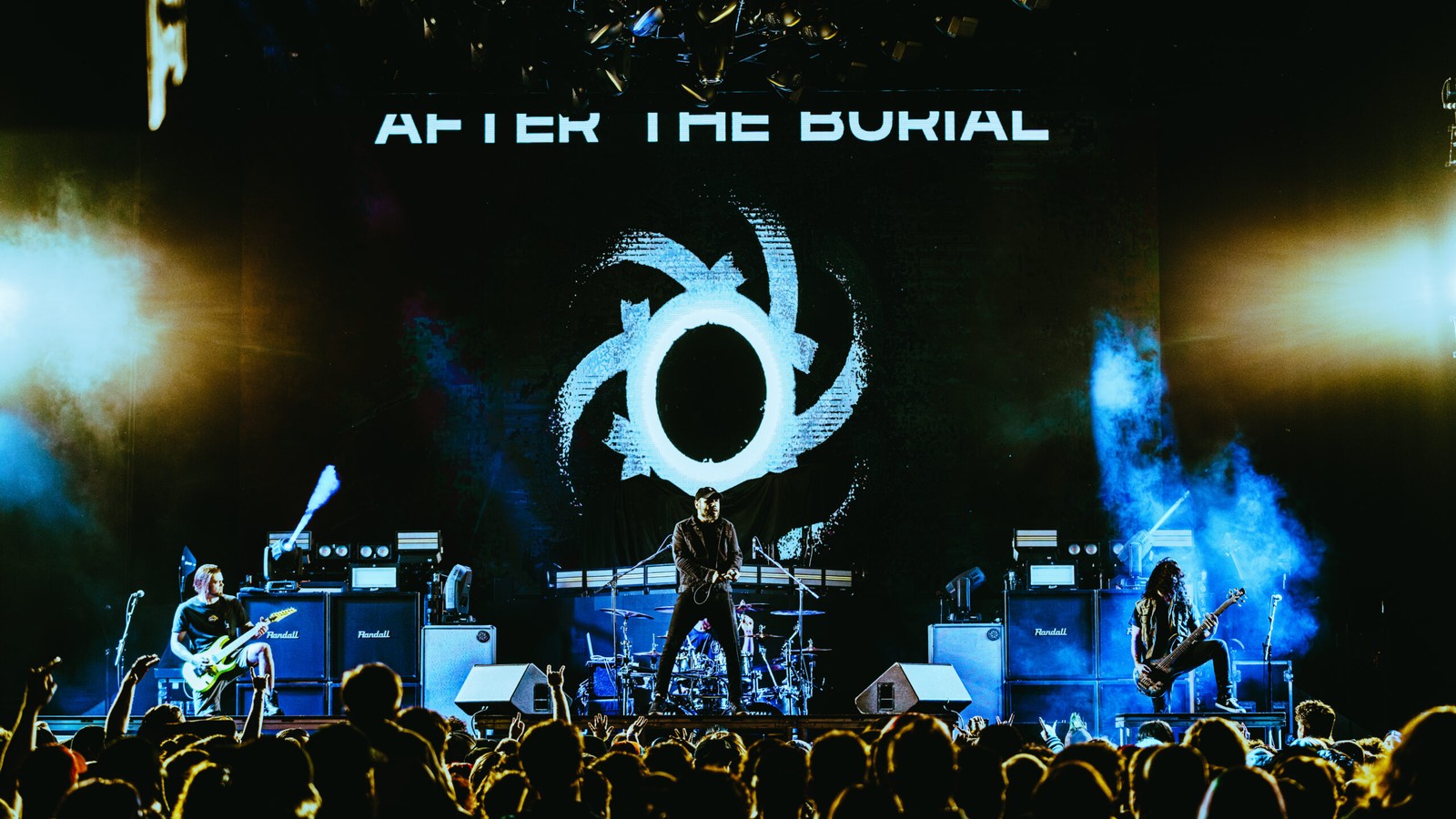
After the Burial is on the roll for the low string. The Minneapolis band, together since 2004, produced Rareform with its own two guitarists in Minnesota studios and put it out on Sumerian on 22 July 2008, eight songs in thirty-five minutes, opening on a track that runs past five and a half minutes, with every drum hit programmed by Justin Lowe on rhythm guitar instead of played, which gave the record the machine tolerance of a grid under a riff built to land off the beat. The record was cut on eight-string guitars, Lowe and Trent Hafdahl having moved up from sevens so they could tune lower and still play in the key of E. Sumerian reissued the album on 15 September 2009 with Anthony Notarmaso singing in place of Grant Luoma.
In Dreams followed on 23 November 2010, and "Your Troubles Will Cease and Fortune Will Smile Upon You" is the one to hear first. On that record the low string of the eight-string guitar lands under the riff like an arcade cabinet in the corner of a pizza-place venue toppled face down onto the tiles, the screen bursting and the whole floor taking the weight at once.
Djent deathcore and the chug that refuses the count
Djent deathcore is the phrase for the same machinery heard from the guitar side. The word djent belongs to progressive metal, which coined it for the sound of a palm-muted, high-gain low string, and inside deathcore it does one specific job: it makes the riff before the breakdown sound like a fight with the beat, so the breakdown can win it. A deathcore band that plays the chug with a blast beat behind it and a guttural on top has not crossed into progressive metal. It has borrowed a tool.
The same borrowing runs one step further out. Thall, the word the Swedish band Vildhjarta turned into a sound, takes the djent chug colder and lower. In deathcore it reaches the genre through Humanity's Last Breath, formed in Helsingborg in 2009, whose sub-drops land under the gutturals like a second floor giving way under the first. Thall is a guest in deathcore, never a resident.
| Band | Formed | Record to start with | What it moves |
|---|---|---|---|
| Born of Osiris | 2003, Palatine, Illinois | A Higher Place (2009) | Keyboards in the line-up, the album as one piece |
| Veil of Maya | 2004, Chicago | [id] (2010) | Eleven songs in twenty-nine minutes |
| After the Burial | 2004, Minneapolis | Rareform (2008) | Eight-string riffs set against programmed drums |
| The Contortionist | 2007, Indianapolis | Exoplanet (2010) | A three-part suite on a forty-eight minute record |
| Fallujah | 2007, San Francisco | The Harvest Wombs (2011) | Melodic lead guitar set against the growls |
| Kardashev | 2012, Tempe, Arizona | Peripety (2015) | Atmosphere before the name deathgaze |
| Alluvial | 2016, Portland, Oregon | Sarcoma (2021) | A Faceless guitarist and a Suffocation voice on one record |
Long songs, and the bands who used them as an exit
Song form is the other half of the branch, and the bands that pushed it hardest tended to leave deathcore by the side door. Formed in Indianapolis in 2007 under the name At the Hands of Machines, carrying a deathcore sound through the EPs Shapeshifter in 2008 and Apparition in 2009 and landing on Good Fight Entertainment for its first album, the group whose debut was a forty-eight minute trip out of the solar system is The Contortionist. Exoplanet, released on 31 August 2010 and produced by Ken Susi, closes on a three-part title suite in which, by Robby Baca's own account, musical ideas return across all three parts. That is through-composition at deathcore weight, and by Intrinsic in 2012 the melody had started to take over.

Early Fallujah belongs on the roll for one record. The Harvest Wombs, released by Unique Leader in November 2011 with Sam Pura engineering, sets long, melodic lead guitar against the growls and the weight underneath, closes "Prison of the Mind" on a vast breakdown, and the weight shoves straight through the reverb as if it were not there. The ambient side then won the argument, and the band's later records sit in technical and progressive death metal.
Kardashev, formed in Tempe in 2012, released Peripety on 30 October 2015 through Subliminal Groove Records, two years before the band started calling its sound deathgaze. On that record synth-laid atmosphere and groove-heavy deathcore riffing share the same tracks, and each drop lands blunt after minutes of drift, the spearhead of a band that would soon trade weight for haze.
Who carries the method now
The progressive line did not stop with the Sumerian class. Alluvial began as a side project of Wes Hauch, who had played guitar in The Faceless, and turned from the instrumental The Deep Longing for Annihilation in 2017 into a full band on Sarcoma, released by Nuclear Blast on 28 May 2021, with Kevin Muller, once of Suffocation, on vocals. Press files that record as progressive technical death metal and Metal Archives files it under deathcore and djent, which is the border this branch has always walked, and the line back to the Sumerian class runs through Hauch's old band, since Michael Keene of The Faceless produced Born of Osiris and Veil of Maya.
The bands that split off in the other direction kept the breakdown and threw away the syncopation, the keyboards and the long forms, and went for the slow chromatic groove of slam instead. That road runs through the brutal and slamming deathcore bands, and it is the cleanest contrast you can draw with the Sumerian class. One line hides the downbeat. The other stamps on it.
The bands of this branch moved the same two parts of the deathcore template and left the rest alone. The riff fights the count, the song outlasts the chorus, and the breakdown waits at the end of both. When a band trades the guttural for clean singing, as Veil of Maya did on Matriarch, or lets the breakdown go, as Fallujah and The Contortionist did in time, it has left the branch for progressive metalcore, technical death metal or progressive rock, and the record where it was still standing on both feet is the one to play first.

