
The Unconquerable Dark came out on Century Media in 2015 with the fast sections cut back until a blast beat was the surprise.
Formed in Hull in 2013, the band that gutted the song down to half-time grooves and breakdown after breakdown is Black Tongue. Strip the speed and the breakdown is still the song. That is the whole test, and on any honest reading the nine deathcore subgenres that turn up on band pages, label one-sheets and festival posters are not nine genres at all but one song with a single part rewired at a time: the tremolo picking, blast beats and low growls of death metal packed inside a hardcore song that exists to deliver the breakdown, with every branch grown out of it since the middle of the 2000s ripping out the guitar line, the drum pattern, the tempo or the vocal and bolting something else into the hole.
Think of the van a band keeps for ten years of touring, the transmission dropped on an interstate shoulder and replaced, the bench seats torn out to make room for the cabinets, the side door swapped for one in the wrong colour off a junkyard lot, the stereo yanked out by its wires and another one spliced in, until nothing that left the dealer survives except the steel frame rails underneath, and those rails are the breakdown: the one part that takes every pothole at full load and never goes to the scrapyard, whoever owns the van that year.
The test is what a name changes in the music, and it sorts every name the scene uses into three piles. There are the branches, which change something in the music. There are the periods and the scenes, which change the date or the address and leave the music where it was. And there are the words that belong to the neighbours, which deathcore borrows and does not own.
The template every branch starts from
Taken apart, the template is two inventories bolted together. From death metal come tremolo picking at speed, blast beats and double bass, chromatic riffing and the low guttural growl; from hardcore and metalcore come the song structure, the verse written to set up a drop, and the breakdown itself, palm-muted single notes on the lowest open string at half the tempo of everything around them, with seven-string guitars in drop A or drop B, drums triggered and quantised until every hit sits on the grid, and a voice split between a cavern growl and a high scream with no sung chorus to rest on.
The story of how deathcore began, from the Montreal and Bay Area rooms of the early 2000s to the MySpace years, is the story of that template being assembled. What happened to it afterwards is the story of the branches, and a branch is defined by the part it tears out and the part it bolts in.
Each of those parts has mechanics of its own, and the deathcore style that holds them together, from the riff to the open-string drop, decides how much a branch can move before it falls off the edge of the genre. Move the breakdown and the breach is total: the result is death metal. Move the blast beat and the death metal riff together and the result is metalcore. Everything else can be swapped.
A branch is defined by the part it tears out and the part it bolts in.
That is also why the subgenre names overlap so badly in practice. A band can change two parts at once, add an orchestra and blacken its guitars in the same record, and then it belongs to two branches without contradicting either. The labels are mechanical descriptions, not membership cards, and a band that wears three of them has simply rewired three parts.
Types of deathcore that recolour the song: symphonic, blackened and melodic
The first group of branches changes the colour of the song and leaves the breakdown where it was. The symphonic branch adds an orchestral layer, strings, choir and brass, nearly always built from sample libraries rather than hired players, and that layer carries the harmony and often the melody, with keyboards that are structural rather than decorative and breakdowns scored against orchestral hits, so that the drop lands on a full chord from an orchestra that does not exist.
Formed in Upland, California, and on Century Media by the time Decimate the Weak came out in 2008, the band named among the first to hang a keyboard orchestra over the half-time drop and leave it there was Winds of Plague. The idea took a decade to reach full size. When it did, it came back with a choir.
The sound of it in a small room is a sampled choir pumped through the house PA of a VFW hall so loud that the framed honour roll of the post's veterans rattles on its nail, and then the breakdown hits and shakes the whole wall of frames loose at once, the orchestra holding the chord in the air while the guitars knock the room out from under it. Shadow of Intent, formed in Connecticut in 2013, Lorna Shore, formed in New Jersey in 2009, Ov Sulfur and Synestia, both formed in 2020, and Betraying the Martyrs from Paris all build on that layer, each with a different balance between the strings and the guitars.
The blackened branch recolours from the inside. Instead of adding a layer, it rewrites the guitar and drum language from inside: tremolo-picked riffs in minor keys and dissonant intervals, blast beats held for whole sections rather than bursts, a high shriek set next to the growl, and in places a colder, thinner guitar tone. The tremolo comes off those records like a snow shovel dragged down the concrete ramp behind a club at two in the morning, a single scraping note that never lets go of the surface and grinds every other sound off the air, and the breakdown, when it comes, is the blade finally leaving the concrete.

Released on Unique Leader on 14 January 2022, two years after the band formed in Brockton, Massachusetts, and filed by Metal Archives as symphonic deathcore while reviewers kept hearing black metal in the riffs, the record that shows the symphonic and blackened branches running in a single song is Ritual Hymns, and the band behind it is Worm Shepherd. Orchestra and black metal do not fight there. They divide the work.
The title track, which Unique Leader released with an official video, is the quickest way to hear both layers in one song. The blackened list runs wider than the orchestral one. Reviewers heard black metal seep into Carnifex on Die Without Hope in 2014, Lorna Shore was called blackened deathcore around Psalms in 2015, Mental Cruelty moved that way in its later records, and the early records of Abigail Williams and Make Them Suffer are where critics place the arrival of black metal tropes in the sound. The thread runs through more catalogues every year.
Melodic deathcore is the third branch in this group, and its boundary is the one that needs drawing most carefully. Here the melody lives in the guitars: harmonised leads, melodic tremolo lines borrowed from the Swedish melodic death metal school, real guitar solos, occasionally a clean vocal, keyboards as colour rather than structure. Recorded for Nuclear Blast and released in 2008, Awaken the Dreamers loaded the blast with lead guitar, and the Bay Area band that kept lead guitar in the middle of the song was All Shall Perish. Through the Eyes of the Dead belongs on the same side of the line, with Bloodlust in 2005.
Where melodic stops and symphonic starts is a single question: who carries the tune. When the guitars carry it and the keys colour it, the record is melodic. When the orchestra carries it and the guitars hold the rhythm underneath, it is symphonic. Shadow of Intent and Synestia sit on the line, and Metal Archives files both of them as symphonic and melodic at once. The line is drawn record by record, not band by band.
Speed and form: technical and progressive
The second group rewires the guitar part for a different purpose: not colour, but density or shape. Technical deathcore raids the ordnance of technical death metal, sweep-picked and tapped arpeggios, fast odd-metre riffing and extended-range guitars, and plays it at blast-beat tempos that leave nothing between the notes, while keeping the breakdowns and the low and high vocal trade that make it deathcore rather than technical death metal. Its records are edited and quantised hard, and critics have held that against them from the start. The gloss is part of the method.
Formed in the San Francisco Bay Area, self-releasing Embryonic Anomaly in 2010 before Unique Leader took them on, and stacking arpeggios at speeds that turned the guitar into a machine for shearing notes off a fretboard faster than a listener can count them, the band at the vanguard of the branch is Rings of Saturn. Infant Annihilator, formed in 2012 and filed by Metal Archives as technical deathcore, stands beside it, the early records of The Faceless came at it from the death metal side, and Within the Ruins belong to the same branch. The tempo is the argument.
Progressive deathcore changes form rather than density. The core of it is syncopated, polyrhythmic chugging on the low strings in the line that runs back to Meshuggah, the technique the guitar world calls djent, set inside longer songs with ambient clean interludes, keyboard pads and seven- and eight-string guitars. The chug lands like a loose stage door slamming against its frame in a gusting wind, never on the same count twice, each slam heavy enough to shake the hinges, and the ear spends the whole song trying to predict the next hit and losing.

Formed in Minneapolis in 2004 and on record with Forging a Future Self in 2006, the band that best shows how the progressive branch leaks into its neighbour is After the Burial. Its early records carry blast beats and gutturals and count as deathcore; its later ones are progressive metalcore. The same is true of Born of Osiris, formed in Palatine, Illinois, in 2003, and of Veil of Maya from Chicago, the early roster of Sumerian Records, the label Ash Avildsen founded in 2006. The defensible line between the genres runs through their catalogues by era, not between the bands.
The difference between the two branches is the one worth keeping. Technical is about how many notes fit in a bar. Progressive is about where the accents fall and how long the song is allowed to run. Kardashev and Alluvial carried the progressive branch into the 2020s, djent chug and all. Djent itself is a technique and a tone used by progressive metal, metalcore and deathcore alike, and it belongs to progressive metal, which coined it.
The thall sound sits right at the border. Its home band, Vildhjarta, is not a deathcore band, but Humanity's Last Breath, formed in Helsingborg in 2009, is the bridge between the two, with the tunings and sub drops of thall on top of deathcore's gutturals. Thall belongs to the progressive side of the fence, and deathcore only borrows it.
Heavier by subtraction: brutal, slamming and downtempo
The third group makes the music heavier by taking things away. Brutal deathcore strips out melody almost entirely and pushes the riffing toward the Suffocation school of brutal death metal: guttural vocals at the bottom of the range, a fusillade of blasts as dense as the drummer can hold, chromatic riffs with no tune to them, and the breakdowns still in place. Slamming deathcore keeps all of that and adds the slam riff, the slow, chromatic, palm-muted groove riff of slam death metal, used beside the breakdown, with pitch-shifted gutturals and a snare tuned so high that every hit cracks like a beer can stomped flat on the concrete of a loading bay.
That makes the relation a subset rather than a boundary. Every slamming deathcore band is a brutal deathcore band; not every brutal band slams. Ingested, formed in Manchester in 2006, Within Destruction, formed in Jesenice, Slovenia, in 2010, and Signs of the Swarm, formed in Pittsburgh in 2014, are the anchors, and the slam riff they share is death metal's property, not deathcore's. On the far side of the line, reviewers still argue about Acranius in both directions.

Formed in Durban in 2014 and on record with a first full-length, Cognizant Castigation, before that year was out, the band that carried the brutal branch to South Africa is Vulvodynia. Mental Cruelty, in its early years, and Waking the Cadaver from the Jersey Shore belong to the same pile. Whether slamming deathcore is deathcore or slam is still argued riff by riff.
Beatdown sits next to this branch and does not belong to it. Beatdown is the heavy hardcore lineage that came out of New York and New Jersey in the mid-1990s, slow grooves and tempo-changing breakdowns, and once the blast beats are gone, which they usually are, a beatdown band at deathcore tuning is a hardcore band at deathcore tuning. Emmure and Bodysnatcher stand on that edge, and slamdown, the meeting of beatdown with the slam riff, took shape in the early to mid 2010s with bands such as No Zodiac. Beatdown is hardcore's word.
Downtempo is the most distinct branch on the map, and it gets there by subtraction too. The tempo drops to roughly half of standard deathcore, the tunings go far below drop A, onto eight-string guitars or six-strings tuned into the F range, the fast sections all but disappear, and the songs become strings of breakdowns joined by long sub drops, with doom and sludge pacing and guttural vocals over the top.
"Second Death" came from Nadir, the 2018 follow-up to The Unconquerable Dark, and Black Tongue put it out on its own channel with an official video. The branch itself is easier to state than to hear in one song: the tempo halved, the tuning dropped, each breakdown set down on the last one like another slab on a stack. Reviewers of Black Tongue and of Traitors, formed in Florida in 2013, have both noted that the records move from one slow breakdown to the next, and one called the format predictable by the end. That observation is the definition, read from the other side. Immoralist and Cabal belong in the same room.
The style has a nickname, doomcore, and the nickname is borrowed. Doomcore is also the slow, dark end of hardcore techno, with labels and a history of its own, which is why the plain name, downtempo deathcore, is the one that travels.
The bounce and the haze: nu-deathcore and deathgaze
The fourth group changes the rhythm feel and the vocal cadence. Nu-deathcore brings back the bounce of nu metal: simpler riff shapes built for jumping rather than for headbanging, rapped or rhythmically spoken lines, choruses, and here and there an electronic texture, all at deathcore tuning and with deathcore breakdowns underneath. The term is usually dated to 2011 and to The Black Crown by Suicide Silence, and it is a branch where a band's label can change halfway through its life.

Founded in Jesenice in 2010 as a slam-leaning deathcore band and filed by Metal Archives as nu metal and metalcore for its later work, the band that walked from one end of the map to the other inside a single decade is Within Destruction, and Yōkai, released on 12 August 2020, is where the bounce takes over. The groove gets wider. The blast gets rarer.
Played in a club with a low ceiling, a nu-deathcore groove gets the whole floor jumping on the same beat until the shrink-wrapped cases of bottled water stacked beside the stage walk themselves off the pallet one by one and burst across the tiles, and the floor goes on jumping in the flood without missing a beat. Emmure leans this way too, as do Upon a Burning Body, formed in San Antonio in 2005, Here Comes the Kraken and the later records of Slaughter to Prevail.
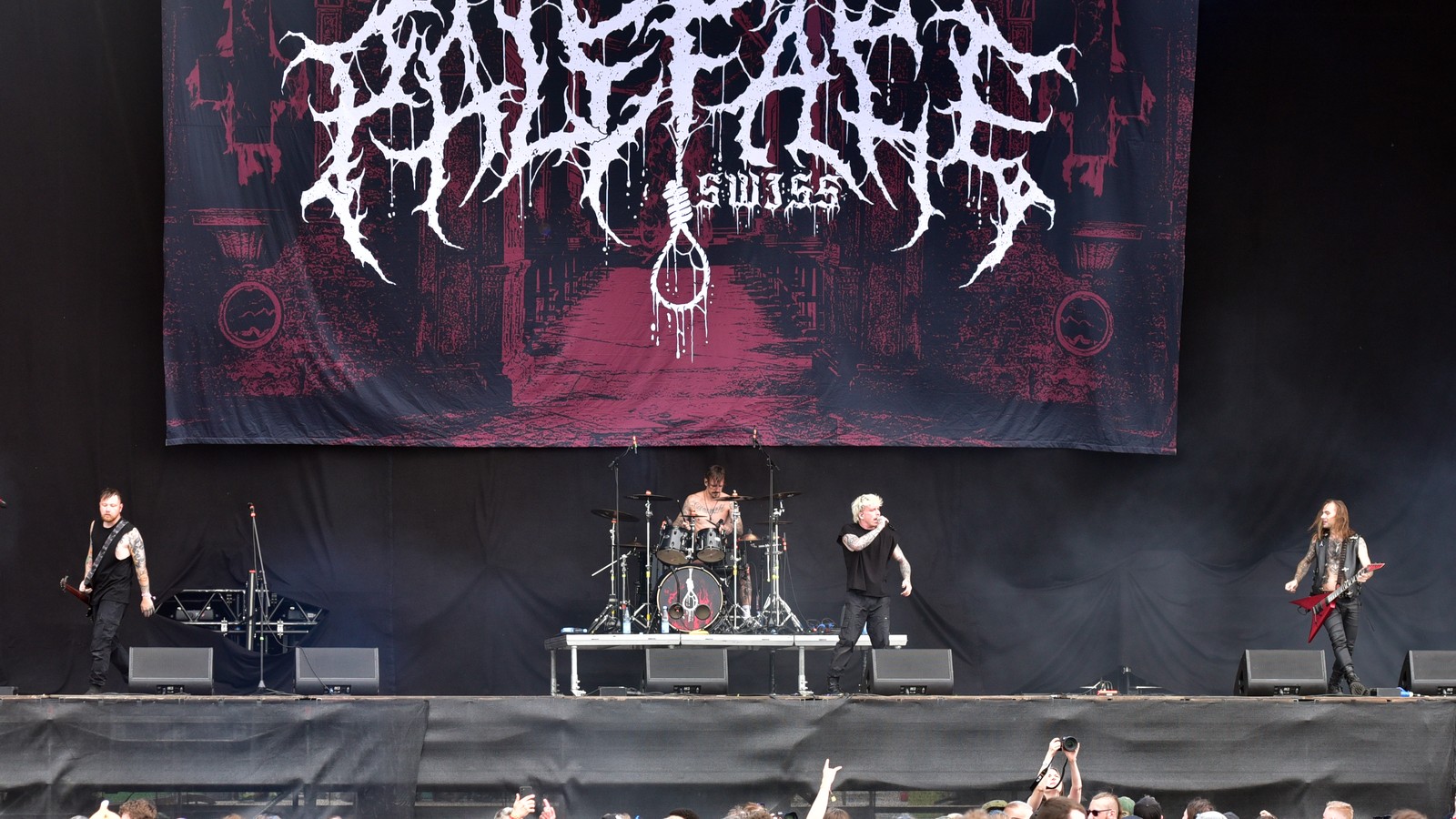
The clearest current case is Paleface Swiss from Zurich, whose third album, Cursed, came out on 3 January 2025. "The Gallow", a single the band first released on its own in 2023 and later added to the complete edition of Cursed, comes with an official video to judge it by. The bounce came back, and the breakdown never left.
Deathgaze is the smallest branch, and the newest name. It takes the wall of reverb and the long, washed-out chords of shoegaze and post-metal and lays them over deathcore's blasts and gutturals, so that the song sounds less like a room than like a basement where a fog machine has been left running with the doors shut, the exit sign gone, and the riff swinging somewhere inside the cloud where nobody can see the hand on the strings.

Formed in Arizona in 2012, filed by Metal Archives as progressive and atmospheric deathcore and post-metal, and on Metal Blade by the time Liminal Rite came out in 2022, the band that has called its own sound deathgaze since The Almanac in 2017, a name its guitarist Nico Mirolla says he designed himself, is Kardashev, and The Baring of Shadows, an EP of 2020, is where, in his account, the move toward the gaze side began. Fallujah, which Metal Archives files as deathcore in its early years, poured ambient soundscapes into The Flesh Prevails in 2014 before the band settled into technical death metal. Deathgaze is the youngest branch on the map, and the least settled.
The deathcore subgenres side by side
Set side by side, the deathcore subgenres read as single substitutions, each one a part swapped for another.
| Branch | What it changes | Anchor bands | A record to start with |
|---|---|---|---|
| Symphonic | Adds an orchestral layer that carries harmony and melody | Winds of Plague, Shadow of Intent, Lorna Shore, Ov Sulfur, Worm Shepherd | Shadow of Intent, Melancholy (2019) |
| Blackened | Rewrites guitars and drums with tremolo, sustained blasts and shrieks | Carnifex (later), Mental Cruelty (later), Worm Shepherd | Worm Shepherd, Ritual Hymns (2022) |
| Melodic | Puts the melody in harmonised lead guitars and solos | All Shall Perish, Through the Eyes of the Dead, Synestia | All Shall Perish, Awaken the Dreamers (2008) |
| Technical | Sweeps, taps and odd metres at very high tempos | Rings of Saturn, Infant Annihilator, Within the Ruins | Rings of Saturn, Dingir (2013) |
| Progressive | Syncopated djent chugging, longer forms, ambient passages | Born of Osiris, Veil of Maya, After the Burial | Veil of Maya, [id] (2010) |
| Brutal and slamming | Strips the melody, adds Suffocation-school riffing and slam riffs | Ingested, Signs of the Swarm, Vulvodynia, Mental Cruelty (early), Within Destruction (early) | Signs of the Swarm, Absolvere (2021) |
| Downtempo | Halves the tempo, drops the tuning, makes the song almost all breakdown | Black Tongue, Traitors, Immoralist | Black Tongue, The Unconquerable Dark (2015) |
| Nu-deathcore | Nu metal bounce, rhythmic vocal cadence, choruses | Suicide Silence (2011 on), Emmure, Within Destruction (later), Paleface Swiss | Paleface Swiss, Cursed (2025) |
| Deathgaze | Shoegaze and post-metal reverb laid over the blasts | Kardashev | Kardashev, Liminal Rite (2022) |
No row in the table replaces the breakdown. Downtempo comes closest, and downtempo does the opposite of replacing it: it makes it nearly the whole song. The same names keep turning up under two branches, because the branches are mechanical and a band can rewire more than one part. Worm Shepherd belongs to two branches, Mental Cruelty moved between branches over its catalogue, and Within Destruction began in one and ended in another.
No branch replaces the breakdown. Downtempo comes closest, and it does the opposite: it turns the breakdown into nearly the whole song.
The evidence is uneven. Symphonic and brutal deathcore are printed as exact genre strings on Metal Archives, downtempo deathcore is a genre on MusicBrainz and nowhere on Metal Archives, and deathgaze rests almost entirely on one band's own word and the reviews that took it up. The branches with the thinnest paper trail are not the weakest mechanically. Downtempo, with one genre string on MusicBrainz and none on Metal Archives, has the plainest mechanics of the lot.
Periods, scenes and the neighbours' words
Some of the names fans use for deathcore are not branches, because they change nothing in the music. MySpace-era deathcore, the sound of roughly 2003 to 2010, is the template itself in its first fixed form, and its distinguishing feature is a production fingerprint rather than a new part: the drop-A seven-strings, the triggered and quantised drums, the low and high vocal trade inside a single bar. "Classic deathcore" names the same bands and the same years with a compliment attached, and "OG deathcore" is a third name for it.
Proto-deathcore is a period, the late-nineties records that put brutal death metal riffs next to hardcore breakdowns before anyone had a name for the meeting, Embodyment, Eighteen Visions, Prayer for Cleansing and Antagony among them, with tunings around C or B, rawer breakdowns and hardcore shouts. Nobody plays it today as a style. It is where the history starts.
The MySpace revival of the 2020s is a scene, not a branch: young scions of the 2007 template such as Mauled from Indianapolis, katywentmissing, Girl of Glass and The Queen Guillotined, who rebuild the 2006 to 2008 template on purpose, horror samples, high, thin snare and all, and make their records sound as old as the template. Mechanically it is the original template. What makes it distinct is the intent and the date of formation.
Christian deathcore works the same way. It changes the lyric sheet and the label, Facedown and Solid State above all, and leaves the music as heavy as the secular side, so it is a scene held together by faith rather than a branch held together by a part.
The last pile is the borrowed words. Mathcore, the dissonant, odd-metred, stop-start style of the Dillinger Escape Plan and Converge, ran through the Montreal underground in the same years as Despised Icon, and Ion Dissonance in Montreal and The Red Chord in Massachusetts played it at deathcore weight, but a "mathy" deathcore band is a mathcore band with a lower tuning, and the word is mathcore's. Beatdown is hardcore's. Djent and thall belong to progressive metal. The slam riff belongs to death metal. Deathcore uses all of them and owns none.
That sorts the genre. Ask what changed in the music and the answer places the band: an added orchestra, a blackened guitar line, a lead guitar carrying the tune, a denser or a longer song, a stripped or slowed one, a bounce or a haze. Ask the same question of a period or a scene and the answer is nothing, which is the answer that tells a listener it is a different kind of name. The genre has spent twenty years testing how much of itself it can change at once, and every branch on the list still opens the floor in the same place.

