
Vertigo released Master of Reality on 6 August 1971, and its seventh track has no riff in it at all. Recorded at Island Studios in London with Rodger Bain producing, the guitarist who had spent two years flattening the pub stages of the Midlands with a detuned Gibson SG laid the instrument down, picked up a flute and a piano, and played both under a singer barely raising his voice above a murmur. The Aston quartet behind "Solitude" was Black Sabbath. The saddest heavy metal songs start there.
Sadness in this music behaves the way darkness does at the bottom of a pothole. Three hundred feet down a limestone shaft, a caver who reaches the floor of the chamber on his rope and switches off his helmet lamp meets a black that no eye ever adjusts to, because no daylight has entered the place since the rock was laid down, and all that remains is a drip somewhere off to the left and his own breath coming back off the walls. The best of these songs switch the lamp off. The rest only dim it.
The saddest heavy metal songs switch the amplifiers off
Most of them begin by taking something away. On "Solitude" it is the distortion, the drums reduced to a brush and a pulse, the voice double tracked so softly that it sounds like a man talking to himself in an empty kitchen, and the flute winding over the top like smoke from a match somebody has just blown out. Nothing in the rest of Master of Reality prepares the listener. That is the point of it.
Iommi's playing carries it, and the thing that carries Iommi's playing is restraint: a guitar figure of a few notes, repeated, never resolved, set against a bass line from Geezer Butler that walks down the scale as if it were counting stairs into a cellar. They never went quieter than this. Where the song sits among the albums that made the genre, and why Master of Reality is argued over at all, is the wider story, told elsewhere and at length.
The Birmingham five that had just recorded "Sinner" and "Dissident Aggressor", the most violent songs of its young career, closed the first side of Sin After Sin in April 1977 with a slow, almost weightless ballad called "Last Rose of Summer", and the band was Judas Priest. Rob Halford sings it soft and low, far below the register that made his name, over a clean guitar and a bass that barely moves. It is a song about something ending that never says what. Few Priest fans pick it first. Fewer forget it.
Three years later the band Ozzy Osbourne had left behind closed its first album without him on the slowest, loneliest song it had made in years, and the voice that carried "Lonely Is the Word" to the end of Heaven and Hell in April 1980 belonged to Ronnie James Dio. Then Dio stops, and Tony Iommi keeps going. His solo over the last minutes goes down the way a cave diver goes through a sump, one breath taken on the near side and the whole body pushed under black water through a flooded passage with no light at all, surfacing only in a chamber nobody could see from the other side.
Farewells, written by the men doing the leaving
The singer Black Sabbath had fired in 1979 filled his first solo record, a year later, with a song about closing the door on everything that had come before, and the man at the microphone on "Goodbye to Romance" was Ozzy Osbourne. Written with Randy Rhoads and Bob Daisley for Blizzard of Ozz, released by Jet in September 1980, it is a farewell to a band and a life, sung by someone who plainly did not yet know whether the next life would hold. Osbourne himself has called it his goodbye to Black Sabbath. Rhoads plays the solo like a letter he rewrote three times. The chorus looks forward. The verses do not.
Farewell songs came late to the band with the most war songs in the catalogue. The East London five that had spent a quarter of a century on pharaohs, fighter pilots and condemned men closed Dance of Death, released by EMI in September 2003, with a song played entirely on acoustic guitars, and the band that did it was Iron Maiden, and it was the band's first fully acoustic studio recording. "Journeyman" is sung by Bruce Dickinson at half his usual height, about a traveller taking leave, with strings rising under the last verses. The faithful had waited twenty years for Maiden to sit down. It was worth the wait.
A rock opera that grieves on purpose
Conceived with the producer Paul O'Neill as the story of a rock singer who falls all the way to the gutter and climbs back, and released by Atlantic in 1991, Streets: A Rock Opera saves its heaviest blow for the last track, where the Florida band built around the brothers Jon and Criss Oliva drops the guitars to a whisper and lets Jon sing "Believe" over piano. The band was Savatage. The song is a dirge that refuses to stay one, climbing out of the piano into a guitar solo from Criss that lifts the whole record off the floor in its last minutes.
Criss Oliva was killed on 17 October 1993, when a drunk driver crossed the median on a Florida highway and struck his car head on. On Handful of Rain, released in 1994, the band closed the record with "Alone You Breathe", a tribute to Criss that reprises "Believe".
The song still will not resolve.
Sad at full volume
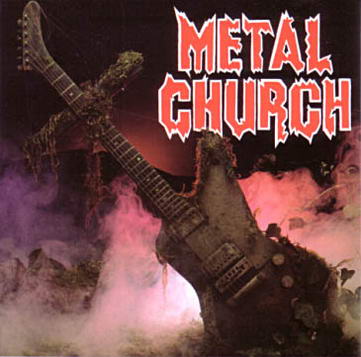
The other road into grief keeps the amplifiers on. The Pacific Northwest five whose debut album, Metal Church, came out on the small Ground Zero label in 1984 before Elektra picked it up the next year, and whose guitarist Kurdt Vanderhoof wrote riffs that tore through the speed metal of its day like a chainsaw through fence posts, was Metal Church. In the middle of that record sits "Watch the Children Pray", a slow song that builds into a storm, David Wayne's voice raw at the top. At just under six minutes, by common consent it is the band's finest recording and the one nobody expected from them.
Across the North Sea the lineage ran through a higher voice. Written by Michael Weikath for Keeper of the Seven Keys Part I in 1987, "A Tale That Wasn't Right" handed the most operatic singer of the German scene a ballad about a man going under, and the eighteen year old who sang it for Helloween was Michael Kiske. He pitched it high and bare, so that the band's speed metal reputation stepped back for five minutes and let him stand alone.
Look at where these songs sit on their records and a pattern shows. "Last Rose of Summer" closes a side, "Lonely Is the Word", "Believe" and "Journeyman" close whole albums, and "Solitude" comes one track before the end. The bands put the grief where the needle was about to lift, after forty minutes of noise had worn the listener's guard down, and let the silence after the last chord finish the song for them. It is an old trick. It still works on every play.
| Song | Band | Year | What does the grieving |
|---|---|---|---|
| "Solitude" | Black Sabbath | 1971 | Flute, piano, a murmured voice |
| "Last Rose of Summer" | Judas Priest | 1977 | Halford soft and low, a still bass |
| "Lonely Is the Word" | Black Sabbath | 1980 | A long closing guitar solo |
| "Goodbye to Romance" | Ozzy Osbourne | 1980 | A farewell and a Randy Rhoads solo |
| "Watch the Children Pray" | Metal Church | 1984 | A slow build to a raw top note |
| "A Tale That Wasn't Right" | Helloween | 1987 | A high voice with the speed taken away |
| "Believe" | Savatage | 1991 | Piano, then a guitar solo that lifts it |
| "Journeyman" | Iron Maiden | 2003 | Acoustic guitars and strings |
None of these is a funeral anthem. What they share is simpler: each band set aside the thing it was famous for, the riff, the speed or the war story, for the length of one song. The rest of that decade's singles, the loud ones and the sad ones together, sit with the 80s heavy metal songs. Sadness in heavy metal was never a genre of its own. It was always a bruise on a louder body.
