
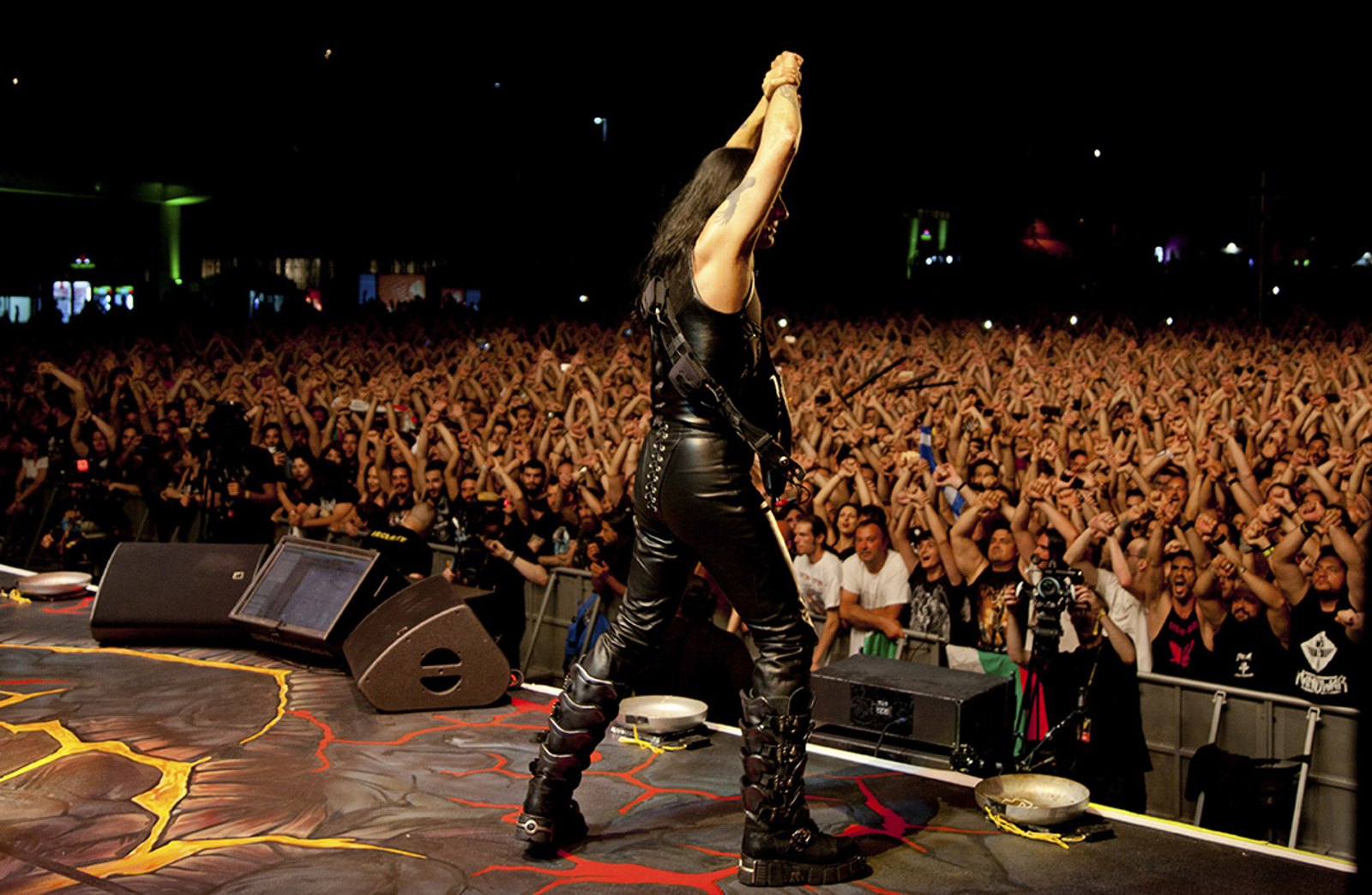
On 20 May 2006, in the Olympic indoor arena in Athens, a Finnish band in latex monster suits won the Eurovision Song Contest with 292 points, then a record for the contest, singing a hymn to loud guitars. The band that carried a song about the music itself onto the biggest television stage in Europe was Lordi. Nobody in the hall mistook it for a joke. Plenty of people at home did.
A song about heavy metal works like a red stag's roar in the October rut, a sound that carries no news whatever except the animal's own name and weight, bellowed down the glen at every rival within a mile, answered roar for roar, and settled, when neither backs off, by antlers cracking together and hooves ripping the turf to black mud. The roar is the point. The fight is rarely needed, and the chorus is pitched as much at the rival styles as at the faithful.
Judas Priest's "Heavy Metal", Anvil's title song and Saxon's hymn to the people in the hall are already filed in the related chapter. The songs about heavy metal beyond them sort best by the job each one does in a room: the oath, the law, the roll call and the joke. Each job has its own specialists.
Songs about heavy metal as an oath
The New York four who swore the oath earliest and loudest, on the second track of an album released on 7 June 1982, were Manowar. "Metal Daze", on Battle Hymns, is a declaration of dependence rather than independence, a band admitting it needs the music the way a garrison needs its walls. Fourteen years later Louder Than Hell, released by Geffen on 29 April 1996, pushed the creed back to the creation itself with "The Gods Made Heavy Metal", a genesis in which the style arrives as a gift from on high.
The same record finally released "Brothers of Metal Pt. 1", a song the band had demoed and played live as early as 1986 and then left on the shelf for a decade, as if the vow had to be taken twice before it could be pressed. It swears the whole hall into a fraternity over a riff that stamps like a shield wall advancing. Kings of Metal, in 1988, sits between the two records. It is the same oath with a bigger budget.
America took the oath with a pun. The Los Angeles four who offered the music as the cure for whatever ailed its listeners were Quiet Riot, and the title track of Metal Health, in 1983, sells headbanging as diagnosis, prescription and discharge note at once, the riff kicking the chairs over in the waiting room. The album reached number one on the Billboard 200 that November, carried there by a Slade cover rather than by the song about the music. America had chosen which of the two it wanted.
The law, the universe and forever
The Hamburg four that gave the oath the force of statute was Helloween, and "Heavy Metal (Is the Law)", the closing track of Walls of Jericho in 1985, is a studio recording with a crowd laid over it afterwards, cheers and whistles dubbed in so that the song could pass for a concert it never was. The song about the congregation needed a congregation so badly it had one added in the mix. That is not a flaw. It is a confession.
The song about the congregation needed a congregation so badly it had one added in the mix.
The guitarist who co-wrote that closer with Michael Weikath, then carried the doctrine out of the band with him, was Kai Hansen. With Gamma Ray he wrote "Heavy Metal Universe" for Power Plant, released on 29 March 1999, and turned the style into a cosmology, whole galaxies run on riffs. Primal Fear dropped the astronomy and kept the promise on "Metal Is Forever", the opening track of Devil's Ground in 2004. Eternity is a big claim. The chorus makes it without blinking.
The roll call
The Swedish band that turned the oath into a register of names was Sabaton. "Metal Machine", on Primo Victoria in 2005, is stitched together from the titles of other bands' songs, and "Metal Crüe", ninth on Attero Dominatus in 2006, goes further and builds nearly its whole lyric out of band names, Venom, Accept, Rainbow, UFO, Armored Saint, Warlord, Pretty Maids and dozens more.
Each name is notched into the song like a cut on a hazel tally stick, the kind the English Exchequer kept by the cartload for its accounts until, in October 1834, a stove crammed with the old sticks set fire to the Palace of Westminster and burned most of it to the ground. The song is a register of the living, read out in order. Knowing every name is the price of admission.
The Swedish band that wrote the rulebook out as a march, and named the album after it, was Dream Evil. "The Book of Heavy Metal (March of the Metallians)" opens the record of the same name, released by Century Media on 13 July 2004 and produced by the band's own guitarist Fredrik Nordström at Studio Fredman in Gothenburg, and it recites the faith like a catechism set to a marching beat, article by article, without a wink visible from the front row.
| Song | Band | Year | The job |
|---|---|---|---|
| Metal Daze | Manowar | 1982 | The first vow |
| Heavy Metal (Is the Law) | Helloween | 1985 | The statute, with a crowd added |
| Heavy Metal Hamsters | Helloween | 1991 | The statute laughed at |
| The Gods Made Heavy Metal | Manowar | 1996 | The creation myth |
| Brothers of Metal Pt. 1 | Manowar | 1996 | The sworn fraternity |
| Heavy Metal Universe | Gamma Ray | 1999 | The cosmology |
| The Book of Heavy Metal | Dream Evil | 2004 | The rulebook |
| Metal Is Forever | Primal Fear | 2004 | The promise |
| Metal Crüe | Sabaton | 2006 | The roll call |
| Hard Rock Hallelujah | Lordi | 2006 | The hymn on television |
| The Metal | Tenacious D | 2006 | The joke that tells the truth |
The joke, and the biggest stage

The band that laughed hardest at its own statute book was Helloween again. Pink Bubbles Go Ape, released by EMI in 1991, carries "Heavy Metal Hamsters", a cartoon of rodents in studs and leather that, by most accounts, took aim at the band's former label, Noise, whose lawsuit over the EMI move had kept Helloween off every stage for close to three years. A style that can mock its own vows is not in danger. It is at home.
Lordi's winner plays the same game from the other side. "Hard Rock Hallelujah", from The Arockalypse in 2006, turns the concert into a church service with monsters at the altar, and it gave Finland its first win in forty-five years of trying, the first rock song ever to take the contest. It is a parody of a hymn sung by men who plainly believe every word, and it flattened the ballads around it on the scoreboard.
The comedy act that buried punk, grunge and every other passing fashion in a single song and left the metal standing on the graves was Tenacious D, Jack Black and Kyle Gass, on "The Metal", from The Pick of Destiny in 2006. The joke works because the chart history agrees with it. Fashions came for the style every decade. The style is still here.
The same fist turned outward, at fathers, teachers and kings rather than raised in praise of the music, belongs to the rebellion anthems, and the two kinds of song share a chorus shape and very little else. A song about metal asks nobody to change anything. It asks for the chorus back, louder, and the pantheon of bands it names grows by one with every band that writes another.
