
On 27 June 1997, Nuclear Blast put out a debut that nobody in the Swedish music business had asked for.
Recorded with Fredrik Nordström at Studio Fredman in Gothenburg, built around a band that had started in 1993 as a side project for a guitarist and a drummer out of the melodic death metal underground, and released into a decade when grunge and death metal had chased the clean high voice off Swedish stages, the quintet with an armoured knight on its sleeve was HammerFall, and the record was Glory to the Brave.
It tore the plaid flannel off the front racks of the record shops and hung a sword where the flannel had been. The effect on the country's musicians was closer to acoustics than to fashion, because the album arrived like a piano tuner walking into a church hall where the old upright had been left to drift for a decade, wrenching every pin back to pitch with his tuning hammer and snapping the strings that would not hold, and every Swedish power metal band since has played on the instrument he left behind.
The scene starts there. It did not start from nothing.
What makes a Swedish power metal band sound Swedish
Laid down across the two decades before HammerFall, the pedigree was already in the ground: Heavy Load were singing about Vikings and old battles by the early eighties, Yngwie Malmsteen carried a neoclassical scale technique out of the country and never brought it home, Europe proved that a Swedish chorus could fill arenas abroad, and Bathory slowed its Viking records to a tolling mid-tempo under massed choirs.
What 1997 added was a method, and three habits have marked it ever since. The first is loyalty to heavy metal before speed metal. Where the German school of Helloween ran on double bass and velocity, the Swedes took their riffs from Accept and Judas Priest and their gallop from the older British records, so the songs sit in the chest rather than in the fingers.
| Band | First full album | Year | Label | Strain |
|---|---|---|---|---|
| Morgana Lefay | Knowing Just as I | 1993 | Black Mark | Dark, thrash-leaning |
| Nocturnal Rites | In a Time of Blood and Fire | 1995 | Megarock | Heavy, direct |
| HammerFall | Glory to the Brave | 1997 | Nuclear Blast | The revival template |
| Persuader | The Hunter | 2000 | Loud 'n' Proud | German school, choirs |
| Falconer | Falconer | 2001 | Metal Blade | Folk melody |
| Lost Horizon | Awakening the World | 2001 | Music for Nations | High, epic |
| Dream Evil | Dragonslayer | 2002 | Century Media | Gothenburg studio anthems |
| Astral Doors | Of the Son and the Father | 2003 | Locomotive Records | Heavy, Dio and Rainbow |
| Sabaton | Primo Victoria | 2005 | Black Lodge | Heavy, mid-tempo, history |
| Bloodbound | Nosferatu | 2006 | Metal Heaven | Heavy, mid-tempo, horror |
| Civil War | The Killer Angels | 2013 | Despotz | Heavy, mid-tempo, history |
| Twilight Force | Tales of Ancient Prophecies | 2014 | Black Lodge | Symphonic fantasy |
The second habit is a studio sound, dry, tight and very loud, inherited from the melodic death metal engineers who shared the city's rooms. The third is a heavier, mid-tempo strain that kept the genre's major keys and slowed them to a stomp. Keyboards mark the border with the neighbours rather than the scene itself: across the Gulf of Bothnia the synthesiser became a lead voice, the difference set out in Swedish vs Finnish power metal, while most Swedish bands kept it behind the guitars.
The lyrics, by contrast, prove nothing. Swedish bands sing of Norse history, real wars and horror films as readily as of dragons, and the sound stays the same whichever book lies open on the music stand.
Gothenburg, the studio and the 1997 revival
Studio Fredman was the room that made the difference. Fredrik Nordström had engineered melodic death metal there for At the Gates, In Flames and Dark Tranquillity. On Glory to the Brave he worked like an orchestral copyist who writes a love duet with the same steel nib he uses for a battle march, cutting the rhythm parts of a heroic anthem into the manuscript as hard as a death metal riff, deep enough to tear the page, and left the chords hard-edged and dry. The heroism was old. The engineering was new.
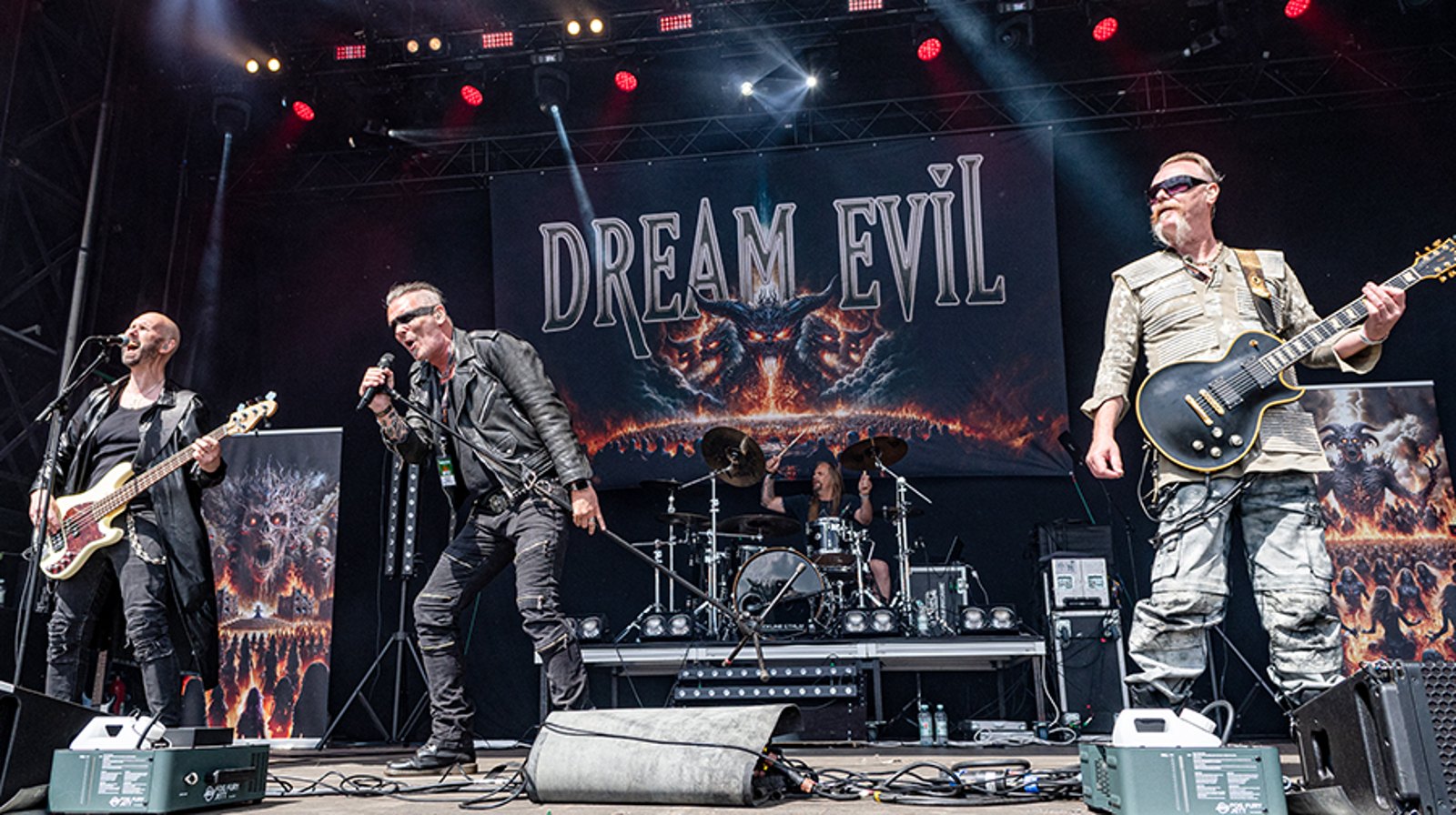
Around that room a small cluster grew. The engineer himself formed Dream Evil in 1999 and released Dragonslayer through Century Media in 2002, a record of hard, uncomplicated anthems that treated the genre's conventions the way a craftsman treats a standard form, as something to be built exactly rather than questioned. Lost Horizon, from the same city, went the other way on Awakening the World behind Daniel Heiman, a singer who went at the top of his range like a descant recorder overblown so hard that the windway splinters and the note keeps climbing anyway.
At the vanguard of the revival, HammerFall kept it on the road for more than a decade. Last Man Standing, a new song from the 2007 compilation Steel Meets Steel: Ten Years of Glory, is the model the band handed down: a gallop in the verse, a chorus pitched for a crowd rather than a soloist, a guitar solo that states the melody before it decorates it, and a running time of four and a half minutes. Nothing is wasted. Nearly every Swedish band that plays the summer festivals carries at least one song cut to that pattern.
The heavier, mid-tempo strain

Released by Black Lodge in 2006, the record that fixed the heavier Swedish strain in its commercial form, with slower tempos, a lower and rougher voice and choruses laid out for a field rather than a hall, was Attero Dominatus, the second full album from Sabaton, by common consent the largest export the scene has produced. The shape is simple. The weight is not.
The strain is older than Sabaton and wider than it. It plays like a tuba player dropped into a string quartet, sitting on every downbeat so hard that the music stands rattle off their feet, and the bands in it prefer a hundred beats a minute to a hundred and eighty because a riff gains mass as its tempo drops and a slow chord has room to ring out before the next one lands on it.
A tuba player dropped into a string quartet, sitting on every downbeat so hard that the music stands rattle off their feet.
The darker end of it came first. Morgana Lefay recorded for Black Mark, the label that had released Bathory, from 1993 into the mid-nineties, with a harsh, theatrical singer in Charles Rytkönen and riffs nearer to thrash than to Helloween, while Nocturnal Rites, who had begun around 1990 as a death metal band, carried a trace of that weight into the melodic power metal of In a Time of Blood and Fire.
By the time Nocturnal Rites reached Century Media they had hardened into the most direct band in the country, and Against the World, from New World Messiah in 2004, is heavy metal with a power metal chorus bolted on top, the riff in front and Jonny Lindqvist singing in the mid-range rather than the rafters.
Three more bands spread the method across the next decade. Nils Patrik Johansson, a singer whose phrasing descends from Ronnie James Dio, fronted Astral Doors from 2002 in the Rainbow manner and later joined Civil War, formed in 2012 by four musicians who had just left Sabaton and kept its history lyrics and marching tempos. Bloodbound, whose debut Nosferatu appeared in 2006, swapped history for horror and fantasy on the same stomp.
The strain also built its own infrastructure. Black Lodge, the Swedish label behind Sabaton's early records, kept signing younger heavy and power metal bands of the same persuasion, and Sabaton Open Air, the festival the band has staged in its home town since 2008, put those bands in front of an audience that already knew the tempo. A scene needs a stage as much as a sound.
Swedish power metal bands off the main road
Not every band took the mid-tempo road. Formed in 1999 out of the wreck of the folk-inflected Viking band Mithotyn, with Stefan Weinerhall writing the songs and Mathias Blad, a singer trained for the musical theatre stage, at the front, the band that brought old Swedish folk melody into the genre without a single bagpipe was Falconer, whose first album came out on Metal Blade in 2001.
Persuader took the opposite lesson and studied Germany, building dense, multitracked choirs over speed metal riffs in the manner of Blind Guardian, and its singer Jens Carlsson later worked beside Blind Guardian's former drummer Thomen Stauch in Savage Circus. Among the progeny of the Krefeld school it is the closest copy the north produced, and it wears the resemblance openly.
Far from both, Twilight Force threw the Swedish restraint out of the window. On Dawn of the Dragonstar, released by Nuclear Blast in 2019, the harpsichord flourishes, flutes and fanfares of Rhapsody of Fire run at full speed over a Swedish rhythm section, like a fairground calliope with its steam valves jammed open, whistling Vivaldi at double tempo until the brass pipes burst, which makes the band at once the most Italian sound in the country and the least typical.
Behind them stands a deeper bench: Narnia with neoclassical guitar and Christian lyrics, Insania, Crystal Eyes and the progressive-leaning Tad Morose, each of them evidence that the country produced power metal in depth rather than in one wave that broke and drained away.
Set beside the German, Finnish, Italian and Brazilian capitals gathered in the account that frames it, the Swedish contribution is weight and discipline rather than velocity or orchestra. The songs are shorter. The guitars are drier. The choruses land lower, and they land harder.
