

In 1980 the London label Gem released Head On by Samson, and the record climbed to number 34 on the British album chart behind a guitarist, a drummer in a mask and a singer billed on the sleeve as Bruce Bruce. The voice hiding behind that joke of a stage name, already holding its long notes at full power over riffs cut for a pub back room, belonged to Bruce Dickinson, and the air raid siren vocals that would carry Iron Maiden through the eighties were on the tape, not yet finished.
An engine bolted into a test stand is the one rocket built never to leave the ground. Clamped into a steel frame above a concrete flame trench and fired at full thrust for the whole length of its burn, it pours every pound of that thrust into staying exactly where it is, the frame shuddering on its footings, the exhaust scouring the concrete, the deluge water flashing to steam, and the roar rolling for miles over empty scrub from a machine that never moves an inch.
That is the held note. The climb is over before anyone hears it, and everything the voice has left goes into standing still at the top.
The nickname, and the nights that made it famous, belong to the longer account. The mechanism is another matter. It comes apart into four pieces, and each of them can be heard on its own.
What air raid siren vocals are made of
The attack comes first. A Dickinson long note lands on its pitch with almost none of the slide up from below that a blues singer uses to find a note, so the first instant of it already stands at full height and full weight, and the band knows where the melody is before the drummer has finished the barrage that led into it.
Then the hold. The tone is chest-dominant, a voice with brass in it, carried high into the tenor range with the vowel left open and bright and kept at one level for a bar or two while the guitars move underneath, with no swell and no fade. A blues singer lets a note die. This one is switched off.
Inside the hold, the vowel does a share of the work. The long notes in these songs tend to land on open sounds, the ah, the oh and the diphthong in fly and high, which let the jaw hang wide and the tone stay bright, while a narrow ee at the top of a phrase gets bent open toward its neighbour or left for a shorter note. A closed vowel held at that height pinches. An open one rings.
The vibrato arrives late. For the first part of a long note the pitch stays close to straight, and only toward the tail does the vibrato open out, wider and slower than a conservatory would allow, so that a held note ends in a wail instead of a full stop. That tail is where the nickname lives. It is also the part imitators copy first and worst, starting the shake on the first beat and turning a held note into a warble.
The bassist who wrote "Children of the Damned" for The Number of the Beast in 1982, a slow song that builds from an acoustic guitar to the full band, was Steve Harris, and its choruses show the late vibrato at walking pace, every long note held straight and then let go into a wail over the chords. At that tempo there is nowhere to hide it. There is no need to.
The breath is the fourth piece, and the one nobody sees. A Highland piper keeps the drones sounding for an hour because the bag under his arm is a reservoir, filled between phrases while his elbow drives the air out, so the mourners at a graveside hear the lament go on without a single gap, as if the man had no lungs at all. Dickinson works the same trick, taking air in the half second under a guitar fill or a drum break, so every long note starts full.
The guitarist who brought the riff of "Flight of Icarus" to the Piece of Mind sessions and wrote the song with the singer was Adrian Smith, and the single, released in April 1983 ahead of the album that May, is the plainest lesson in the style on record. The tempo is slow for Iron Maiden, a mid pace that leaves air around every line, and each chorus hangs its long notes over the riff at full power and holds them there until the tail opens out. Nothing is screamed. All of it carries.
A blues singer lets a note die. This one is switched off.
Before the nickname: the Samson tapes
The songwriter who handed Samson its best single, a man who had already given Rainbow "Since You Been Gone", was Russ Ballard, and "Riding with the Angels", from Shock Tactics on RCA in 1981, catches the voice a few months before Iron Maiden came for it. The attack is already there, and so is the hold. What a single guitar could not give it was a setting, and the long notes float over the riff instead of riding on it.
The producer who built that setting, across seven studio albums from The Number of the Beast in 1982 to Fear of the Dark in 1992, was Martin Birch, and his answer to a voice that size was to leave it room. Two guitars to either side and the bass of Harris driving up the middle gave the held notes a floor to stand on, and from 1982 the faithful heard them laid across the top of all three. The style needed a band that loud to mean anything.
Blow, bugle, blow, set the wild echoes flying, / Blow, bugle; answer, echoes, dying, dying, dying.
Alfred, Lord Tennyson, The Princess
Powerslave and the long note stretched
Released by EMI in September 1984, Powerslave gave the style its longest workout, and its title song, credited to Dickinson alone, is the clearest statement of what he thought his own voice was for: a verse pitched in the middle, a chorus that climbs and then stays up, and a closing section where the long notes are laid end to end over the riff with the breaths hidden between them. The pharaoh in the lyric pleads not to die. The voice sounds as if it has no intention of doing so.
No singer since has been as complete an exponent of the style. Plenty have had the range. Fewer have had the lungs, and fewer still the patience to leave a note alone once it is up.
| Piece | What the voice does | Where to hear it |
|---|---|---|
| Attack | Lands on the pitch with no slide from below | Iron Maiden, "Flight of Icarus" (1983) |
| Hold | Chest-dominant tone kept at one level for bars at a time | Iron Maiden, "Powerslave" (1984) |
| Late vibrato | Straight at the start, widening only at the tail | Iron Maiden, "Children of the Damned" (1982) |
| The prototype | The same voice with one guitar behind it | Samson, "Riding with the Angels" (1981) |
| The late voice | Fewer long notes, each one placed | Bruce Dickinson, "Afterglow of Ragnarok" (2023) |
The siren at sixty five
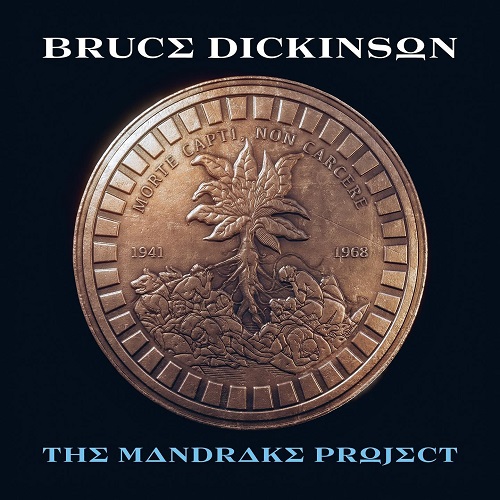
The producer and guitarist who had worked beside him since Balls to Picasso in 1994, and who produced and co-wrote The Mandrake Project, released by BMG on 1 March 2024, was Roy Z, and the record is the plainest evidence of what the style becomes when the man behind it is sixty five. The attack survived the years intact. So did the open vowel.
"Afterglow of Ragnarok", the first single, released at the end of 2023, keeps both, while the long notes come fewer and each is placed where the song needs weight rather than spread across every chorus.
None of it was ever operatic singing in heavy metal, however often the word gets attached to it: the vowel stays open where a trained tenor would cover it, and the power comes from the chest rather than from a lowered larynx. The two roads reach the same back row. They are not the same road.
Strip away the band, the stage and the nickname, and four habits are left: the note struck clean, held level, released into a wail and fed by a breath nobody hears taken. Copy any one of them and it sounds like an impression. All four together have only ever belonged to one voice.

