
Why, it's a Looking-glass book, of course! And if I hold it up to a glass, the words will all go the right way again.Lewis Carroll, Through the Looking-Glass (1871)
Backmasking is a message recorded backwards into a song that plays forwards, so that it passes the ear as a smear of noise and turns into words only when the recording itself is run in reverse. It is a studio trick, nothing more. Everything else that grew up around it, the sermons, the bills, the lawsuits, was built on top of that one plain fact.
The Newcastle trio that first hid a whole invocation in reverse at the head of a heavy metal record was Venom, and the way it did so explains the whole technique in one stroke. Cronos intoned the words into a microphone, the tape was turned round, and the reversed voice was laid in front of "In League with Satan" on the album Welcome to Hell, released by Neat Records in December 1981, where it sits like a Roman curse tablet scratched right to left into a sheet of lead, pierced through with an iron nail and flung into a sacred spring for the gods below to read. The song had gone out eight months earlier as a single on the same label, on 17 April 1981, with no reversed voice on it at all.
The guitarist Jeff Dunn said the point was to make the song sound more evil. It did.
How backmasking works
On reel-to-reel tape the method takes minutes. The engineer turns the reel over so that the tape passes the heads the wrong way, records the voice onto a spare track, and turns the reel back, and from then on the voice runs in reverse under or between the instruments for as long as the song plays. On a cassette the tape has to be reversed and spliced back in. On a vinyl record the listener has to do the work, disengaging the drive and dragging the platter backwards by hand with the stylus still in the groove, which is how a generation of teenagers learned exactly how much a needle can take.
What turns up when a record runs backwards falls into three kinds, and the arguments of the 1980s came from mixing them up:
- Deliberate backmasking, words recorded in reverse on purpose, which the band can always confirm because somebody had to stand at the microphone and say them.
- Reversed sound, a guitar, a cymbal or a vocal line run backwards for its colour, a staple of the psychedelic studio since the middle of the 1960s, with no message in it at all.
- Phonetic reversal, ordinary forward singing that happens to throw up something like words when it runs the wrong way, which is what nearly every accusation against a record actually rested on.
The third kind is the one worth understanding. Speech played backwards is not speech, but the ear hunts for pattern in any noise it is given, and a listener told in advance what a reversed passage says will usually hear it say exactly that. Psychologists at the University of Lethbridge showed as much in 1985. The seminars never needed their permission.
The charge sheet against metal records
The preachers of the early 1980s worked a reversed record the way a Roman haruspex worked a sheep, slitting it open on the altar, lifting out the liver and reading the coming war in its folds, and wherever the knife went it found the devil and his blasphemy, in "Stairway to Heaven", in the AC/DC of Highway to Hell, in anything with a guitar solo and a record contract. Heavy metal was not the only suspect. It was the one that never objected to the charge.
The politics followed the pulpit. Representative Bob Dornan put House Resolution 6363 before Congress in May 1982, a bill to require a federal warning label on records carrying backward messages, and it was referred to the House Subcommittee on Commerce, Transportation and Tourism, where it died without ever coming to a vote. California opened a different front in 1983, passing a bill that made selling a record with an undeclared backward message an invasion of privacy, leaving the shop and the distributor open to a lawsuit from any buyer who found one. How the Sacramento hearing of that year went, and what the courts made of the whole affair, is told in the wider the moral panic chapter.
The one case that put a reversed record in front of a judge came at the end of the decade. The families who sued Judas Priest in Nevada over Stained Class brought an expert who said further phrases turned up when passages of the album ran backwards, phrases like "sing my evil spirit" and "fuck the Lord", and the court found no proof any of it had been put there on purpose. The word the case actually turned on, "do it", was not a backward recording at all but a guitar figure meeting a breath, as the Judas Priest subliminal message trial tells in full.
Heavy metal was not the only suspect. It was the one that never objected to the charge.
The joke played on the preachers
Hard rock had been playing with the trick before anyone called it satanic. The Hertfordshire-born five that opened the title track of Stormbringer in 1974 with a burst of studio swearing run backwards were Deep Purple, and nobody in a pulpit noticed for years. The bands of the eighties answered the accusation by doing precisely what they stood accused of, and doing it badly on purpose. Released in October 1983, Shout at the Devil carried a printed warning that the record might contain backward masked messages, and the four men from Hollywood who put it there were Mötley Crüe. Nikki Sixx and Tommy Lee did chant a reversed "Jesus is Satan" during the sessions, though it ended up on a leftover, unreleased track rather than the title song itself.
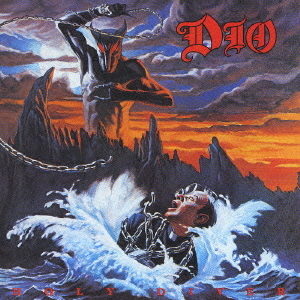
The singer who had fronted Rainbow and Black Sabbath before putting his own name on a band was Ronnie James Dio, and on Holy Diver, released in May 1983, he closed "Shame on the Night" with a reversed line widely read as "Crucify the diver", an idea drummer Vinny Appice has said he suggested to him. What the words mean depends on who you ask; the band never spelled it out.
The Birmingham band that recorded a backward message on purpose, six years before a court asked whether it had recorded one by accident, was Judas Priest. On "Love Bites", from Defenders of the Faith in January 1984, a slow and heavy stomp built on a riff that lands like a hammer on an anvil, Rob Halford recorded a line from the song and had it inserted in reverse, and on 1 August 1990, under oath in Reno, he said so, comparing it to a painter adding another dab of colour to a canvas.
The glossier end of the decade joined in too. Def Leppard slipped a reversed vocal into "Rocket", on Hysteria in 1987, running the chorus of the album's own "Gods of War" backwards under the mix, a song already built from studio tricks, tape loops and a drum machine's worth of processed thunder. By then a backward message on a multi-platinum record, dropped from the single edit without a fuss, was a wink at the fans rather than a dare to the pulpit.
Death metal plays it straight

By the time death metal took up the trick the preachers had stopped listening, which left the bands with an audience of fans who knew exactly what to do with a reversed passage. The Florida quartet that opened its second album with the reversed chant of a song title was Deicide, whose Legion, released by Roadrunner in 1992, opens its first track with the words "Satan Spawn, the Caco-Daemon" chanted backwards, and Cradle of Filth later hid a reversed reading of the Lord's Prayer, read by a bandmate's young son, inside "Dinner at Deviant's Palace", on the 2001 EP Bitter Suites to Succubi.
No reversed passage on any of these records has ever been shown to do anything to anyone. What they did do was turn the accusation into a party game, a turntable dragged backwards at two in the morning by a room full of the faithful waiting for the devil to say something, and he only ever said what the band had written for him.
The game has not ended. Every reverse function on every phone can now do in a second what took an engineer a reel turned over by hand, and Venom's album still opens with its buried voice, speaking the wrong way round to anyone who plays it the right way. The preachers moved on. The records stayed exactly as they were cut.
